Is Keto Bread Healthy? Benefits, Downsides and What’s Inside
Keto bread has almost as many total carbs as white bread, but most are fiber. What 16 keto breads contain, the real benefits and how long it keeps.


TL;DR: Keto bread can be a healthy swap for regular bread if you watch carbs. We looked at 16 keto breads in USDA’s branded food database: the typical slice has 11 g of total carbs, close to white bread’s 14 g, but 8 g of that is fiber, leaving about 2 g of net carbs. The quality depends on the fiber source, sweeteners and protein, so read the label.
What is keto bread?
Keto bread is bread made to fit a ketogenic diet, which usually means about 20–50 g of carbs a day (Oh et al., StatPearls, NIH). Regular bread has about 12–17 g of net carbs a slice, so most keto breads swap the flour for ingredients with fewer digestible carbs:
- Added fibers: wheat fiber, oat fiber, resistant wheat starch or inulin. These count as carbohydrate on the label but are mostly not digested.
- Wheat protein (vital wheat gluten): gives the dough structure and adds protein.
- Nut and seed flours: almond flour, flaxseed or sesame in some brands.
- Eggs and fats: in many home recipes and some “cloud” or almond breads.
“Keto” is a marketing term, not a regulated label. That is why two keto breads can look nothing alike on the Nutrition Facts panel.
What’s inside 16 keto breads
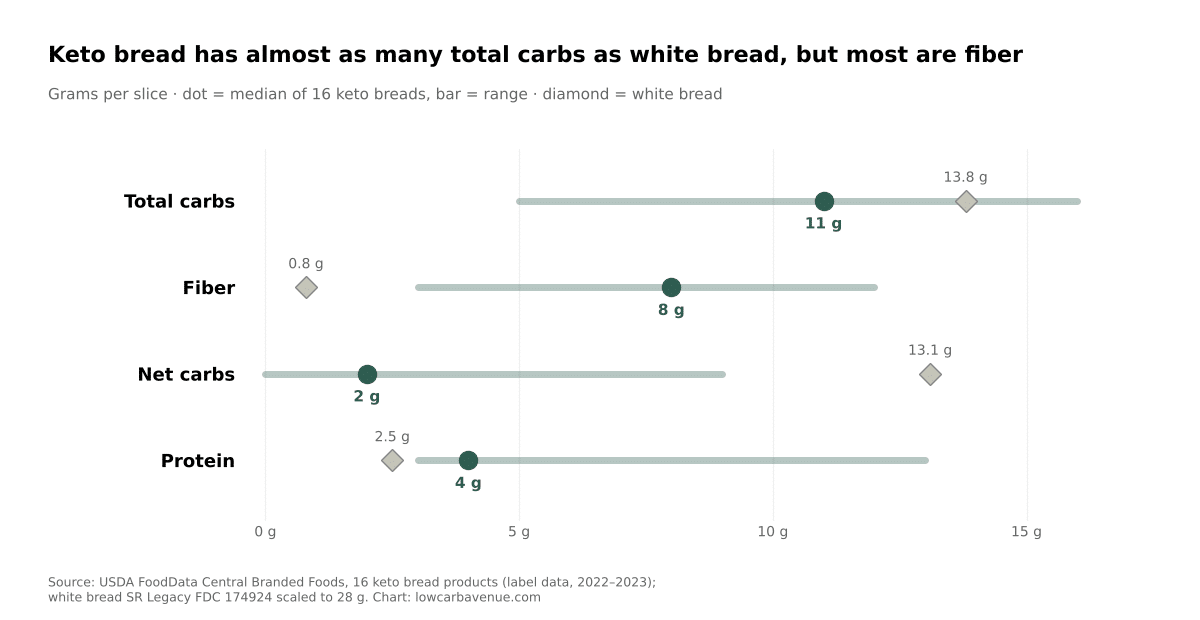
The typical keto slice has 11 g of total carbs, not far from white bread’s 14 g. The difference is what kind: about 8 g is fiber, so net carbs drop to about 2 g. Protein is a little higher, but most keto breads still have only 3–4 g a slice.
Keto bread benefits
Compared with regular bread, a well-made keto bread offers:
- Far fewer net carbs. About 2 g a slice in the typical product we reviewed, versus about 13 g in white bread. Two slices can fit inside a 20–50 g keto day.
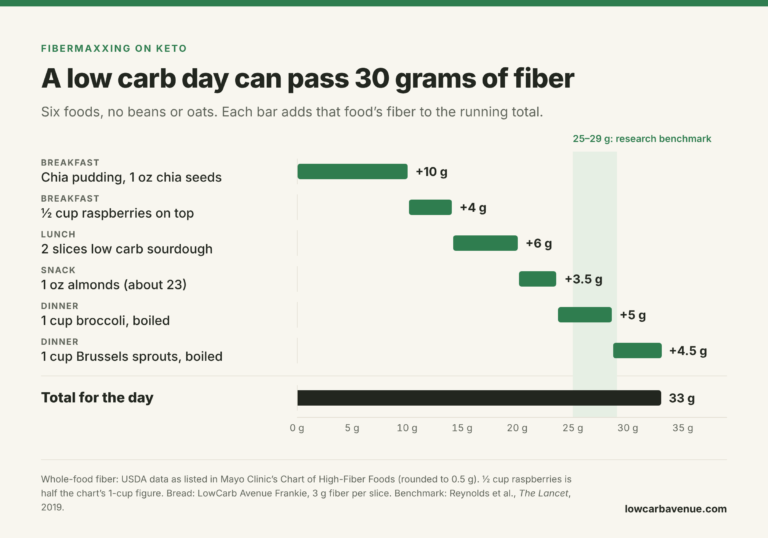
- Much more fiber. About 8 g a slice, versus under 1 g in white bread. Most Americans fall short of the 25–29 g of fiber a day that a major review linked to lower death rates (Reynolds et al., 2019, The Lancet).
- A little more protein. About 4 g a slice, versus about 2.5 g in white bread. Breads made with wheat protein or seeds can go higher.
- Fewer calories, often. The typical keto slice in USDA’s database has about 40 calories, versus 74 for a same-size slice of white bread.
- Sandwiches stay on the menu. For many people, being able to eat a sandwich or toast is what makes a low carb plan last.
The downsides to watch for
- Isolated fibers can upset some stomachs. Large amounts of added fiber such as inulin can cause gas or bloating, especially if you are not used to it. Start with one slice.
- Sweeteners. Some keto breads add erythritol or other sugar alcohols. A 2023 study linked high blood erythritol to more heart attacks and strokes in people at risk; it showed a link, not proof (TCTMD report on Witkowski et al.). Savory bread rarely needs them.
- “Net carb” claims vary. Net carbs are not a term the FDA defines, so brands calculate them differently. Check total carbs and fiber yourself.
- Shorter shelf life. Many keto breads skip preservatives, so they mold faster (see below).
- Gluten. Most keto breads use wheat protein, so they are not gluten-free.
Is keto bread healthy?
For most people on a low carb or keto diet, yes: it is a better fit than regular bread, with fewer net carbs and more fiber. It is not a health food by itself. Choose one with a short ingredient list, real fiber, a decent amount of protein and no added sugar, and eat it as part of meals built on vegetables and protein. If you have diabetes, also see is keto bread good for diabetics.
How much keto bread can you eat in a day?
It depends on your carb budget. At 2 g of net carbs a slice, two slices use 4 g, about a fifth of a strict 20 g keto day. At 5 g a slice, two slices use half of it. Count bread with everything else you eat, and adjust if you are not hitting your goals. Our list of foods to avoid on a low carb diet shows where the other carbs hide.
How long does keto bread last?
USDA guidance for commercially baked bread is about 2–4 days at room temperature, 7–14 days in the refrigerator and up to three months in the freezer (ClickOrlando, citing USDA). Keto breads without preservatives often fall at the short end. Freeze what you won’t eat within a few days and toast slices straight from frozen.
If you see mold, throw the whole loaf out: bread is porous, so mold can spread below the surface (Today’s Dietitian, citing USDA FSIS).
How to choose a good keto bread
- Net carbs: 5 g or less per slice for keto.
- Fiber source: wheat or oat fiber and seeds are well tolerated by most people; very high inulin may not be.
- Protein: 4 g or more per slice.
- No added sugar, and ideally no sugar alcohols.
- A real slice: check the serving weight in grams.
Prefer sourdough flavor? See our guide to low carb sourdough bread.
Frequently Asked Questions
It is a healthier fit than regular bread for a low carb diet, with fewer net carbs and more fiber. Pick one with simple ingredients, no added sugar and at least 4 g of protein per slice.
Usually wheat or oat fiber, wheat protein, seeds or nut flours, and sometimes eggs. These replace most of the regular flour.
Regular bread uses most of a strict keto day in one slice. Keto bread with a few grams of net carbs per slice can fit.
About 2–4 days at room temperature, 7–14 days refrigerated and up to three months frozen, per USDA guidance for bread. Preservative-free loaves last less.
One or two slices of a 1–5 g net carb bread usually fit a keto day. Higher-carb “keto” breads, or many slices, can push you over your limit.
Keto bread, made simply
LowCarb Avenue is a physician-founded keto bread bakery in Frederick, Maryland. We bake clean-label low carb and keto bread with high-fiber wheat flour, wheat protein, sourdough starter, olive oil and sea salt, and no sugar or sugar alcohols. Our Frankie sourdough has 3 g of net carbs and 6 g of protein per serving, per our product label. See our ketogenic breads or shop at lowcarbavenue.com.
General information only, not medical advice.
Sources
- USDA FoodData Central, Branded Foods: 16 distinct keto bread products (category “Breads & Buns,” search “keto bread,” published 2022–2023), per-serving values computed from per-100 g label data; FDC IDs 2593382, 2382864, 2423198, 2462647, 2486455, 2484531, 2609111, 2554433, 2675911, 2425906, 2448843, 2448854, 2546901, 2469097, 2654842, 2415337. White bread: SR Legacy FDC 174924, scaled to 28 g. Accessed October 20, 2026. fdc.nal.usda.gov
- Oh R, Gilani B, Uppaluri KR. Low-Carbohydrate Diet. StatPearls. Updated August 17, 2023. NCBI Bookshelf NBK537084
- Reynolds A, Mann J, Cummings J, et al. Carbohydrate quality and human health. The Lancet. 2019. ScienceDaily summary
- Witkowski M, et al. The artificial sweetener erythritol and cardiovascular event risk. Nat Med. 2023. TCTMD report
- Bread storage times, USDA guidance as reported by ClickOrlando, Oct 29, 2025.
- Amidor T. Ask the Expert: When to Toss Moldy Food. Today’s Dietitian, Oct 1, 2022, citing USDA FSIS “Molds on Food.” Today’s Dietitian on when to toss moldy food