Fibermaxxing on Keto: How to Hit 30 Grams of Fiber Without the Carbs
Fibermaxxing on keto: how much fiber you need, what research shows, and a 33 g low carb fiber day with seeds, veggies and keto bread.

Quick take: Fibermaxxing means deliberately eating more fiber, and most Americans have plenty of room to grow. Low carb and keto eaters can join in, because fiber does not count toward net carbs. The smart way to do it is slowly, with a wide variety of plants, seeds and high-fiber staples like keto bread.
Fiber has had a glow-up. For years it was the nutrient on the side of the cereal box that nobody talked about. Now fibermaxxing is all over TikTok, and grocery shelves are filling up with high-fiber labels.
If you eat low carb or keto, you may wonder whether this trend is for you. Most high-fiber advice points you toward beans, oats and whole grains, the same foods a keto plan cuts back. The good news: you can hit 30 grams of fiber a day on a low carb diet. Here is what the research says and how to do it.
What is fibermaxxing, and why is everyone talking about it?
Fibermaxxing simply means making fiber a priority, building your meals so that by bedtime you have reached or passed the recommended target. It took off as a TikTok hashtag. In 2026 it became a grocery-aisle trend.
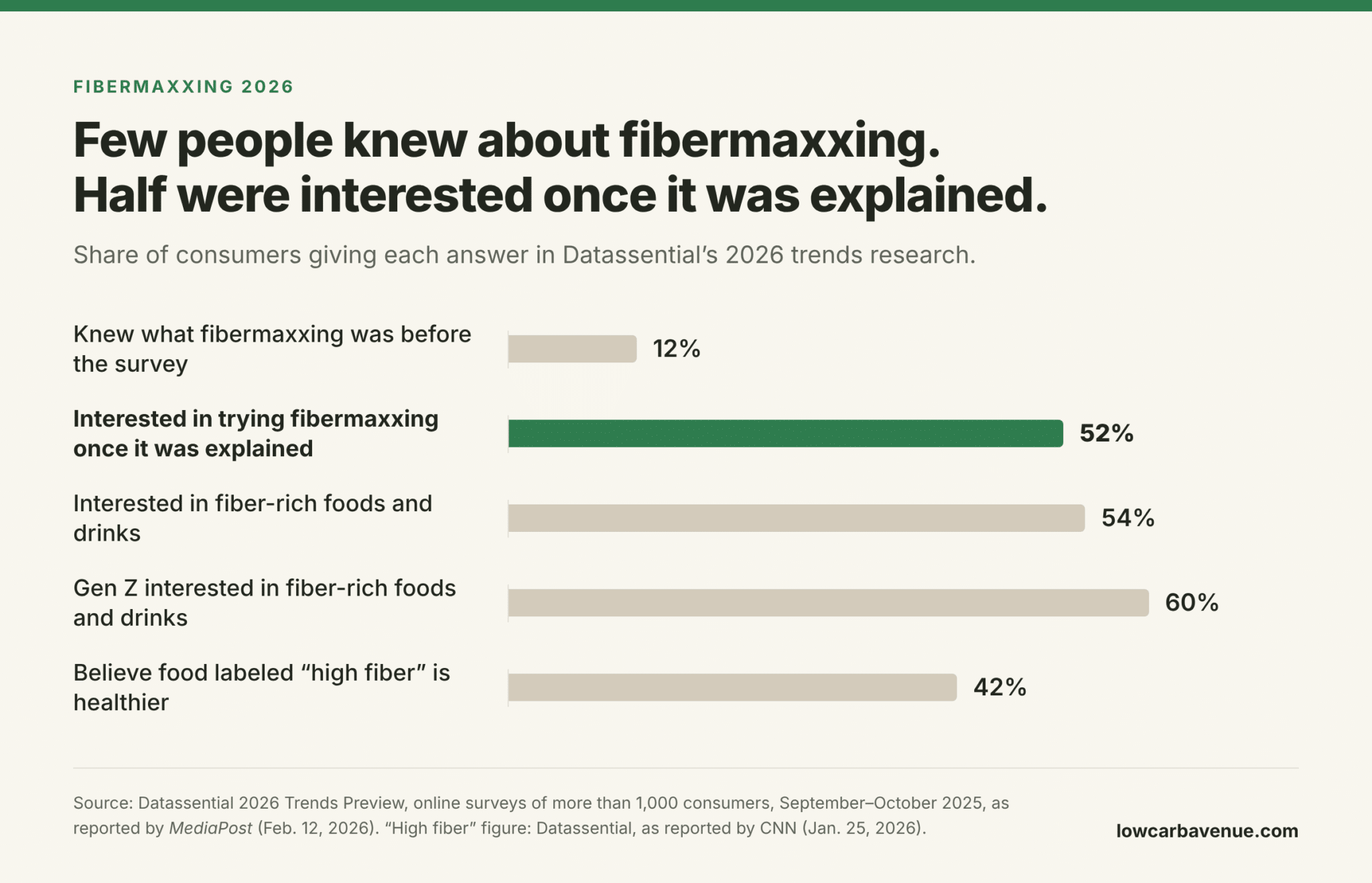
The food research firm Datassential surveyed more than 1,000 consumers in the fall of 2025. Only 12% knew what fibermaxxing was beforehand. Once it was explained, 52% said they were interested in trying it. More than half (54%) were interested in fiber-rich foods and drinks, rising to 60% among Gen Z. Datassential also found, according to CNN, that 42% of shoppers believe food labeled “high fiber” is healthier.
The industry has noticed. Whole Foods Market’s 2026 trend forecast pointed to more fiber callouts on packaging and more breads, pastas and crackers with added fiber. PepsiCo’s CEO told investors he expects fiber to become “the next protein.” Online grocer Thrive Market says shopper searches for fiber-related terms rose 30% in a year.
One reason for the buzz is GLP-1, the appetite hormone that drugs like Wegovy copy. Some types of fiber prompt the gut to release its own GLP-1, which we explain below.
How much fiber do you need, and how much do Americans eat?
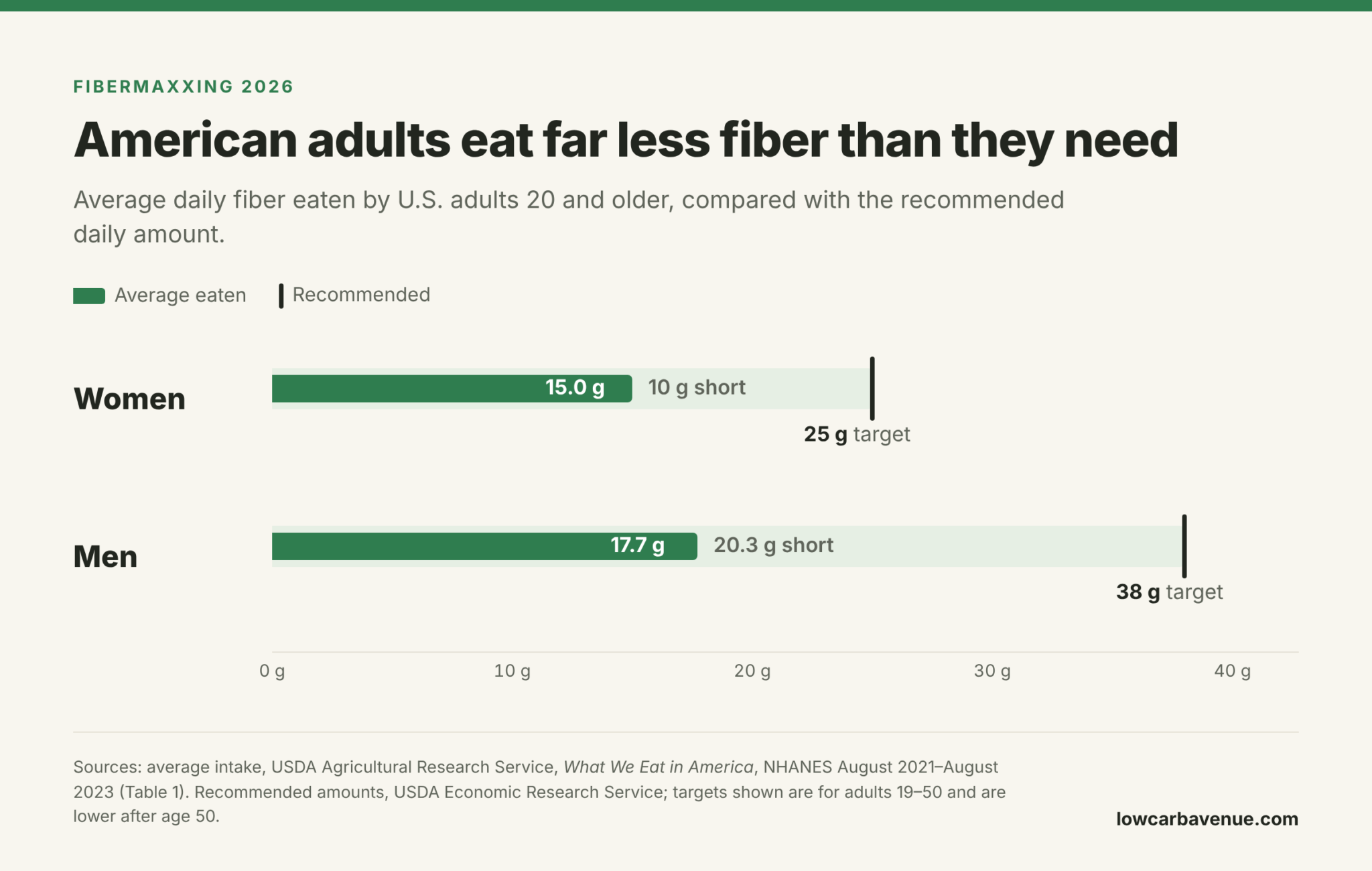
Women need about 25 grams of fiber a day and men about 38 grams, a little less after age 50. The average American adult gets only 15 to 18 grams. The official benchmark is 14 grams for every 1,000 calories you eat, which is where those daily targets come from.
The latest federal food survey, What We Eat in America for August 2021 to August 2023, found that men 20 and older average 17.7 grams a day and women average 15.0 grams. The 2020–2025 Dietary Guidelines for Americans reported that more than 90% of women and 97% of men fall short. Federal dietary guidelines first flagged fiber as a nutrient of public health concern back in 2005.
That gap is the whole reason fibermaxxing caught on. It is one of the rare diet trends that asks you to add something instead of cutting something out.
Does a keto diet have to be low in fiber?
No, but it often ends up that way. Fiber is a carbohydrate, yet your body cannot break it down into sugar the way it breaks down starch. That is why low carb eaters count net carbs: total carbohydrates minus dietary fiber. Net carbs are not printed on the Nutrition Facts label, so you work them out yourself from two lines that are.
The catch is that many classic high-fiber foods, like beans, oats and whole-grain bread, are also high in starch. Cut them and fiber can quietly fall away. Stanford researchers saw this in the Keto-Med trial, published in the American Journal of Clinical Nutrition in 2022. Forty adults with prediabetes or type 2 diabetes were assigned to 12 weeks on a well-formulated ketogenic diet and 12 weeks on a Mediterranean-style low carb diet. On the keto phase, they ate less fiber than on the Mediterranean phase.
Fibermaxxing on keto is not about giving up low carb eating. It is about choosing low carb foods that bring fiber with them: non-starchy vegetables, berries, nuts, seeds and high-fiber breads.
A label tip: not every fiber counts the same way. Under FDA rules, fiber that is naturally intact in plants counts as dietary fiber. A fiber that has been isolated or made in a lab only counts if FDA has found it has a real health benefit, such as lowering blood sugar or cholesterol. Psyllium husk, pectin and guar gum are on that list. Read the ingredient list as well as the fiber number, and favor foods where the fiber comes from seeds, vegetables and grains.
What does the science say fiber does?
The research on fiber is unusually strong for a nutrition topic, and it points to a clear daily target of at least 25 to 29 grams. Four studies stand out.
- Heart, diabetes and cancer risk. In 2019 a team at the University of Otago published a review in The Lancet whose findings were used to inform World Health Organization guidance on fiber. It pooled 185 long-term observational studies and 58 clinical trials. In the long-term studies, people who ate the most fiber had 15% to 30% lower death rates from all causes and from cardiovascular disease than those who ate the least. They also had less coronary heart disease, stroke, type 2 diabetes and colorectal cancer. Risk reduction was greatest at 25 to 29 grams a day, and the authors note that more may bring further benefit.
- Blood sugar. A 2020 review in PLOS Medicine focused on adults with prediabetes or diabetes. Across 42 controlled trials with 1,789 people, eating more fiber improved blood sugar control, cholesterol, body weight and inflammation. The authors suggest a target of 35 grams a day.
- Fullness and the body’s own GLP-1. When gut bacteria ferment fiber, they make short-chain fatty acids. A 2015 study in the journal Gut showed in lab tests that one of them, propionate, triggers human colon cells to release GLP-1 and PYY, two hormones that signal fullness. A fiber built to deliver propionate raised both hormones after meals and helped volunteers eat less. That was a specially designed fiber, though, and a food will not work like a GLP-1 drug.
- Variety. The American Gut Project compared people’s gut bacteria with their diets. Those who ate more than 30 kinds of plants a week had more diverse gut microbes than those who ate 10 or fewer. Different fibers feed different microbes, so variety may matter alongside the total.
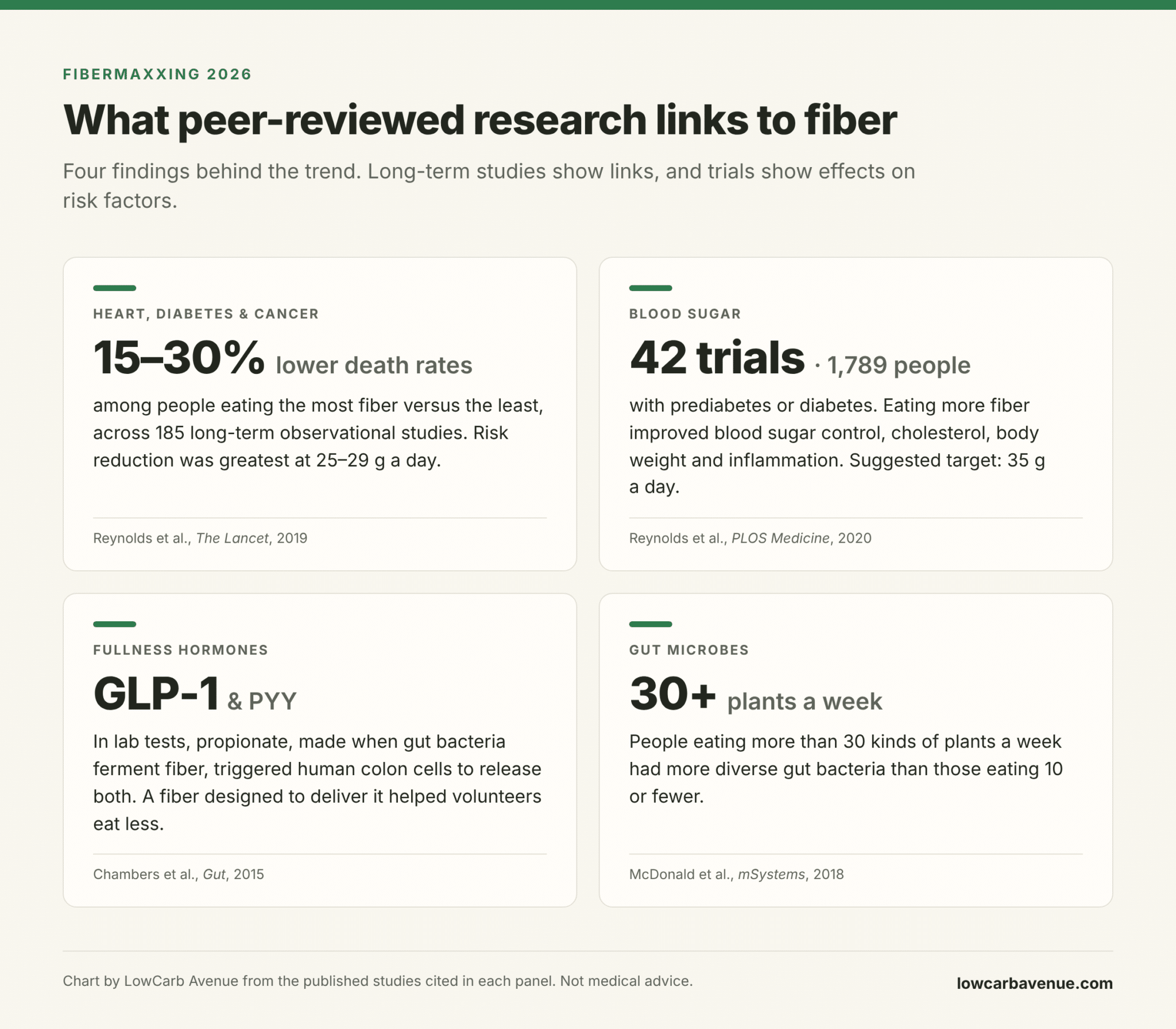
The bottom line for fibermaxxing: more fiber is linked to better health in study after study, and the benefits show up at intakes most of us are not reaching yet.
What does a 30-gram fibermaxxing day look like on low carb?
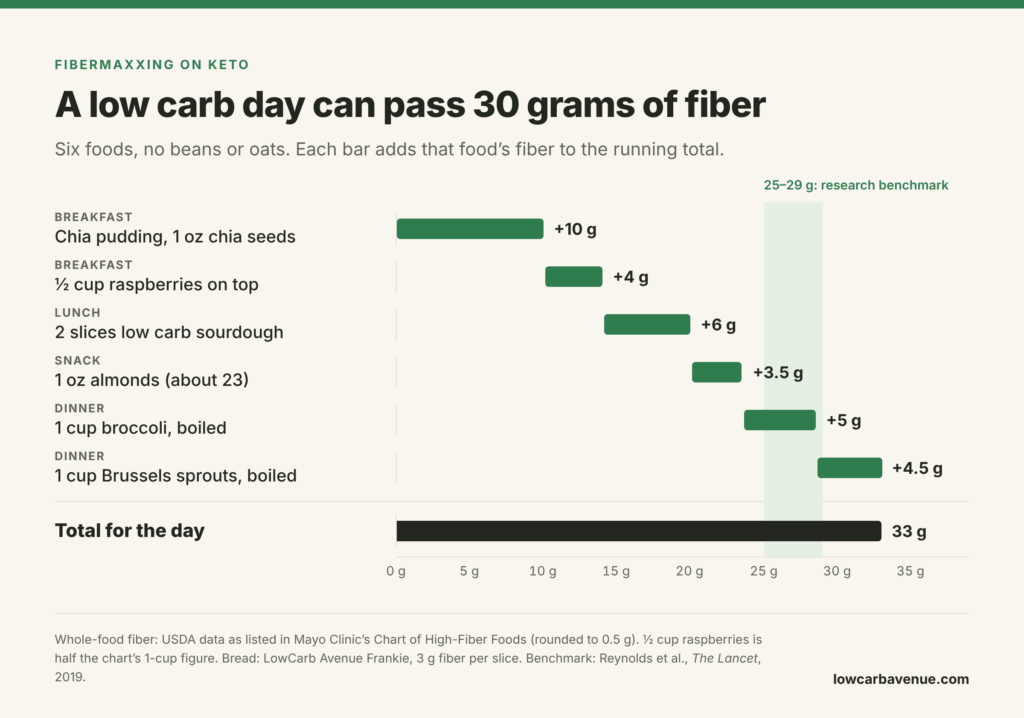
You can pass 30 grams without a single bean or bowl of oatmeal. Here is one simple day built from six foods.
| Meal | Food | Fiber (g) |
|---|---|---|
| Breakfast | Chia pudding made with 1 oz chia seeds | 10 |
| Breakfast | ½ cup raspberries on top | 4 |
| Lunch | Sandwich on 2 slices of low carb sourdough | 6 |
| Snack | 1 oz almonds (about 23 nuts) | 3.5 |
| Dinner | 1 cup broccoli, boiled | 5 |
| Dinner | 1 cup Brussels sprouts, boiled | 4.5 |
| Total | 33 |
Fiber values for whole foods are USDA figures as listed in Mayo Clinic’s high-fiber food chart. The raspberry figure is half of the chart’s 1-cup amount, and the bread figure is from our own label.
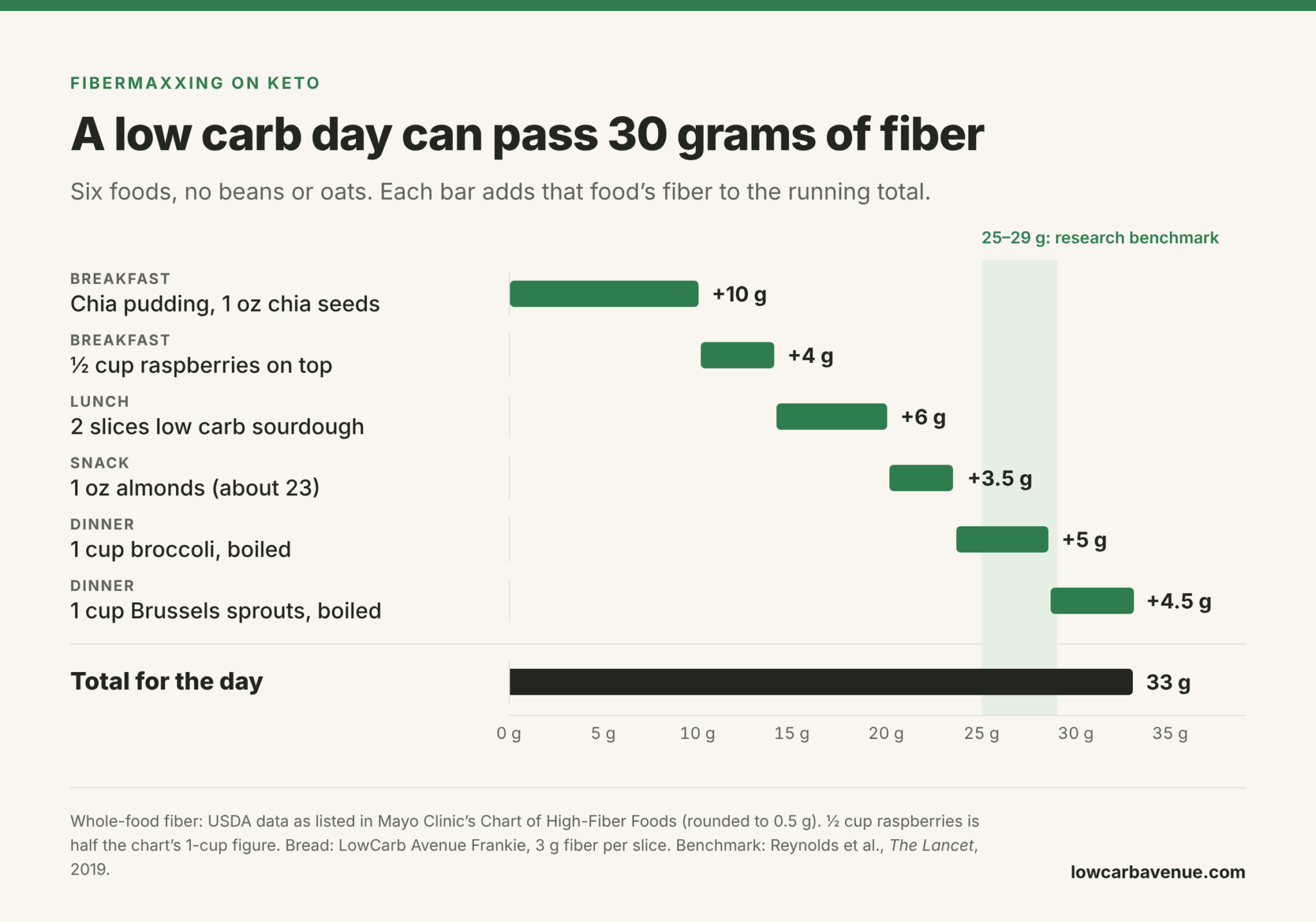
This is a low carb day rather than a strict keto day. If you keep net carbs very low, shrink the berry and Brussels sprout portions and add another tablespoon of chia or a second ounce of almonds.
How do you start fibermaxxing without the bloat?
Go slowly and drink more water. Life Time dietitian Paul Kriegler says the most common mistake is adding fiber too quickly, which can lead to gas and cramps.
- Add 3 to 5 grams every couple of days. That is the pace Houston Methodist physician Dr. Sophie Lin recommends. Mayo Clinic suggests spreading the increase over a few weeks.
- Drink more as you eat more. Fiber pulls water into the gut, which is how it keeps things moving.
- Do not overshoot. There is no official upper limit, but around 50 grams a day can cause gas and bloating.
- Mix your sources. Seeds, nuts, vegetables, berries and fiber-rich bread each feed different gut microbes.
- Lean on food before powders. Whole foods bring vitamins and minerals along with the fiber.
Houston Methodist advises some people to skip fibermaxxing or check with their doctor first. That includes anyone with gastroparesis, a recent flare of inflammatory bowel disease, recent abdominal surgery or a colonoscopy coming up.
Where does clean label, low carb keto bread fit?
Bread is something most people already eat every day, which makes it one of the easiest places to add fiber. A slice of regular whole-wheat bread has about 2 grams. A good low carb keto bread can give you more fiber and more protein for far fewer carbs.
That is what we bake at LowCarb Avenue in Frederick, Maryland:
- Frankie, our New York-style low carb sourdough, has 3 g fiber, 6 g plant protein and 3 g net carbs in a 60-calorie slice.
- Elodie, our sourdough sandwich bread, has 3 g fiber, 7 g protein and 3 g net carbs per slice. It is made with high-fiber wheat flour and wheat protein.
- Wilbur, our seeded low carb multigrain bread, is made with ground flaxseed and almond flour and has 4 g fiber, 7 g protein and 1 g net carbs per slice.
Two slices of Frankie cover nearly a quarter of a woman’s daily fiber target. Pair them with the seeds, nuts and vegetables above and fibermaxxing on low carb gets a lot easier. Browse our full range of low carb keto sourdough bread, see the sourdough trends shaping 2026, or read more about what makes a bread keto-friendly.
Frequently asked questions
Fibermaxxing is a social media trend in which people make a point of reaching, or passing, the recommended daily fiber target, usually with seeds, vegetables, fruit and high-fiber foods.
The common targets are about 25 grams a day for women and 38 grams for men, or 14 grams for every 1,000 calories you eat. Research links the biggest health benefits to at least 25 to 29 grams.
Yes. Chia and flax seeds, almonds, non-starchy vegetables, berries and high-fiber keto bread can take you past 30 grams a day while keeping net carbs low.
No. Net carbs are total carbohydrates minus dietary fiber, because your body does not digest fiber into sugar the way it digests starch.
There is no official upper limit, but around 50 grams a day can cause gas and bloating. Raising fiber too fast can also cause cramps or diarrhea, so add it gradually and drink more water.
Watch: how fiber feeds your gut
More to watch: A High-Fiber Diet Boosts Health (UCTV, Dr. Sean Spencer, 9 minutes), on how fiber shapes the gut microbiome.
Sources
- Datassential 2026 Trends Preview, reported in “Fibermaxxing” and “Natural Meat” Trends for 2026, MediaPost, February 12, 2026
- Jordan Valinsky, CNN, Protein is so last year. Why fiber is the next big thing, January 25, 2026
- U.S. Department of Agriculture, Agricultural Research Service, What We Eat in America, NHANES August 2021–August 2023, Table 1
- USDA Economic Research Service, Home foods have highest fiber density in U.S. adults’ diets
- U.S. Departments of Agriculture and Health and Human Services, Dietary Guidelines for Americans, 2020–2025
- Mobley et al., Identifying Practical Solutions to Meet America’s Fiber Needs, Nutrients 6(7), 2014
- Gardner et al., Effect of a ketogenic diet versus Mediterranean diet on glycated hemoglobin, American Journal of Clinical Nutrition 116(3), 2022
- U.S. Food and Drug Administration, Questions and Answers on Dietary Fiber
- Reynolds et al., Carbohydrate quality and human health: a series of systematic reviews and meta-analyses, The Lancet 393(10170), 2019
- Reynolds et al., Dietary fibre and whole grains in diabetes management, PLOS Medicine 17(3), 2020
- Chambers et al., Effects of targeted delivery of propionate to the human colon on appetite regulation, Gut 64(11), 2015
- McDonald et al., American Gut: an Open Platform for Citizen Science Microbiome Research, mSystems 3(3), 2018
- Mayo Clinic, Chart of high-fiber foods, December 24, 2025
- Houston Methodist, Fibermaxxing: Should You Try the High-Fiber Diet Trend?, January 21, 2026
- Life Time, What Is Fibermaxxing?, PR Newswire, February 2026
This article is for general information and is not medical advice. If you have a digestive condition or diabetes, talk with your doctor before making big changes to your diet.