Sourdough Trends in 2026: What Shoppers Want and What the Science Says
Quick take: Sourdough is now the bread more Americans say they would keep than any other. Shoppers like the taste, and many believe it is better for their…

Quick take: Sourdough is now the bread more Americans say they would keep than any other. Shoppers like the taste, and many believe it is better for their gut. The research is encouraging but less settled than social media suggests, so the ingredient label matters more than the word on the front of the bag. These sourdough trends reflect growing interest in flavor, ingredients and everyday nutrition.
Sourdough has outlasted its lockdown-hobby phase. Six years later it is the first loaf many shoppers reach for, and this year’s numbers on sourdough trends are hard to ignore. Here is what the surveys show, what peer-reviewed studies have actually found, and where low carb and keto sourdough fits in.
Sourdough is now the loaf people would keep
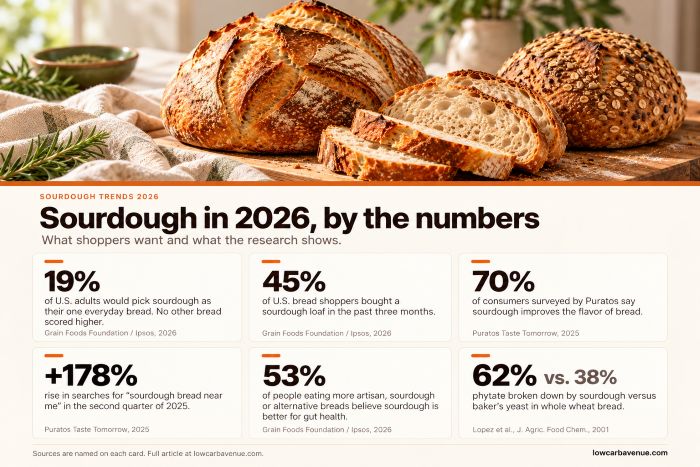
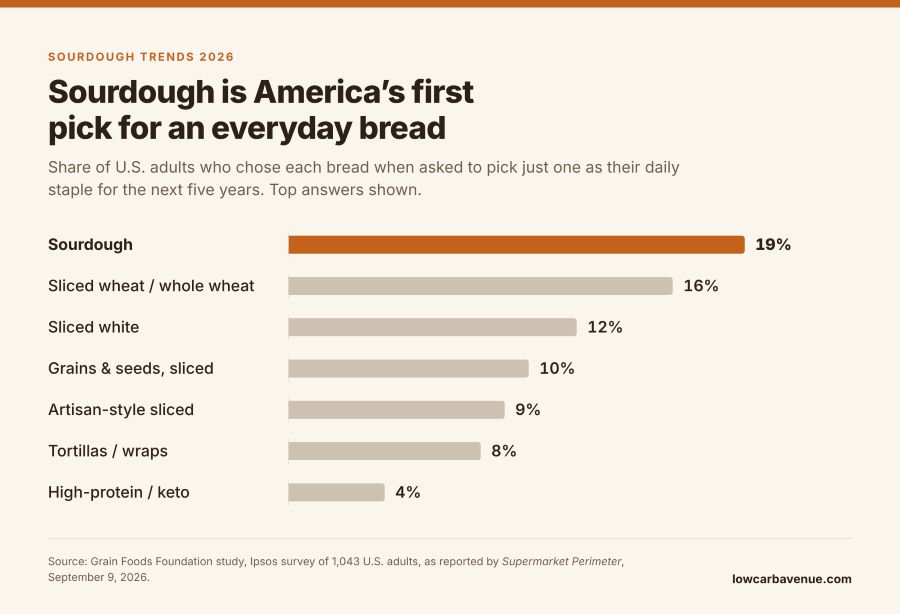
A 2026 Grain Foods Foundation study, based on an Ipsos survey of 1,043 U.S. adults, asked people to choose one bread as their daily staple for the next five years. Sourdough came first with 19%. Whole wheat was second at 16% and sliced white third at 12%. Sourdough also led the vote for the “ideal sandwich” bread, at 20%.
Shopping baskets are catching up. Among the people who do the bread shopping, 45% had bought a sourdough loaf in the past three months. Across all respondents, 31% said they were eating more sourdough than a year ago, against 14% eating less. These shopping habits help explain the sourdough trends shaping bread purchases in 2026.
The pattern holds outside the United States. Puratos, whose Taste Tomorrow program surveys more than 23,000 people in 56 countries, ranks sourdough as the most talked-about trend in bakery. In its research, 70% of consumers say sourdough improves flavor and 58% believe it makes bread healthier. Searches for “sourdough bread near me” rose 178% in the second quarter of 2025.
Market estimates vary by analyst, but they point the same way. Fortune Business Insights puts the global sourdough market at $4.94 billion in 2026 and forecasts $7.35 billion by 2034.
Three sourdough trends worth watching
1. Sourdough is leaving the loaf. Puratos tracked sharp rises in online interest in sourdough focaccia (up 141%) and “sourdoughnuts” (up 172%). New sweet baked goods carrying a sourdough claim rose 31%.
2. Gut health is a major selling point. In the Grain Foods Foundation survey, 53% of people eating more artisan, sourdough or alternative breads said they believe sourdough is better for gut health and digestion than regular bread. Puratos saw searches for “sourdough bread gut health” nearly double.
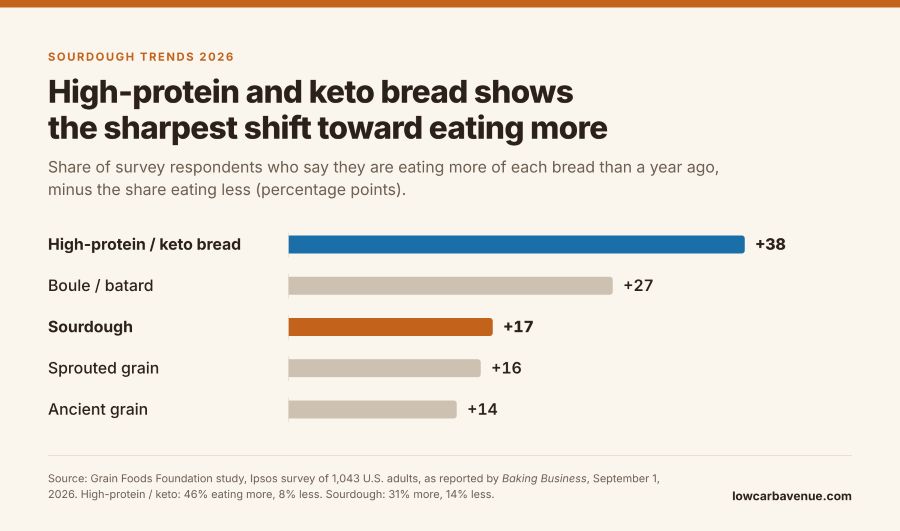
3. Protein and fiber are catching up. The sharpest shift in the same survey was toward high-protein and keto bread: 46% of respondents said they were eating more of it and 8% less. That is a net 38 points, against 17 for sourdough. It fits a wider pattern. In the International Food Information Council’s 2025 survey, 70% of Americans said they were trying to eat more protein and 64% more fiber.
What the science says about sourdough
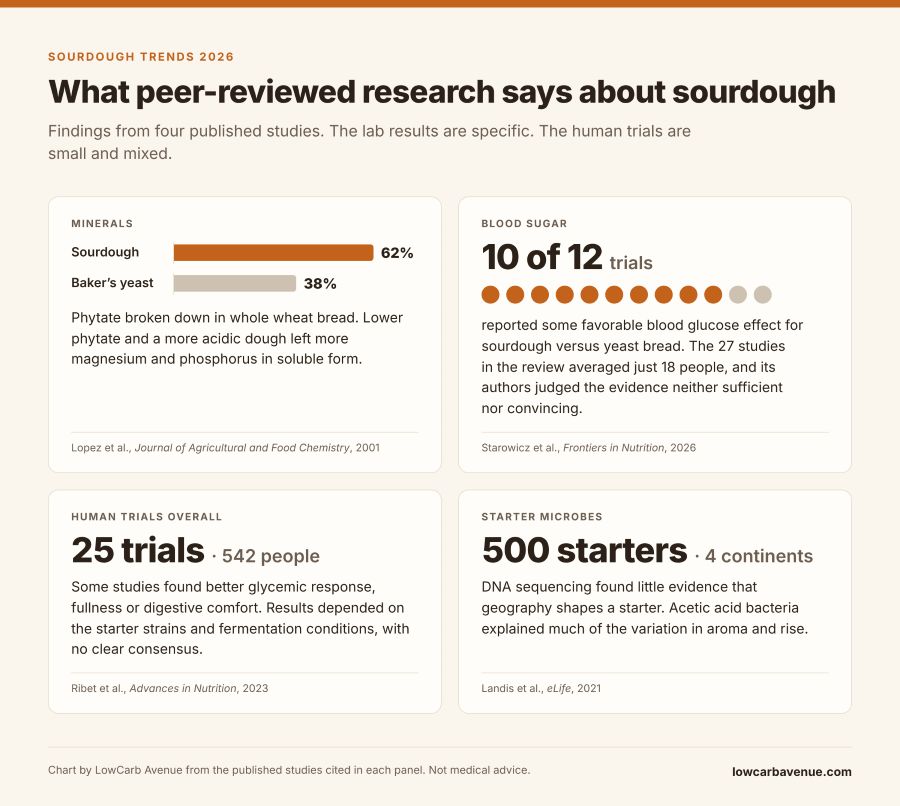
Sourdough is raised by a living culture of wild yeasts and lactic acid bacteria rather than packaged baker’s yeast alone. When researchers sequenced 500 starters from four continents for a 2021 study in eLife, they found that geography matters far less than bakers tend to assume. A lesser-known group, acetic acid bacteria, explained much of the difference in aroma and rise.
What that fermentation does for the person eating the bread is a harder question. Three findings stand out.
- Minerals. In a laboratory study, sourdough fermentation broke down 62% of the phytate in whole wheat bread, compared with 38% for yeast. Phytate binds minerals. Lower phytate and a more acidic dough left more magnesium and phosphorus in soluble form.
- Digestion. A 2018 review in Foods explains how sourdough microbes break down part of the fructans in wheat and rye. Fructans are a type of FODMAP, a group of carbohydrates that troubles many people with sensitive digestion. That does not make every sourdough loaf low-FODMAP, and wheat sourdough still contains gluten, so it is not safe for people with celiac disease.
- Blood sugar. This is where claims run ahead of the evidence. A 2023 review in Advances in Nutrition covered 25 clinical trials with 542 people. Some found a better glycemic response, more fullness or easier digestion, but results depended on the starter and the method. A 2026 review in Frontiers in Nutrition found that 10 of 12 trials in healthy adults reported some favorable blood glucose effect for sourdough over yeast bread. Yet the trials it reviewed averaged just 18 participants, and the authors concluded the evidence is “neither sufficient nor convincing.”
Our reading: fermentation may help, but it does not turn white bread into health food. What goes into the loaf still matters most.
Check the label, not the name
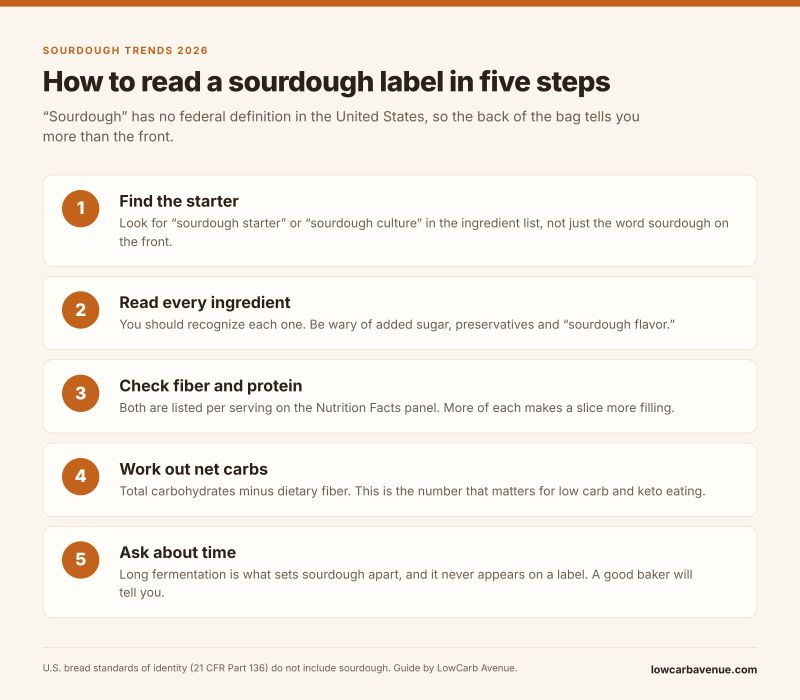
As sourdough trends attract more attention, reading the ingredient label remains essential. “Sourdough” has no federal definition in the United States. The bread standards in 21 CFR Part 136 cover white, enriched, milk, raisin and whole wheat bread, and stop there. So the word on the front of the bag does not tell you how the loaf was made. In the U.K., the Real Bread Campaign coined “sourfaux” for loaves sold as sourdough but made with baker’s yeast or additives.
Before you buy, look for:
- a sourdough starter or culture in the ingredient list
- ingredients you recognize, with no added sugar or preservatives
- fiber and protein per slice
- net carbs, which are total carbohydrates minus fiber
Where clean label, low carb keto sourdough fits
Put these trends together and the next step is easy to see: real fermentation, more fiber, more protein and far fewer carbs in one loaf.
Fiber is the piece most of us are missing. The 2020-2025 Dietary Guidelines for Americans reported that more than 90% of women and 97% of men fall short of the recommended intake. Bread is something people already eat every day, which makes it a practical place to add some.
That is the idea behind low carb sourdough, often called keto sourdough bread. It keeps the starter and the fermentation, and replaces much of the starch with fiber and plant protein. We bake ours in Frederick, Maryland. A slice of our Frankie loaf has 3 g net carbs, 6 g protein and 3 g fiber, with no sugar and no preservatives.
If you want to see what goes into a clean label, low carb keto sourdough, start with our low carb sourdough bread.
Watch: the science of sourdough
- Sourdough bread is a microbial mystery (Sci NC, PBS North Carolina, 6 minutes). NC State scientists explain why they collected starters from bakers around the world.
- Wild Sourdough (NC State Department of Applied Ecology, Fermentology seminar series). A full talk on how a starter forms and what lives in it.
Sources
- Grain Foods Foundation and Ipsos survey, reported in Sourdough in the spotlight, Supermarket Perimeter, September 9, 2026, and Consumers rethinking how they buy bread, Baking Business, September 1, 2026
- Grain Foods Foundation, Research Looks at America’s Evolving Bread Basket, September 3, 2026
- Puratos Taste Tomorrow, The hottest bakery trends for 2026, October 28, 2025
- Fortune Business Insights, Sourdough Market Size, Share & Industry Analysis, updated September 2026
- International Food Information Council 2025 Food & Health Survey, cited by Penn State Extension in Food Trends 2026, March 6, 2026
- Landis et al., The diversity and function of sourdough starter microbiomes, eLife, 2021
- Lopez et al., Prolonged fermentation of whole wheat sourdough reduces phytate level and increases soluble magnesium, Journal of Agricultural and Food Chemistry 49(5), 2001
- Loponen and Gänzle, Use of Sourdough in Low FODMAP Baking, Foods 7(7), 2018
- Ribet et al., Nutritional benefits of sourdoughs: A systematic review, Advances in Nutrition 14(1), 2023
- Starowicz et al., Effects of sourdough and yeast fermented breads consumption on glycaemia in healthy populations: a systematic review, Frontiers in Nutrition 13, 2026
- U.S. Code of Federal Regulations, 21 CFR Part 136: Bakery Products
- Real Bread Campaign, New Sourdough Loaf Mark, August 2020
- U.S. Departments of Agriculture and Health and Human Services, Dietary Guidelines for Americans, 2020-2025
This article is for general information and is not medical advice.