
Keto Net Carb Calculator
Keto Net Carb Calculator
Photograph the Nutrition Facts and the ingredients. You’ll check the numbers before you see a result.
Photos are read by Claude AI and never saved by LowCarb Avenue.
Scan or type the barcode. Data comes from Open Food Facts; you’ll check it first.
or type the number under the barcode
Type the numbers from the label. The result appears and updates as you type — no button needed.
Added to your home screen.
Free · No sign-up · For education only, not medical advice.
Snap a nutrition label, scan a barcode, or type the numbers. This free keto net carb calculator shows exactly how fiber and sugar alcohols are counted, so you can check a “2 g net carbs” claim for yourself.
How the net carb scanner works
Snap or scan
Point your phone at the Nutrition Facts panel and ingredient list, or at the barcode — or type the numbers. No app store, no account.
Sweetener check
The calculator reads the ingredients. It tells erythritol and allulose apart from maltitol, sorbitol and other sweeteners that act more like sugar.
Check, then see your estimate
Typed numbers update the result as you go. Photo and barcode numbers wait until you confirm they match the package. You get an estimate per serving and for the amount you’ll eat, with the full math line by line.
Why the net carbs on the box can be wrong
“Net carbs” is a popular way to count the carbs that actually raise blood sugar. But it is not a term the U.S. Food and Drug Administration (FDA) defines. So each brand can do the math its own way. Here are the four traps we see most often.
1. The maltitol trap
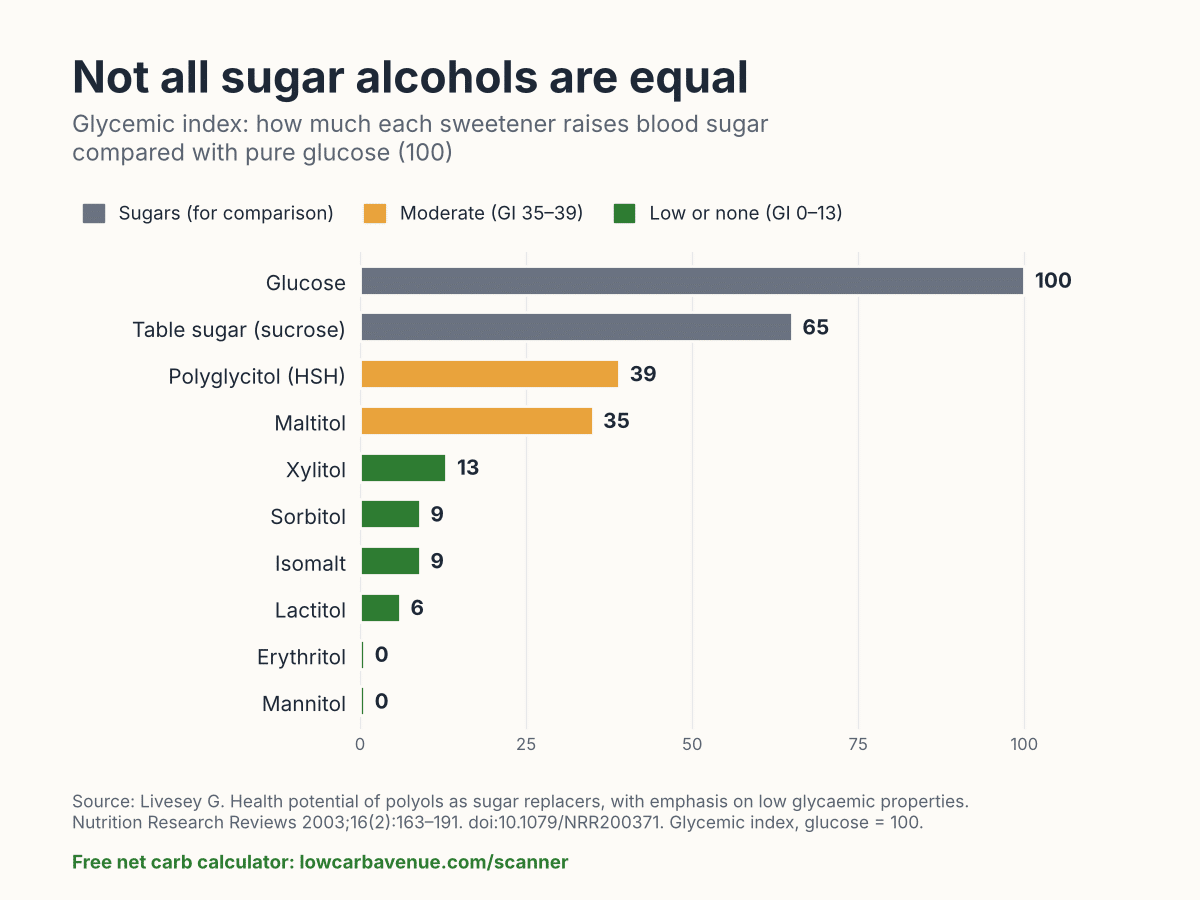
Most brands subtract all sugar alcohols from total carbs. That works for erythritol, which has a glycemic index (GI) of about 0. It does not work for maltitol, which has a GI of about 35 in a major review of the research. Your body digests a good part of it. A bar with 12 g of maltitol can claim 3 g net carbs, while a more cautious estimate is about 9 g.
2. Rounding on the label
Under FDA rules, carbs are rounded to the nearest gram. A line that reads “0 g” can mean up to 0.49 g. “Less than 1 g” can mean almost a full gram. That is tiny for one serving, but it adds up when you eat four or five servings a day.
3. Small serving sizes
Check the serving size before you trust any number. A package may list half a bar, or 2 crackers, as one serving. The calculator lets you set how many servings you will really eat, and it updates the total for you.
4. “Fibers” that act like sugar
Some added fibers are low impact. Others are not. Studies show isomalto-oligosaccharides (IMO), often sold as a fiber syrup, can raise blood sugar much like regular sugar. The calculator flags IMO, maltodextrin, dextrose and sugar syrups so you can decide for yourself.
How this calculator works out net carbs
The formula is simple and the same every time:
Estimated net carbs = total carbs − fiber − erythritol − allulose − (½ × maltitol, sorbitol and other sugar alcohols)
On European, UK, Australian and New Zealand labels, “Carbohydrate” already leaves fiber out, so fiber is not subtracted again. You choose the label type, and the calculator remembers it.
| Ingredient | How we count it | Why |
|---|---|---|
| Dietary fiber | Subtract 100% | Not digested into sugar |
| Erythritol | Subtract 100% | Glycemic index of about 0 |
| Allulose | Subtract 100% | FDA lets brands leave it out of “sugars” because the body does not use it like table sugar |
| Stevia, monk fruit, sucralose | No change | Used in tiny amounts with no meaningful carbs |
| Maltitol, sorbitol, xylitol, isomalt, lactitol | Subtract only 50% | Partly digested; maltitol has the biggest effect |
| IMO, maltodextrin, dextrose, syrups | Counted in full; named in the ingredient notes | Digestible carbs that can raise blood sugar fast |
Most labels list all sugar alcohols on one line. You tell the calculator which kind it is (the ingredient list usually says). If you’re not sure, it is counted at 50% to stay cautious. If you know the grams of each, enter them and they are taken out of the total once, never twice. Allulose has its own box because it is not a sugar alcohol, and it is only subtracted when the package gives grams.
The 50% rule is a common simplified convention, not a measurement: different sugar alcohols, and different people, respond differently. When you snap a label or scan a barcode, the AI or the database only fills in the numbers. You check them against the package before you see a result, and anything missing is shown as unknown — never as zero. The math runs in plain code in your browser, so the same numbers always give the same answer.
Want the full explanation? Read our LowCarb Wiki guides: What Are Net Carbs? How to Calculate Them and Sugar Alcohols and Low-Carb Sweeteners.
What the labels mean
- ✓ Lower estimated net carbs: 5 g or less for the amount you’ll eat.
- ! Moderate estimated net carbs: more than 5 g, up to 10 g.
- ▲ Higher estimated net carbs: more than 10 g.
- Ingredient notes (maltitol, IMO, maltodextrin and others) are shown separately. They never change the number or the label.
These labels describe the carb estimate only. They do not predict your blood sugar, and they are not medical advice. People respond differently. If you use a glucose meter or CGM, your own readings are the best guide. If you take insulin or diabetes medicine, talk with your care team before you change how you eat.
Why a physician co-founded bakery built a free tool
LowCarb Avenue is a family-owned artisan bakery in Frederick, Maryland, co-founded by a physician. We bake low carb sourdough, breads and bagels the slow way, with olive oil and clean, non-GMO ingredients. Many of our customers manage diabetes or follow keto. They kept asking us the same question at farmers markets: “Can I trust this label?”
This calculator is our answer. It is free, it works on any product from any brand, and it does not ask for your email. We built it to make label reading easy, not to sell you something.
Frequently asked questions
Is this keto net carb calculator free?
Yes. It is 100% free, with no sign-up and no app store download. It runs in your phone or computer’s web browser.
Do you save my label photos?
No. Your photo is shrunk and its location (EXIF) data removed on your device, then sent over an encrypted connection through our server to Anthropic’s Claude API only to read the label. LowCarb Avenue doesn’t save it. Anthropic doesn’t use API data to train its models and automatically deletes it within 30 days, unless it is flagged for a safety review or must be kept by law. Barcode numbers are looked up in Open Food Facts. Numbers you type in Manual Math stay in your browser.
Why can’t the barcode scanner find my product?
Barcode results come from Open Food Facts, a free public database built by volunteers. Some products are missing or incomplete. If a barcode is not found, snap a photo of the label or use Manual Math.
How do I add the calculator to my home screen?
Tap the green Add to Home Screen button at the top of the calculator. On Android it installs in one tap. On iPhone or iPad it shows the quick steps: tap Share in Safari, then “Add to Home Screen.”
How accurate is the label scanner?
It reads clear, well-lit photos well, but glare, blur or an unusual layout can cause mistakes. That is why you always see the numbers first, with anything hard to read marked for you to check, and tap “Numbers match — show result” before getting one.
Real bread, honest numbers
If you are looking for bread that does not need a calculator to make sense, try our clean-label low carb sourdough and keto bagels, made with real fiber and protein. Shop LowCarb Avenue.
Sources: Livesey G. Health potential of polyols as sugar replacers, Nutrition Research Reviews, 2003 · FDA, Declaration of Allulose on Nutrition Facts Labels, 2020 · 21 CFR 101.9, Nutrition labeling of food · Subhan FB et al. Ingestion of isomalto-oligosaccharides stimulates insulin and incretin hormone secretion, Journal of Functional Foods, 2020 · OFW Law, Low-Carb Food Labeling.