
Sugar Alcohols and Low-Carb Sweeteners: What to Know
Sugar alcohols and low-carb sweeteners let you enjoy something sweet without the blood sugar jump that table sugar brings, but they aren’t all the same. Erythritol, allulose, stevia, and monk fruit barely touch blood glucose, while maltitol acts a lot more like sugar. Erythritol also drew attention in 2023 after a heart study, so it’s worth knowing what that research did and didn’t show.
Low-carb sweeteners at a glance
Most sweeteners you’ll see in keto and low-carb products fall into three groups: sugar alcohols (also called polyols), rare sugars like allulose, and high-intensity plant extracts like stevia and monk fruit. Here’s how the common ones compare.
| Sweetener | Type | Sweetness vs. table sugar | Worth knowing |
|---|---|---|---|
| Erythritol | Sugar alcohol | About 60-80% as sweet [9] | Glycemic index of 0 [9] |
| Xylitol | Sugar alcohol | About as sweet [9] | Toxic to dogs [11] |
| Maltitol | Sugar alcohol | About 90% as sweet [9] | Highest glycemic index of the common polyols [9] |
| Allulose | Rare sugar | About 70% as sweet [12] | FDA uses 0.4 calories per gram for labels [6] |
| Stevia (steviol glycosides) | Plant extract | 200-400 times sweeter [8] | Only purified extracts are allowed as sweeteners in the U.S. [8] |
| Monk fruit (luo han guo) | Plant extract | 100-250 times sweeter [8] | No acceptable daily intake has been set yet [8] |
Sugar alcohols: how they work
Despite the name, sugar alcohols don’t contain the alcohol in beer or wine. They’re carbohydrates with a structure that sits partway between a sugar and an alcohol. Small amounts occur naturally in some fruits and vegetables, and manufacturers make them from sugars and starches [5]. Your body absorbs them slowly and only partly, so they supply fewer calories than sugar and raise blood sugar less than other carbs [5]. They also don’t feed the mouth bacteria that cause cavities, which is why they’re common in sugar-free gum [5].
On a Nutrition Facts label, listing sugar alcohols under Total Carbohydrate is usually voluntary. It becomes required when the package makes a claim about sugar or sugar alcohols [5]. That’s one reason net carb math can get confusing. Our guide to net carbs explains how brands arrive at their numbers.
Not all sugar alcohols are equal
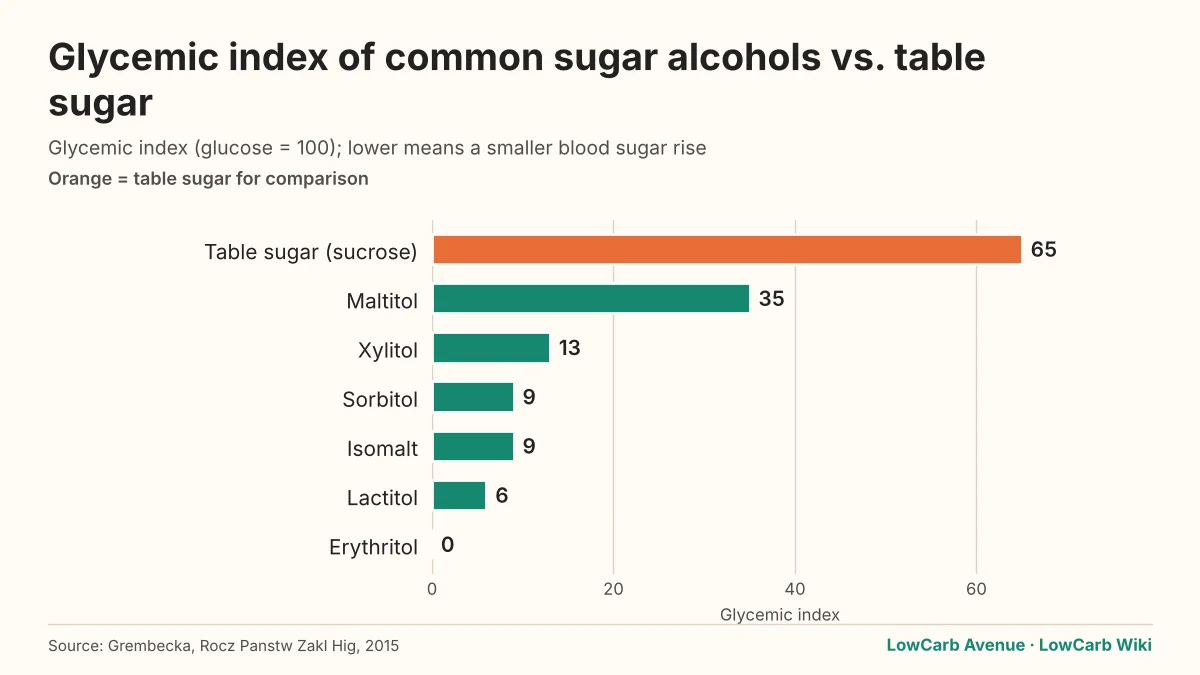
This is the part many keto shoppers miss. Erythritol has a glycemic index of 0, while maltitol sits at 35, more than half of table sugar’s 65 [9]. Xylitol and sorbitol land in between. If a “sugar-free” chocolate bar is sweetened mainly with maltitol, subtracting all of its sugar alcohols from total carbs can make the net carb count look better than your blood sugar may agree with. For more on what these numbers mean, see glycemic index vs. glycemic load.
Your gut gets a vote
Because much of a sugar alcohol isn’t absorbed, the rest travels to the large intestine, where bacteria ferment it. That can mean gas, bloating, or diarrhea for some people [5]. Foods with sorbitol or mannitol must carry a warning that eating too much may have a laxative effect [5]. Harvard nutrition experts note that tolerance varies and may improve with regular use [8].
Erythritol and the 2023 heart study
In February 2023, a Cleveland Clinic-led team published a study in Nature Medicine that made headlines [1]. Researchers measured fasting blood erythritol in people being evaluated for heart disease, then followed them for three years. In a U.S. group of 2,149 people, those in the top quarter of erythritol levels had about 1.8 times the risk of heart attack, stroke, or death compared with the bottom quarter, after adjusting for other risk factors. A European group of 833 people showed a similar pattern [1].
The team also ran lab and animal tests suggesting erythritol made platelets, the blood cells that form clots, more reactive. In a small pilot, eight healthy volunteers drank 30 grams of erythritol. Their blood levels rose roughly 1,000-fold and stayed high for more than two days [1].
What the study did not show
The authors were upfront about its limits, and they matter [1]:
- It was observational. It showed a link, not proof that erythritol causes heart problems.
- Blood levels were checked once. One fasting sample can’t tell you how much erythritol someone ate over years.
- Participants were already high-risk. Many had heart disease or several risk factors, so results may not apply to healthy adults.
- Diet wasn’t tracked. Unmeasured habits could explain part of the link.
There’s another twist. Your body makes some erythritol on its own. Research using human blood samples found that erythritol can be produced from glucose through a normal metabolic pathway [4]. So a high blood level might partly reflect a person’s metabolism, not just the sweeteners they ate.
What came next
In 2024, the same research group gave 20 healthy young adults either 30 grams of erythritol or 30 grams of glucose. Platelet clotting response rose after erythritol but not after glucose [2]. That’s a more direct test, but it was small and short, and it measured lab markers rather than actual heart attacks. A separate 2024 study found a similar pattern for xylitol: people in the top third of blood xylitol levels had about 50% higher risk of major cardiac events over three years [3]. It, too, was observational.
The fair summary: these are real signals that deserve follow-up, not settled proof. No long-term randomized trial has tested whether everyday amounts of erythritol harm the heart. If you have heart disease, a history of clots, or take blood thinners, talk with your doctor about sugar alcohols, especially in large amounts.
Allulose: the rare sugar that labels treat differently
Allulose is a sugar that’s rare in nature and about 70% as sweet as table sugar, yet it supplies very little energy [12]. The FDA lets companies count it at 0.4 calories per gram and leave it out of both Total Sugars and Added Sugars on the label [6]. A 2023 review of studies in healthy adults found that small amounts of allulose taken with a meal lowered the post-meal rise in blood glucose [7]. Research in people with diabetes is still limited, so it’s a promising option rather than a proven tool.
Stevia and monk fruit
Both come from plants and are intensely sweet, so products need only a pinch. Stevia’s steviol glycosides are 200 to 400 times sweeter than sugar, and monk fruit extract is 100 to 250 times sweeter [8]. In the U.S., purified extracts are generally recognized as safe, but whole stevia leaf and crude extracts aren’t approved as sweeteners [8]. Because they’re so concentrated, many packets and baking blends bulk them up with erythritol or another filler. Check the ingredient list if you’re trying to avoid a particular sugar alcohol.
What the World Health Organization says
In May 2023, the WHO issued a conditional recommendation against using non-sugar sweeteners like stevia and sucralose to control body weight [10]. Its review found no long-term benefit for body fat. Two details often get lost: the guideline doesn’t cover sugar alcohols, and it doesn’t apply to people who already have diabetes [10]. In other words, sweeteners can help you swap out sugar, but they aren’t a weight-loss strategy on their own.
Practical tips for low-carb and keto shoppers
- Read past the front label. “Sugar-free” or “keto” tells you little. Find the sweetener in the ingredient list.
- Treat maltitol like a partial sugar. Don’t assume all sugar alcohol grams are free carbs.
- Start small with polyols. If your stomach complains, it’s a sign to cut back.
- Keep xylitol away from dogs. Even small amounts can cause a dangerous drop in a dog’s blood sugar [11].
- Use sweet treats as treats. The goal of low carb eating is real food first, with sweeteners as a supporting player.
If you take insulin or other diabetes medicine, check with your doctor or dietitian before making big changes to how you sweeten foods, since your carb intake affects dosing.
Where LowCarb Avenue fits
Sweeteners can make low-carb eating easier, but everyday staples matter more. At LowCarb Avenue, we bake clean-label low-carb and keto bread built around fiber and protein, so your sandwich or morning toast doesn’t depend on sweeteners at all. Try Wilbur, our multigrain loaf, Frankie and Elodie, our sourdough options, or Brooklyn Baby bagels. Each label lists exactly what’s inside, so you can read it with the same care this guide encourages. Browse the LowCarb Avenue shop.
Frequently asked questions
Do sugar alcohols count toward net carbs?
Many low-carb brands subtract sugar alcohols from total carbs, but they don't all behave the same. Erythritol has a glycemic index of 0, while maltitol's is 35, so maltitol-sweetened foods can raise blood sugar more than their net carb count suggests.
Is erythritol safe to eat?
Erythritol is permitted in U.S. foods. A 2023 study linked high blood erythritol to heart attack and stroke in people already at high risk, but it was observational and measured levels only once. If you have heart disease or clotting concerns, ask your doctor about it.
What is the best keto sweetener for baking?
It depends on the recipe. Allulose and erythritol add bulk and are milder than sugar, while stevia and monk fruit add a lot of sweetness in tiny amounts. Many bakers use a blend. Check labels so you know which sweeteners a blend contains.
Why do sugar-free sweets upset my stomach?
Sugar alcohols aren't fully absorbed, so bacteria in the large intestine ferment what's left. That can cause gas, bloating, or diarrhea, especially with larger servings. Tolerance varies from person to person.
Sources
- The artificial sweetener erythritol and cardiovascular event risk (Witkowski M, Nemet I, et al.).
- Evidence mounts that sugar substitute erythritol raises cardiovascular risk (summary of Witkowski et al., Arteriosclerosis, Thrombosis, and Vascular Biology, 2024).
- Xylitol may affect cardiovascular health (summary of Witkowski et al., European Heart Journal, 2024).
- Erythritol is a pentose-phosphate pathway metabolite and associated with adiposity gain in young adults (Hootman KC, et al.).
- Interactive Nutrition Facts Label: Sugar Alcohols.
- Guidance for Industry: The Declaration of Allulose and Calories from Allulose on Nutrition and Supplement Facts Labels.
- Allulose for the attenuation of postprandial blood glucose levels in healthy humans: A systematic review and meta-analysis (Tani Y, et al.).
- Low-Calorie Sweeteners.
- Natural sweeteners in a human diet (Grembecka M.).
- WHO advises not to use non-sugar sweeteners for weight control in newly released guideline.
- Paws Off Xylitol; It's Dangerous for Dogs.
- Recent Advances Regarding the Physiological Functions and Biosynthesis of D-Allulose (Chen Z, Gao XD, Li Z).
This article is for general education and is not medical advice. Talk with your doctor or a registered dietitian before changing your diet, especially if you take medication for diabetes or blood pressure. How we research and write.