
Hidden Sugars: 40+ Names to Spot on Ingredient Lists
Added sugar hides on ingredient lists under dozens of names, from dextrose and maltose to cane juice, rice syrup, and fruit juice concentrate. If you know the patterns, such as words ending in “-ose,” anything called a syrup or nectar, and most things with “malt” or “cane” in the name, you can spot it in seconds. Pair that with the Added Sugars line on the Nutrition Facts panel and very little gets past you.
Why sugar is so easy to miss
Sweeteners are everywhere in packaged food. A study of more than 85,000 packaged foods and drinks bought by U.S. households found that 75% contained some kind of sweetener, and 68% contained only caloric sweeteners like sugar or syrups [7]. Corn syrup was the most common one [7].
Ingredients are listed by weight, from most to least [10]. So a product that uses three or four different sweeteners can spread them out, and each one shows up lower on the list than a single “sugar” would. Add unfamiliar names to the mix, and it’s easy to assume a product is low in sugar when it isn’t. For low-carb and keto eaters, that matters: hidden sugar means hidden carbs.
40+ names for added sugar, grouped so they’re easy to remember
Researchers at UC San Francisco’s SugarScience project count at least 61 names for sugar on food labels [9]. You don’t need to memorize all of them. Learn the families instead.
1. Words ending in “-ose”
The CDC flags any ingredient ending in “-ose” as a sugar [4].
- Sucrose, glucose, fructose, dextrose, maltose, lactose [4]
- Crystalline fructose [6], mannose, and saccharose (another name for sucrose) [9]
2. Anything called a syrup, nectar, or honey
- Corn syrup, corn syrup solids, high-fructose corn syrup [6][9]
- Rice syrup, malt syrup, barley malt syrup [4][6][9]
- Maple syrup, golden syrup, refiner’s syrup, carob syrup, sorghum syrup, buttered syrup [6][9]
- Agave nectar, honey, molasses, treacle [6][9]
3. Sugars named for their source or color
- Cane sugar, beet sugar, coconut sugar, coconut palm sugar, palm sugar, date sugar, grape sugar [6][9]
- Brown sugar, raw sugar, turbinado, demerara, muscovado, Barbados sugar, panocha, golden sugar, yellow sugar [6][9]
- Confectioner’s sugar, powdered sugar, icing sugar, castor sugar [4][9]
- Invert sugar and caramel [6][9]
4. Cane juice and fruit juice terms
- Evaporated cane juice, dehydrated cane juice, cane juice crystals [6][9]
- Fruit juice concentrate and fruit juice [6][9]
Juice concentrates count as added sugar under FDA rules when they’re used to sweeten a food [1].
5. Malt and starch cousins
- Barley malt, dextrin, maltodextrin, glucose solids [9]
Here’s a detail many shoppers never hear. On the Nutrition Facts panel, “Total Sugars” only counts free single and double sugars (mono- and disaccharides) [2]. Maltodextrin and dextrin are longer chains made from starch, so they may not show up on the sugar lines at all. They’re still digestible carbs, though, and they count in Total Carbohydrate. If you’re tracking net carbs, that’s the number to watch.
6. Kitchen words that signal sugar
Terms like “glazed,” “candied,” “caramelized,” and “frosted” usually mean sugar was added during processing [4].
“Healthier” sugars are still added sugar
Honey, maple syrup, coconut sugar, and agave often carry a natural, wholesome image. Your body doesn’t see it that way, and neither does the label. FDA rules count sugars from syrups and honey as added sugars [2]. One small exception: a jar of pure honey or a bottle of maple syrup shows the added sugar grams in a footnote rather than the main line, so the product doesn’t look like extra sugar was mixed in [1]. Once honey goes into a granola bar or a loaf of bread, it counts like any other added sugar.
Use the Nutrition Facts panel as your backup
The ingredient list tells you what sweeteners are in a food. The Nutrition Facts panel tells you how much. Since the label update, packaged foods show an Added Sugars line with a percent Daily Value, based on a 50 gram daily limit [1]. A quick rule from the FDA: 5% DV or less per serving is low, and 20% DV or more is high [1].
A few more label details worth knowing:
- Four grams of sugar equals about one teaspoon [6]. A product with 12 grams of added sugar holds about three teaspoons.
- “Zero” isn’t always zero. A serving with less than 0.5 gram of sugar may be listed as 0 grams [2]. Small servings can add up if you eat several.
- Sugar alcohols and allulose sit outside the sugar lines. Sugar alcohols are listed separately and often voluntarily [10], and allulose is excluded from Total and Added Sugars [11]. Our guide to sugar alcohols and low-carb sweeteners explains how each one behaves.
For a full walk-through of the panel, see how to read a Nutrition Facts label for low-carb eating.
How much added sugar is too much?
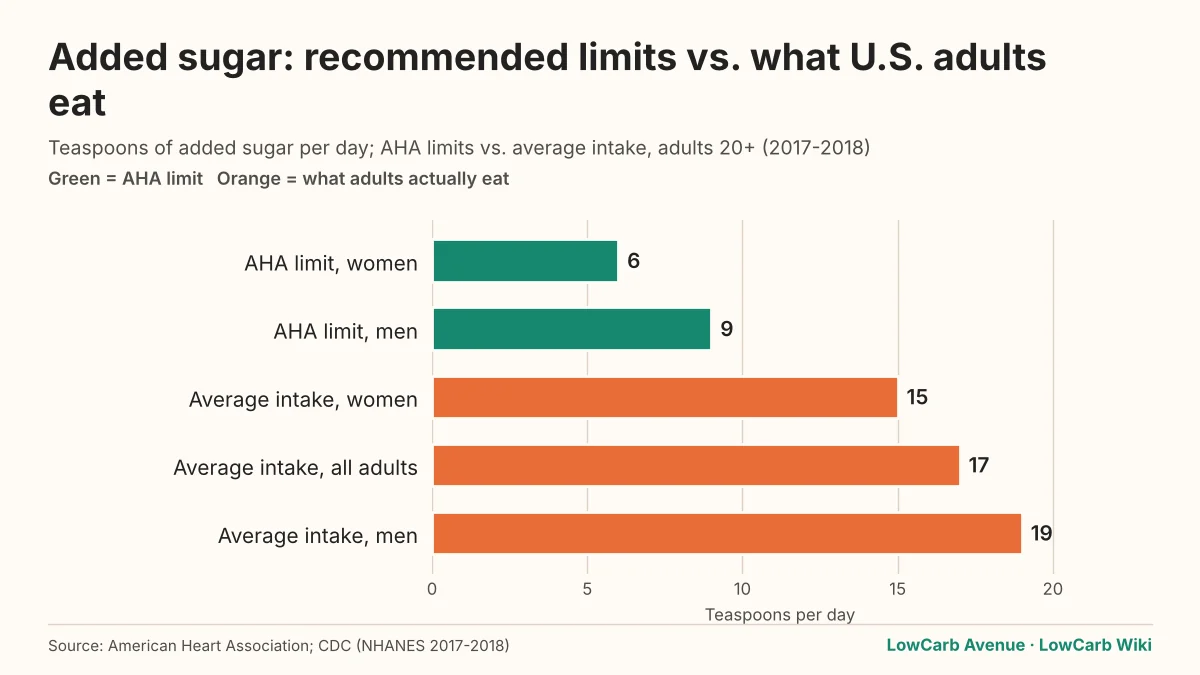
The American Heart Association recommends no more than about 6 teaspoons (25 grams) of added sugar a day for most women and 9 teaspoons (36 grams) for most men [5]. U.S. adults average about 17 teaspoons a day, with men at 19 and women at 15 [3]. That gap is wide, and hidden sugars are a big part of it.
The newest federal advice goes further. The 2025-2030 Dietary Guidelines for Americans say added sugars and nonnutritive sweeteners should be avoided, and if added sugars are eaten, a single meal shouldn’t exceed 10 grams [8]. They also advise that children younger than 11 avoid added sugars entirely [8].
Where hidden sugars turn up most
Some sources are obvious. Others aren’t. The CDC points to sauces and condiments like ketchup, barbecue sauce, pasta sauce, and salad dressing, plus protein bars, flavored yogurt, flavored milks and creamers, granola, instant oatmeal, cereal, and nut butters [4]. Drinks remain the biggest single trap.
| Food or drink | Sugar | About how many teaspoons |
|---|---|---|
| 12-ounce cola | 39 g | Almost 10 |
| 20-ounce soda, lemonade, or sweet tea | About 65 g | 16 |
| Small bowl of a popular breakfast cereal | 18 g | 4.5 |
| One granola bar | 6 g | 1.5 |
Figures are examples from Harvard’s Nutrition Source [6].
Bread deserves a mention, too. Many sandwich loaves list sugar, honey, molasses, or malt among the first few ingredients. Some “keto” breads skip sugar but lean on processed starches and added fibers instead, which is why we wrote a separate guide to added fibers in keto bread.
A quick low-carb shopping checklist
- Scan the first five ingredients. If any sweetener appears there, it’s a major part of the food.
- Count the sweeteners. Two or three different sugar names usually mean more total sugar than any one suggests.
- Check the Added Sugars line and its %DV.
- Look at Total Carbohydrate, not just sugar, to catch maltodextrin and other starches.
- Compare “no sugar added” products with the regular version. They may still contain natural sugars from fruit or milk, which aren’t counted as added [1].
If you have diabetes or take medicine that lowers blood sugar, talk with your doctor or a registered dietitian before making big changes to your carb intake.
Where LowCarb Avenue fits
Reading labels gets easier when the label is short. At LowCarb Avenue, we bake clean-label low-carb and keto bread with fiber and protein in mind, so your everyday toast and sandwiches don’t come with a hidden sugar surprise. Look for Wilbur, our multigrain loaf, Frankie and Elodie, our sourdough options, and Brooklyn Baby bagels. Flip any package over and read the ingredients yourself. Shop LowCarb Avenue breads and bagels.
Frequently asked questions
Does sugar from fruit or milk count as added sugar?
No. Sugars that occur naturally in fruit, vegetables, and milk aren't counted as added sugars. They still count in Total Sugars and Total Carbohydrate, which matters if you're tracking carbs on a low-carb or keto diet.
Is honey healthier than table sugar for a low-carb diet?
Not in any way that helps your carb count. FDA rules treat honey, maple syrup, and agave as added sugars, just like table sugar. On a low-carb plan, they add carbs the same way.
Is maltodextrin a sugar?
Technically it's a starch-based carbohydrate, not a sugar, so it may not appear in Total Sugars on the label. It's still digestible and counts toward Total Carbohydrate, so it isn't a free pass for keto eaters.
How can I tell how much sugar a teaspoon is on a label?
Divide the grams by four. About 4 grams of sugar equals one teaspoon, so 16 grams of added sugar is roughly four teaspoons.
Sources
- Added Sugars on the Nutrition Facts Label.
- 21 CFR 101.9: Nutrition labeling of food.
- Get the Facts: Added Sugars.
- Spotting Hidden Sugars in Everyday Foods.
- How Much Sugar Is Too Much?.
- Added Sugar.
- Use of Caloric and Noncaloric Sweeteners in US Consumer Packaged Foods, 2005-2009 (Ng SW, Slining MM, Popkin BM).
- Dietary Guidelines for 2025-2030: Recommendations From the USDA and HHS.
- Hidden in Plain Sight: At least 61 names for sugar.
- Interactive Nutrition Facts Label: Sugar Alcohols.
- Guidance for Industry: The Declaration of Allulose and Calories from Allulose on Nutrition and Supplement Facts Labels.
This article is for general education and is not medical advice. Talk with your doctor or a registered dietitian before changing your diet, especially if you take medication for diabetes or blood pressure. How we research and write.