High Protein Bread: How Much Protein Is in Bread, and Which Has the Most
Most bread has 3 to 5 g of protein a slice. We compare white, whole wheat, sprouted and keto bread with USDA data, explain FDA "high protein" rules…


TL;DR: A regular slice of bread has 3–5 g of protein. Most keto breads have about 4 g, the same as whole wheat, but only about 2 g of net carbs instead of 12–17 g. Under FDA rules, a bread can say it is a “good source” of protein at 5 g per 50 g of bread and “high” in protein at 10 g. To get the most from a high protein bread, look at protein and net carbs together, then add a protein filling.
Does bread have protein?
Yes, but not much. Wheat flour is mostly starch, and the protein in it is mainly gluten. In USDA data, a 34 g slice of commercial white bread has about 3 g of protein, regular sourdough about 3.7 g and whole wheat about 4.2 g. A slice of sprouted Ezekiel 4:9 bread lists 5 g on its label (USDA FoodData Central).
Those same slices carry 12–17 g of net carbs. So for every gram of protein, regular bread gives you three to five grams of digestible carbohydrate. That ratio is what a high protein low carb bread tries to change.
What counts as “high protein” bread?
The FDA sets the Daily Value for protein at 50 g for adults and children 4 and older (FDA). Nutrient content claims are tied to that number and measured per reference amount, which for bread is 50 g, or about one and a half typical slices (21 CFR 101.54; 21 CFR 101.12):
- “Good source of protein”: 10–19% of the Daily Value per 50 g of bread, or 5–9 g.
- “High protein” or “excellent source”: 20% of the Daily Value or more per 50 g, or at least 10 g.
There is a catch. When a label makes a protein claim, the %DV has to be adjusted for protein quality. Wheat protein is low in the amino acid lysine, so a bread made mostly with wheat protein may need more grams to make the same claim. Words like “protein bread” or “made with protein” have no legal threshold at all, so always read the numbers.
High protein bread compared with regular bread
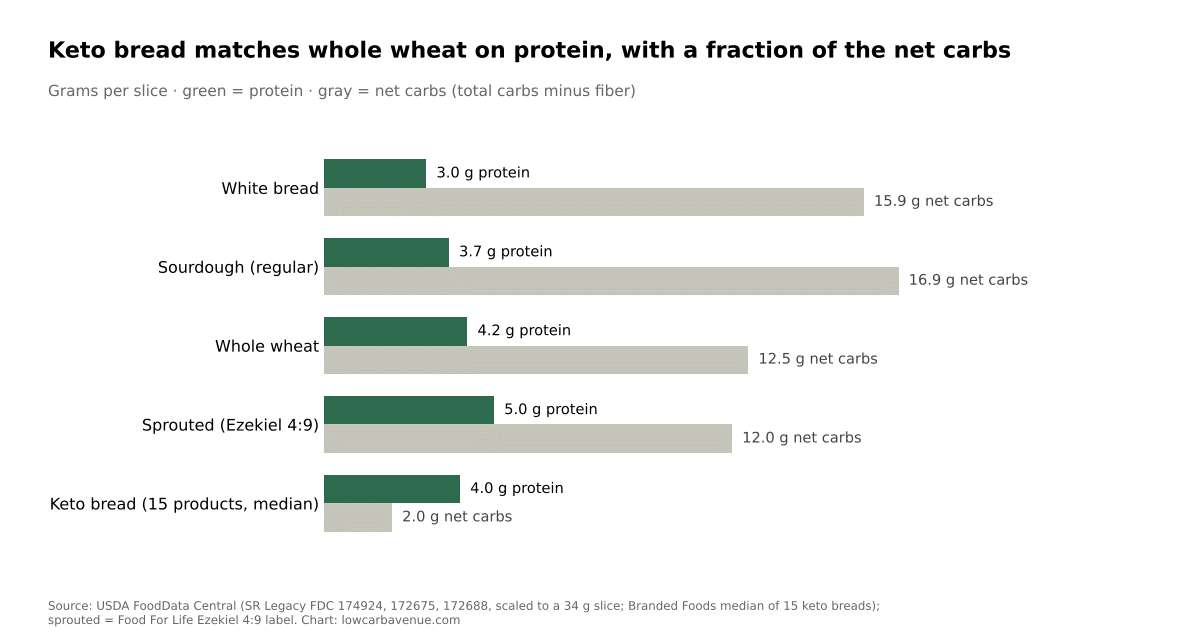
Across 15 keto breads in USDA’s branded database, the median slice has 4 g of protein (range 3–13 g) and 2 g of net carbs (range 0–4 g). On protein alone, most keto breads are in the same range as whole wheat. Where they stand apart is the carbs: you get the same protein for a fraction of the net carbs.
Only one of the 15 products lists 10 g or more of protein per serving. So if protein is your main goal, compare labels rather than relying on the word “keto.”
How bakers raise the protein in bread
- Wheat protein (vital wheat gluten): about 75 g of protein per 100 g in USDA data (FDC 168147). It gives low carb dough its stretch and lifts the protein count.
- Seeds: flax, sunflower, pumpkin and sesame add protein, fat and fiber.
- Nut flours: almond flour adds protein and fat with few net carbs.
- Egg whites or whey: common in very high protein loaves; they also change the texture.
- Legume flours: chickpea, pea or lupin flour add protein, though some (like chickpea) also add carbs.
The trade-off is texture. The more protein a loaf has, the denser and chewier it tends to be, which is why most keto breads stay in the 4–6 g range and use fiber for bulk.
How much protein do you need in a day?
The Recommended Dietary Allowance for adults is 0.8 g of protein per kilogram of body weight per day, or about 56 g for a 70 kg (154 lb) person (National Academies, Dietary Reference Intakes). For adults over 65, the PROT-AGE Study Group recommended at least 1.0–1.2 g per kilogram per day (Bauer et al., 2013).
When you eat protein matters too. In a small controlled study, healthy adults who spread about 30 g of protein across each of their three meals had 25% higher 24-hour muscle protein synthesis than when most of the same protein came at dinner (Mamerow et al., 2014). Breakfast is often the lowest-protein meal of the day, which is where bread comes in.
Protein is also linked with fullness. A 2015 review in the American Journal of Clinical Nutrition found that higher-protein diets tended to increase satiety compared with lower-protein diets (Leidy et al., 2015).
Building a higher protein sandwich
Bread alone will not get you to 30 g at a meal, but it can do part of the work without adding many carbs. A rough guide using USDA values and typical labels:
| Breakfast | Protein | Net carbs |
|---|---|---|
| 2 slices white bread + 2 large eggs | about 18.6 g | about 32.5 g |
| 2 slices typical keto bread + 2 large eggs | about 20.6 g | about 4.7 g |
| 2 slices typical keto bread + 3 large eggs | about 26.9 g | about 5.1 g |
A large egg (50 g) has about 6.3 g of protein and 0.4 g of carbs in USDA data (FDC 171287). Add cheese, smoked salmon or turkey to close the gap to 30 g.
How to choose a high protein bread
- Protein per slice: 5 g or more per slice is a solid amount. For label claims, FDA counts per 50 g of bread: 5 g is a “good source” and 10 g is “high.”
- Net carbs per slice: 5 g or less for keto. Compare protein to net carbs: 2 g of protein per gram of net carb or better is a strong ratio.
- Slice weight: compare grams per serving, since a thick slice will always look better.
- Fiber: 3 g or more per slice.
- Ingredients: wheat protein, seeds, eggs or whey are all normal. Skip added sugar.
- Texture: try a loaf toasted before you buy in bulk. Very high protein breads can be dry.
For more on reading keto bread labels, see is keto bread healthy and our ranking of the best low carb bread options.
Frequently Asked Questions
Yes. A typical slice of white, sourdough or whole wheat bread has about 3–4 g of protein, mostly from wheat gluten, along with 12–17 g of net carbs.
Breads made with added wheat protein, egg whites or whey have the most. In USDA’s branded database, one keto bread lists 13 g per serving, but most keto breads have 3–6 g per slice.
Not always. Some high protein breads are made with regular flour and still have 15 g or more of net carbs. Check both protein and net carbs on the label.
About 4.2 g in a 34 g slice, with about 12.5 g of net carbs, based on USDA data.
Under FDA rules, it means 10–19% of the 50 g Daily Value, or about 5–9 g of protein, in each 50 g of bread, adjusted for protein quality.
Protein and fiber in every slice
LowCarb Avenue is a physician-founded low carb bread bakery in Frederick, Maryland. We bake clean-label low carb and keto bread with high-fiber wheat flour, wheat protein, sourdough starter, olive oil and sea salt, and no sugar or sugar alcohols. Our Frankie sourdough has 6 g of protein and 3 g of net carbs per serving, per our product label. Shop our low carb sourdough breads or browse everything at lowcarbavenue.com.
General information only, not medical advice.
Sources
- USDA FoodData Central, SR Legacy, accessed October 20, 2026: Bread, white, commercially prepared (FDC 174924); Bread, french or vienna (includes sourdough) (172675); Bread, whole-wheat, commercially prepared (172688); Vital wheat gluten (168147); Egg, whole, raw, fresh (171287). Values scaled to a 34 g slice or 50 g egg. fdc.nal.usda.gov
- USDA FoodData Central, Branded Foods: 15 keto bread products (FDC 2593382, 2382864, 2423198, 2462647, 2486455, 2484531, 2609111, 2554433, 2675911, 2425906, 2448843, 2448854, 2546901, 2469097, 2654842). Per-serving label values.
- Food For Life Ezekiel 4:9 Sprouted Whole Grain Bread label, 1 slice (34 g).
- U.S. Food and Drug Administration. Daily Value on the Nutrition and Supplement Facts Labels. fda.gov
- Code of Federal Regulations, 21 CFR 101.54, Nutrient content claims for “good source,” “high,” “more,” and “high potency”; 21 CFR 101.12, Reference amounts customarily consumed (bread: 50 g). ecfr.gov
- Institute of Medicine. Dietary Reference Intakes for Energy, Carbohydrate, Fiber, Fat, Fatty Acids, Cholesterol, Protein, and Amino Acids. National Academies Press; 2005. nap.edu/10490
- Bauer J, Biolo G, Cederholm T, et al. Evidence-based recommendations for optimal dietary protein intake in older people: a position paper from the PROT-AGE Study Group. J Am Med Dir Assoc. 2013;14(8):542–559. PMID 23867520
- Mamerow MM, Mettler JA, English KL, et al. Dietary protein distribution positively influences 24-h muscle protein synthesis in healthy adults. J Nutr. 2014;144(6):876–880. PMC4018950
- Leidy HJ, Clifton PM, Astrup A, et al. The role of protein in weight loss and maintenance. Am J Clin Nutr. 2015;101(6):1320S–1329S. PMID 25926512