
How to Build a Satisfying Low-Carb Sandwich (with Carb Counts)
In a typical sandwich, almost all the carbs come from the bread or wrap, not the fillings. Swap the base, build around protein and vegetables, and go easy on sweet sauces, and you can keep a satisfying sandwich well inside a low-carb budget.
Where the carbs in a sandwich actually come from
It helps to see the numbers side by side. The table below uses USDA FoodData Central values for common sandwich parts, scaled to everyday portion sizes. Net carbs here are simply total carbohydrate minus fiber. (Our guide to net carbs explains when that math holds up and when it doesn’t.)
| Component | Portion | Total carbs (g) | Fiber (g) | Net carbs (g) |
|---|---|---|---|---|
| Flour tortilla | 70 g | 34.6 | 2.4 | 32.1 |
| White bread | 2 slices, 28 g each | 27.7 | 1.5 | 26.2 |
| Whole-wheat bread | 2 slices, 32 g each | 27.3 | 3.8 | 23.5 |
| Ketchup | 17 g (about 1 tbsp) | 4.7 | 0.1 | 4.6 |
| Avocado | 50 g | 4.3 | 3.4 | 0.9 |
| Sliced deli turkey breast | 85 g (3 oz) | 1.9 | 0 | 1.9 |
| Tomato, sliced | 40 g | 1.6 | 0.5 | 1.1 |
| Cheddar cheese | 28 g (1 oz) | 1.0 | 0 | 1.0 |
| Romaine lettuce | 20 g | 0.7 | 0.4 | 0.2 |
| Yellow mustard | 5 g (about 1 tsp) | 0.3 | 0.2 | 0.1 |
| Mayonnaise | 14 g (about 1 tbsp) | 0.1 | 0 | 0.1 |
Values are calculated from USDA per-100-gram data for breads and tortillas [1], meat and cheese [2], vegetables and avocado [3], and condiments [4]. Brands vary, so your package label is always the final word.
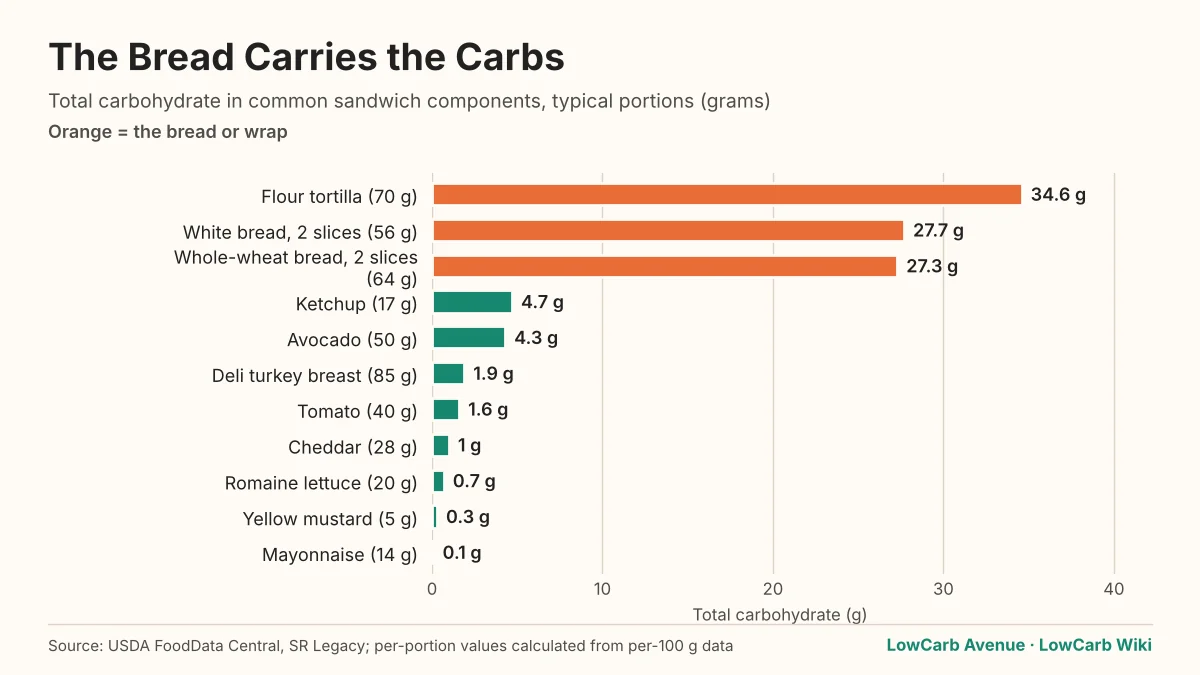
The pattern is hard to miss. Two slices of ordinary bread carry more carbs than everything else in a loaded sandwich combined. The CDC counts about 15 grams of carbohydrate as one carb serving [5], so two slices of white bread add up to nearly two servings before you’ve added a single filling.
Step 1: Rethink the base
Since the bread is where the carbs live, that’s where your choices make the biggest difference. Here are the most common low-carb approaches:
- Go open-faced. Using one slice instead of two cuts the bread carbs in half. One 28-gram slice of white bread has about 13.8 grams of carbs [1].
- Use a lettuce wrap. Large romaine or butter lettuce leaves hold fillings surprisingly well. Forty grams of romaine has about 1.3 grams of total carbs, most of it fiber [3].
- Choose a purpose-made low-carb bread. These breads usually replace much of the flour with ingredients higher in fiber and protein. Read the label carefully, because the fibers used can vary a lot. Our article on added fibers in keto bread covers what to look for.
- Don’t assume a wrap is lighter. A 70-gram flour tortilla carries more carbs than two slices of white bread [1].
Whole-wheat bread is a step up in fiber, but its total carbs are about the same as white bread at a typical portion [1]. It’s a better choice for fiber, not a low-carb one.
Step 2: Build around protein
Protein is what makes a sandwich feel like a meal. Plain sliced turkey breast, roast chicken, tuna, egg salad, roast beef, and cheese are all naturally low in carbs. Three ounces of sliced turkey breast has under 2 grams of carbs, and an ounce of cheddar has about 1 gram [2].
Two things are worth checking on the label:
- Added sugars. Honey-glazed, maple, and some smoked deli meats can include sugar. The FDA’s Daily Value for added sugars is 50 grams a day [6], and small amounts in deli meat add up if you eat it often.
- How often you eat processed meat. The World Health Organization’s cancer agency classifies processed meat as carcinogenic to humans. Its review estimated that each 50-gram portion eaten daily raises colorectal cancer risk by about 18% [7]. That’s a statement about the strength of evidence, not a reason to panic, but it’s a good argument for rotating in leftover roast chicken, eggs, or canned fish.
For more on hitting your protein needs without overdoing it, see how much protein you need on a low-carb diet.
Step 3: Add crunch and volume with vegetables
Non-starchy vegetables make a low-carb sandwich feel generous. Lettuce, tomato, cucumber, sprouts, peppers, pickles, and thinly sliced onion add texture and flavor for very few carbs. A couple of tomato slices (40 grams) have about 1.6 grams of total carbs [3].
Avocado is a standout. Fifty grams has 4.3 grams of total carbs, but 3.4 grams of that is fiber, leaving under 1 gram of net carbs [3]. It also brings healthy fat, which helps a smaller sandwich keep you full.
Vegetables are also an easy way to work toward the FDA’s Daily Value of 28 grams of fiber [6], something many low-carb eaters struggle with. Our guide to fiber on a low-carb diet has more ideas.
Step 4: Choose spreads and sauces carefully
Condiments are where hidden sugar sneaks in. Mayonnaise and yellow mustard barely register, at about 0.1 grams of net carbs each per typical serving [4]. Ketchup is a different story: one tablespoon has about 4.7 grams of carbs, and about 3.6 grams of that is sugar [4].
Sweet sauces such as honey mustard, barbecue sauce, and some “special” sandwich spreads tend to follow ketchup’s pattern. Check the Nutrition Facts panel, or swap in mayo, mustard, pesto, olive oil and vinegar, or mashed avocado. If you’re not sure what sugar looks like on an ingredient list, our list of hidden sugar names helps.
Don’t forget about sodium
Carbs aren’t the only thing to watch. A CDC analysis of U.S. eating habits found that bread and rolls were the single biggest source of sodium in the American diet (7.4% of intake), cold cuts and cured meats were second (5.1%), and sandwiches ranked sixth (4.0%) [8]. Stack those together and one sandwich can carry a large share of the FDA’s 2,300-milligram Daily Value for sodium [6].
Low-sodium deli meat, home-cooked chicken, fresh vegetables, and fewer salty extras like pickles and bacon can bring that number down.
Putting it together: three sample builds
Here’s how the same basic fillings (85 g turkey, 1 oz cheddar, 40 g tomato) add up on different bases, using the USDA values above [1][2][3][4]:
- Classic on two slices of white bread with 20 g romaine and mayo: about 32.8 g total carbs, 30.4 g net carbs.
- Open-faced on one slice with the same toppings: about 19.0 g total carbs, 17.3 g net carbs.
- Lettuce wrap using 40 g romaine leaves, with avocado and mustard instead of mayo: about 10.3 g total carbs, 5.4 g net carbs.
Same flavors, very different carb counts. The fillings barely change; the base does almost all the work.
If you’re managing diabetes, the American Diabetes Association’s 2019 consensus report found that reducing overall carbohydrate intake has the most evidence for improving blood sugar [9]. Still, talk with your doctor or a registered dietitian before making big changes, especially if you take insulin or other diabetes or blood-pressure medication.
Where LowCarb Avenue fits
Sometimes a lettuce wrap just isn’t the same as real bread. That’s why LowCarb Avenue bakes clean-label low-carb and keto bread designed around fiber and protein. Elodie, our sourdough sandwich loaf, is made for exactly this kind of lunch. Frankie (sourdough) and Wilbur (multigrain) work well for open-faced builds, and Brooklyn Baby bagels make a great breakfast sandwich. Check each label for the numbers that fit your plan. Shop LowCarb Avenue breads.
Frequently asked questions
How many carbs are in a typical sandwich?
Using USDA values, a turkey and cheddar sandwich on two slices of white bread with lettuce, tomato, and mayo comes to about 33 grams of total carbs. Roughly 28 grams of that comes from the bread.
Is a wrap lower in carbs than bread?
Not usually. A 70-gram flour tortilla has about 34.6 grams of carbs according to USDA data, which is more than two 28-gram slices of white bread. Low-carb tortillas or lettuce wraps are different, so check the label.
What can I use instead of bread for a low-carb sandwich?
Popular options include large lettuce leaves, a single slice for an open-faced sandwich, purpose-made low-carb bread, or sliced cucumber or bell pepper as a base. Each one cuts carbs compared with two slices of regular bread.
Which condiments are lowest in carbs?
Mayonnaise and yellow mustard have almost no carbs in a typical serving. Pesto, olive oil, and vinegar are also good choices. Ketchup, honey mustard, and barbecue sauce usually contain added sugar, so check the label.
Is deli meat okay on a low-carb diet?
Plain deli meats are very low in carbs, but some flavors include sugar. They're also processed meats, which the WHO's cancer agency links to higher colorectal cancer risk, so many people mix in fresh-cooked chicken, eggs, or fish.
Sources
- FoodData Central, SR Legacy: Bread, white, commercially prepared [FDC 174924]; Bread, whole-wheat, commercially prepared [FDC 172688]; Tortillas, ready-to-bake or -fry, flour, refrigerated [FDC 175037].
- FoodData Central, SR Legacy: Turkey breast, sliced, prepackaged [FDC 172941]; Cheese, cheddar [FDC 173414].
- FoodData Central, SR Legacy: Lettuce, cos or romaine, raw [FDC 169247]; Tomatoes, red, ripe, raw, year round average [FDC 170457]; Avocados, raw, California [FDC 171706].
- FoodData Central, SR Legacy: Salad dressing, mayonnaise, regular [FDC 171009]; Mustard, prepared, yellow [FDC 172234]; Catsup [FDC 168556].
- Carb Counting.
- Daily Value on the Nutrition and Supplement Facts Labels.
- Q&A on the carcinogenicity of the consumption of red meat and processed meat (IARC Monographs Vol. 114).
- Vital Signs: Food Categories Contributing the Most to Sodium Consumption, United States, 2007-2008.
- Nutrition Therapy for Adults With Diabetes or Prediabetes: A Consensus Report.
This article is for general education and is not medical advice. Talk with your doctor or a registered dietitian before changing your diet, especially if you take medication for diabetes or blood pressure. How we research and write.