
How Much Protein Do You Need on a Low-Carb Diet?
Most adults need at least 0.8 grams of protein per kilogram of body weight each day, which works out to about 0.36 grams per pound [1]. Many people on a low-carb diet, especially adults over 65, active people, and anyone trying to lose weight, may do better somewhere between 1.0 and 1.6 grams per kilogram, spread across their meals [3][5][7].
The baseline: what the RDA actually means
The Recommended Dietary Allowance (RDA) for protein is 0.8 g per kilogram of body weight per day [1][2]. It’s a useful starting point, but it’s worth knowing what it was built to do. Harvard Health describes the RDA as the minimum amount you need to avoid getting sick, not the amount that’s ideal for every body and every goal [1].
To find your RDA, multiply your weight in pounds by 0.36. A 140-pound person lands at roughly 50 grams a day, and a 200-pound person at about 70 grams [2]. For reference, the Daily Value used on U.S. Nutrition Facts labels is 50 grams [9], so a food listing “20% DV” for protein has about 10 grams.
The National Academies also set a broad acceptable range: protein can supply anywhere from 10% to 35% of your daily calories [2]. That’s a wide window, and most low-carb eating patterns fall comfortably inside it.
Who may need more than the minimum
Adults over 65
Muscle gets harder to build and keep as we age. An international expert group known as PROT-AGE reviewed the evidence and recommended that people over 65 average at least 1.0 to 1.2 g of protein per kilogram per day to help maintain muscle and function [3]. For older adults who exercise, they suggested at least 1.2 g/kg, and for those with an acute or chronic illness, 1.2 to 1.5 g/kg [3].
There’s an important exception. The same group noted that people with severe kidney disease who aren’t on dialysis may need to limit protein instead [3]. If you have kidney disease, your protein target should come from your care team, not from an article.
People losing weight
Many people start low-carb eating to lose weight. A review in the American Journal of Clinical Nutrition found that higher-protein diets, roughly 1.2 to 1.6 g/kg per day with at least about 25 to 30 grams per meal, may help with appetite and weight management [5]. In shorter, well-controlled studies, people eating more protein while cutting calories lost more fat and held on to more lean tissue than people eating less [5]. The authors were honest that long-term results are mixed, and that sticking with the diet seems to matter most [5].
People who lift weights
If you do strength training, protein helps you get more from your workouts. A large meta-analysis pooling 49 studies and 1,863 participants found that gains in lean mass from resistance training tended to level off at about 1.62 g/kg per day [6]. The statistical range around that number was wide, from about 1.03 to 2.20 g/kg [6], so treat it as a reasonable ceiling for most people rather than a precise magic number.
What the newest federal guidelines say
The 2025-2030 Dietary Guidelines for Americans, released in January 2026, put protein front and center. They encourage including protein at every meal, aiming for 1.2 to 1.6 g per kilogram of body weight daily [7]. A university extension summary notes that the RDA itself is still 0.8 g/kg and that the higher range reflects emerging evidence for groups like older adults and physically active people [8].
How the numbers compare for a 150-pound adult
Grams per kilogram can feel abstract, so here’s what each benchmark looks like for one person. A 150-pound adult weighs about 68 kilograms.
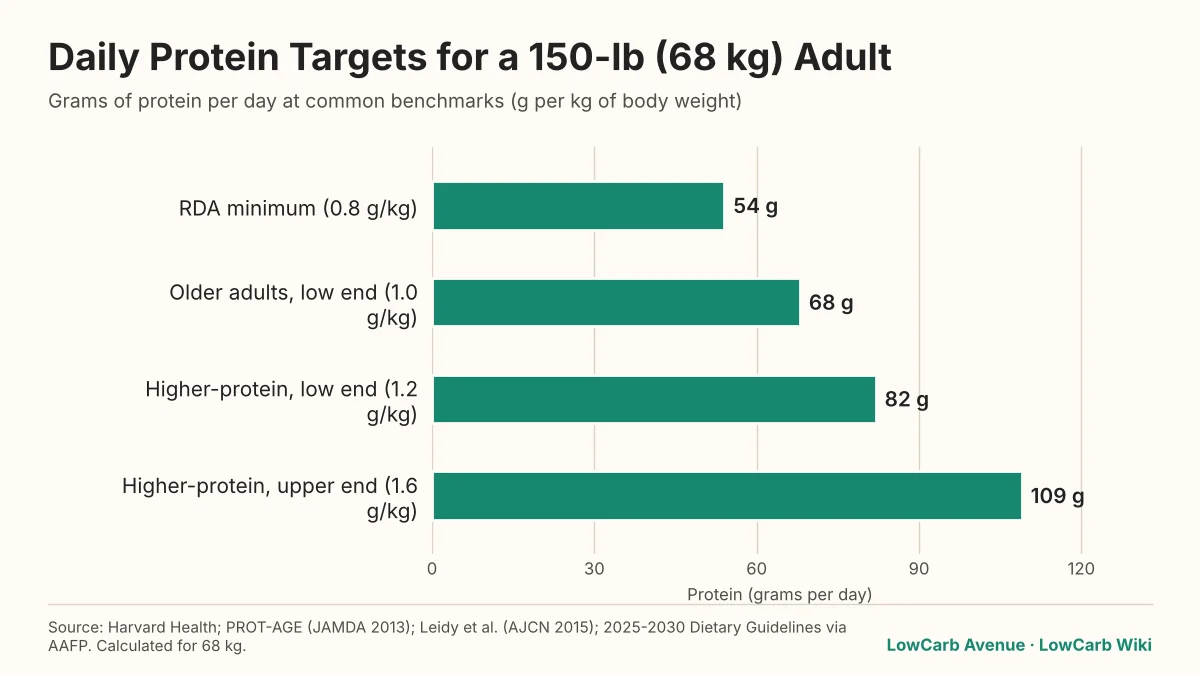
As you can see, the gap between the minimum and the higher targets is real: roughly 54 grams a day at the RDA versus about 82 to 109 grams at 1.2 to 1.6 g/kg [1][3][7]. That difference is about one or two extra palm-sized portions of fish, poultry, or meat a day.
Spread it out: protein per meal
When you eat protein matters, too. Research on muscle building suggests that about 25 to 30 grams of protein at a meal gives muscle-building signals a strong boost in both younger and older adults [4]. In older adults, meals with less than about 20 grams seem to produce a weaker response [4].
A lot of people eat a light breakfast, a modest lunch, and most of their protein at dinner. Shifting some of that protein earlier in the day is an easy change. On a low-carb plan, that might look like eggs with smoked salmon in the morning, a big salad topped with chicken at lunch, and fish or steak with vegetables at dinner.
Protein in common low-carb foods
Here are a few protein amounts from Harvard’s Nutrition Source to help you plan [2]:
| Food | Portion | Protein |
|---|---|---|
| Broiled sirloin steak | 4 oz | 33 g |
| Grilled sockeye salmon | 4 oz | 30 g |
| Chicken thigh, skinless | 4 oz | 28 g |
| Ham steak | 4 oz | 22 g |
| Lentils, cooked | 1 cup | 18 g |
| Milk | 8 oz | 8 g |
| Almonds, dry-roasted | 1 oz | 6 g |
A 4-ounce portion of most meats or fish gets you close to that 25 to 30 gram per-meal mark on its own. Lentils are a solid plant protein, but they’re also fairly high in carbs, so people on strict keto usually keep portions small. Milk carries natural sugar as well, which is worth counting if you track net carbs.
Quality matters as much as quantity
On a low-carb diet, it’s easy to lean heavily on red and processed meats. Harvard’s review of the research points out that the “package” protein comes in makes a difference [2]. Processed red meat in particular has been linked to higher risks of heart disease and type 2 diabetes in large observational studies, while fish, poultry, nuts, and legumes are tied to lower risk [2]. Those studies show associations rather than proof of cause, but they’re a good reason to rotate your protein sources.
Some simple swaps that keep carbs low:
- Choose fish or poultry a few times a week instead of bacon or deli meat.
- Use eggs, Greek yogurt, or cottage cheese for quick breakfasts (check the label for added sugar; our guide to hidden sugars can help).
- Snack on nuts and seeds, which add fiber along with protein.
- Try tofu or tempeh if you want a low-carb plant option.
Does protein knock you out of ketosis?
This is a common worry on keto. Your body can turn some protein into glucose, so very large amounts could, in theory, nudge blood sugar or ketone levels. In practice, most people do fine eating moderate portions at each meal rather than fearing protein. If you’re following a strict ketogenic plan for a specific reason, or you’re comparing keto vs. low-carb approaches, a registered dietitian can help you find a target that fits.
A quick way to set your own target
- Convert your weight to kilograms (pounds divided by 2.2).
- Multiply by 0.8 for the minimum [1].
- If you’re over 65, active, or losing weight, consider a range of 1.0 to 1.6 instead [3][5][7].
- Divide the total across your meals, aiming for roughly 25 to 30 grams at each one [4].
If you have kidney disease, diabetes, or take medications that affect blood sugar or blood pressure, talk with your doctor or a registered dietitian before changing how much protein you eat.
Where LowCarb Avenue fits
Hitting a protein goal is easier when your meals are built around it, and a sandwich is one of the simplest ways to get there. At LowCarb Avenue, we bake clean-label low-carb and keto bread with fiber and protein built in, so the bread does part of the work instead of just holding the fillings. Try Wilbur, our multigrain loaf, Frankie or Elodie sourdough for a turkey-and-avocado sandwich, or a Brooklyn Baby bagel with eggs and smoked salmon. Browse the full lineup at lowcarbavenue.com/shop.
Frequently asked questions
How much protein should I eat a day on keto?
Start with the RDA of 0.8 g per kilogram of body weight as a minimum. Many people on keto or low-carb diets, especially older adults, active people, and those losing weight, aim for about 1.0 to 1.6 g/kg. A dietitian can help you pick a number that fits your health and goals.
Can eating too much protein kick me out of ketosis?
Your body can convert some protein to glucose, but moderate portions at each meal are unlikely to be a problem for most people. Very large amounts could make a difference for someone following a strict therapeutic ketogenic diet, which should be supervised by a professional.
How much protein should I eat per meal?
Research on muscle protein synthesis suggests about 25 to 30 grams per meal gives a strong response in both younger and older adults. A 4-ounce serving of steak, salmon, or chicken provides roughly 28 to 33 grams.
Do older adults need more protein?
The PROT-AGE expert group recommends that adults over 65 average at least 1.0 to 1.2 g/kg per day, and more if they're active or ill. People with severe kidney disease are an exception and should follow their doctor's advice.
Is a high-protein diet safe for my kidneys?
For people with healthy kidneys, intakes within the ranges discussed here are commonly recommended by expert groups. If you have chronic kidney disease, protein needs are very different, so talk with your nephrologist or a renal dietitian before increasing protein.
Sources
- How much protein do you need every day?.
- Protein.
- Evidence-based recommendations for optimal dietary protein intake in older people: a position paper from the PROT-AGE Study Group (Bauer J, et al.). Journal of the American Medical Directors Association 14(8):542-559.
- Dietary protein recommendations and the prevention of sarcopenia (Paddon-Jones D, Rasmussen BB). Current Opinion in Clinical Nutrition and Metabolic Care 12(1):86-90.
- The role of protein in weight loss and maintenance (Leidy HJ, et al.). American Journal of Clinical Nutrition.
- A systematic review, meta-analysis and meta-regression of the effect of protein supplementation on resistance training-induced gains in muscle mass and strength in healthy adults (Morton RW, et al.). British Journal of Sports Medicine.
- Dietary Guidelines for 2025-2030: Recommendations From the USDA and HHS.
- The New Dietary Guidelines for Americans 2025-2030.
- Daily Value on the Nutrition and Supplement Facts Labels.
This article is for general education and is not medical advice. Talk with your doctor or a registered dietitian before changing your diet, especially if you take medication for diabetes or blood pressure. How we research and write.