
Sourdough and Blood Sugar: What the Research Says
Sourdough might soften the blood sugar rise from bread a little for some people, but the research is small, mixed, and far from settled. It’s still a starchy, high-carb bread, so it isn’t a free pass for anyone watching their glucose or following a low-carb or keto plan.
Why sourdough has a “better for blood sugar” reputation
Traditional sourdough rises with a starter, a living mix of wild yeasts and lactic acid bacteria, instead of just commercial baker’s yeast. During a long fermentation, those bacteria make organic acids such as lactic and acetic acid. That’s where the tang comes from.
The idea is that these acids, along with changes to the starch and protein during fermentation, slow how quickly the bread is digested. A 2017 review in the British Journal of Nutrition looked at how different bread-making methods affect the body’s response after eating. It concluded that sourdough fermentation can shift the glucose response, while the effect on insulin was less clear, and that the exact mechanism still hasn’t been confirmed [1]. The same review noted that other baking choices, like proofing time and how the bread is cooked or frozen, can also change the glucose response [1].
So the theory is reasonable. The real question is how well it holds up when people actually eat the bread.
What the human studies actually show
The big picture: a lot of variation
The largest look at the evidence so far is a 2023 systematic review in Advances in Nutrition. Researchers searched for randomized controlled trials in adults that compared sourdough bread with yeast-leavened bread. They found 25 trials that met their criteria, with 542 participants in total. Fifteen of those trials measured blood glucose response [2].
Their conclusion was cautious. Because starter microbes, fermentation conditions, and flour types differed so much from study to study, the authors said it was difficult to reach a clear consensus on sourdough’s benefits. Some trials that used specific strains and conditions did report better glycemic responses, but the authors said sourdough needs more standardization before its clinical benefits can be confirmed [2].
Studies that found a benefit
A Canadian crossover study gave 10 overweight or obese men four different breads, each portion containing 50 grams of available carbohydrate. The overall glucose response after the sourdough was lower than after regular white bread. There was no meaningful difference in insulin response between the breads, though [3].
A Finnish study of 11 people with insulin resistance tested several wholemeal wheat breads against a white wheat reference, again at 50 grams of available carbohydrate. The wholemeal sourdough version produced the lowest glucose and insulin responses of the breads tested [4]. That’s an encouraging result, but it combines two factors (whole grain flour and sourdough), and the group was small.
Studies that didn’t
A follow-up study from the same Canadian research group tested sourdough white bread against white bread and several whole-grain and sprouted-grain breads in overweight and obese men. When portions were matched for carbohydrate, sourdough raised glucose more than the sprouted-grain and 12-grain breads. When the breads were served as the same weight portion, sourdough produced a larger glucose response than all the other breads, white bread included, largely because each portion carried more available carbohydrate [5].
A well-known 2017 trial in Cell Metabolism had 20 healthy adults eat either industrial white bread or artisanal whole-grain sourdough for a week, then switch. Researchers found no significant difference between the breads on the main glycemic measures or on 18 other clinical markers. What stood out was how personal the response was: 10 of the 20 people had a higher blood sugar response to the sourdough than to the white bread [6].
| Study | Who took part | Main result for sourdough |
|---|---|---|
| Najjar et al. [3] | 10 overweight or obese men | Lower overall glucose than white bread; no insulin difference |
| Lappi et al. [4] | 11 adults with insulin resistance | Wholemeal sourdough gave the lowest glucose and insulin responses |
| Mofidi et al. [5] | Overweight or obese men (12 and 11) | No advantage; higher glucose than several whole-grain breads |
| Korem et al. [6] | 20 healthy adults | No average difference vs. white bread; half responded worse to sourdough |
Why the results don’t line up
When studies disagree this much, it usually means the “thing” being tested isn’t the same from one study to the next. That’s true here.
- Every starter is different. The mix of yeasts and bacteria, fermentation time, and temperature all change how acidic the bread gets and what happens to the starch [2].
- Flour matters. A sourdough made from whole grain flour isn’t the same food as one made from refined white flour, and some trials mix the two effects together [4].
- Portion design matters. Matching breads by carbohydrate gives different answers than matching them by weight [5].
- People differ. In the Cell Metabolism trial, gut bacteria measured before the study helped predict which bread gave each person the lower response [6].
- Lab results aren’t the same as people. A 2023 critical review in Frontiers in Nutrition pointed out that many claimed sourdough benefits rely mostly on chemical and in vitro (test tube) data, which raises questions about how much they matter in real diets [7].
You’ll also notice the studies are short. Most measured blood sugar for a few hours after one meal. That tells us little about long-term outcomes like A1C, weight, or heart health.
The part that doesn’t change: it’s still bread
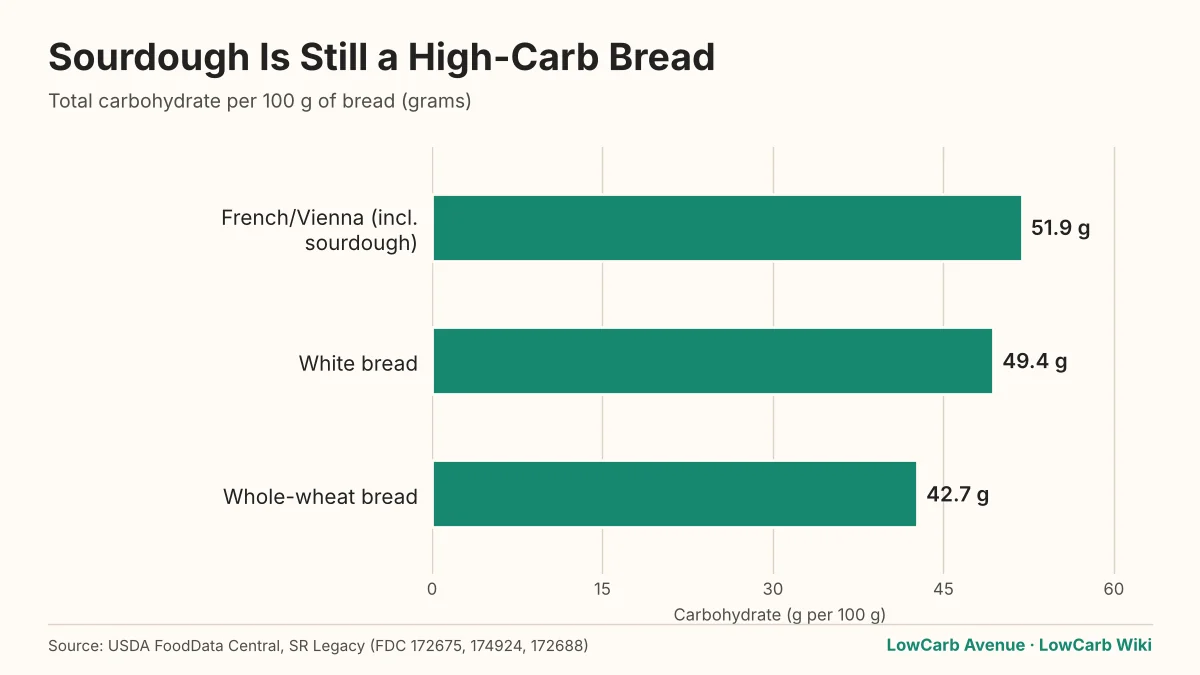
Fermentation doesn’t remove most of the starch. According to USDA FoodData Central, French or Vienna bread (a category that includes sourdough) has 51.9 grams of carbohydrate per 100 grams, with 2.2 grams of fiber. Commercial white bread has 49.4 grams, and commercial whole-wheat bread has 42.7 grams [8].
The CDC explains that sugars and starches raise blood sugar while fiber doesn’t, and that about 15 grams of carbohydrate counts as one carb serving [9]. By that measure, 100 grams of sourdough-style bread works out to roughly three and a half carb servings. Subtract the fiber and you get about 49.7 grams of net carbs, which is far more than most keto plans allow in a whole day.
That’s why the glycemic response question, while interesting, is a smaller issue for low-carb eaters than the total carb count. A slower rise from a big load of starch is still a rise. If you want to understand how the speed and the size of that rise fit together, our guide to glycemic index vs. glycemic load walks through it.
If you still want sourdough, a few practical ideas
None of this means you can never eat a slice of traditional sourdough. It just means treating it like any other bread.
- Mind the portion. A thin slice is a very different carb load than a thick slice from a big round loaf.
- Don’t eat it alone. Pair it with protein, healthy fat, and non-starchy vegetables, the way you would in a low-carb sandwich.
- Look at the label. “Sourdough” on a package doesn’t always mean a long fermentation, and the carb and fiber numbers vary by brand.
- Learn your own response. Since reactions to bread can be so personal [6], people who already check their glucose may find their own readings more useful than any general rule.
It’s also worth remembering the bigger picture. The American Diabetes Association’s 2019 nutrition consensus report found that reducing overall carbohydrate intake has the most evidence for improving blood sugar, and that this approach can fit many eating styles [10]. Swapping one high-carb bread for another doesn’t do much on that front.
Talk with your doctor or a registered dietitian before changing your diet, especially if you take insulin or other diabetes or blood-pressure medication, since cutting carbs can change how those medicines work.
Where LowCarb Avenue fits
If you love the tang and chew of sourdough but want a low-carb bread that fits a keto or low-carb plan, that’s the gap LowCarb Avenue set out to fill. Our Frankie sourdough and Elodie sourdough sandwich loaves are made with clean-label ingredients and built around fiber and protein instead of refined flour. Wilbur, our multigrain, and Brooklyn Baby bagels round out the lineup. As with any bread, check the label for the numbers that matter to you. Browse the LowCarb Avenue shop.
Frequently asked questions
Is sourdough bread low carb?
No. Traditional sourdough is made from wheat flour and is about as starchy as other breads. USDA FoodData Central lists 51.9 grams of carbohydrate per 100 grams for French or Vienna bread, a category that includes sourdough.
Does sourdough raise blood sugar less than white bread?
Sometimes, in some people, under some conditions. A few small studies found a lower glucose response, while others found no difference or a higher one. A 2023 systematic review said the results are too varied to draw firm conclusions yet.
Is sourdough a good choice for people with diabetes?
The research doesn't support calling sourdough a diabetes-friendly bread. It's still a significant source of carbohydrate. Anyone managing diabetes should work out bread choices and portions with their doctor or a registered dietitian.
Does a longer fermentation lower the carbs in sourdough?
Fermentation changes the bread's acidity and starch structure, but published nutrient data show sourdough-style bread still carries roughly as many carbs as white bread. The fermentation mainly affects texture, flavor, and possibly digestion speed, not the total carb count.
Can I eat sourdough on a keto diet?
A regular slice of traditional sourdough can use up most or all of a typical keto day's carb budget. Most people following keto choose a purpose-made low-carb bread instead and check the net carbs on the label.
Sources
- Bread making technology influences postprandial glucose response: a review of the clinical evidence.
- Nutritional benefits of sourdoughs: a systematic review.
- The acute impact of ingestion of breads of varying composition on blood glucose, insulin and incretins following first and second meals.
- Sourdough fermentation of wholemeal wheat bread increases solubility of arabinoxylan and protein and decreases postprandial glucose and insulin responses.
- The acute impact of ingestion of sourdough and whole-grain breads on blood glucose, insulin, and incretins in overweight and obese men.
- Bread affects clinical parameters and induces gut microbiome-associated personal glycemic responses.
- Does sourdough bread provide clinically relevant health benefits?.
- FoodData Central, SR Legacy: Bread, french or vienna (includes sourdough) [FDC 172675]; Bread, white, commercially prepared [FDC 174924]; Bread, whole-wheat, commercially prepared [FDC 172688].
- Carb Counting.
- Nutrition Therapy for Adults With Diabetes or Prediabetes: A Consensus Report.
This article is for general education and is not medical advice. Talk with your doctor or a registered dietitian before changing your diet, especially if you take medication for diabetes or blood pressure. How we research and write.