
Low-Carb for Beginners: Your First Two Weeks
Starting low carb is simpler than it looks. For your first two weeks, pick one clear daily carb target, build each meal around protein and non-starchy vegetables, read labels before you shop, and expect a few days of adjustment. That’s really it. Here’s how to do each step without overthinking it.
What “low carb” actually means
There’s no single official definition, but clinicians commonly group carb intake into a few bands. A review in the NIH’s StatPearls library describes a low-carb diet as under 130 grams of carbohydrate a day, or less than 26% of calories, and a very low-carb (keto-style) diet as 20 to 50 grams a day, or under 10% of calories [1]. For comparison, the National Academies set the adult Recommended Dietary Allowance for carbohydrate at 130 grams a day and suggest getting 45% to 65% of calories from carbs [2]. The FDA’s Daily Value used on food labels is 275 grams, based on a 2,000-calorie diet [3].
| Approach | Carbs per day | Share of calories |
|---|---|---|
| Very low carb / keto | 20-50 g | Under 10% |
| Low carb | Under 130 g | Under 26% |
| Moderate carb | Not set in grams | 26% to 44% |
| Typical guideline range | Varies with calories | 45% to 65% |
Source: StatPearls [1], National Academies [2].
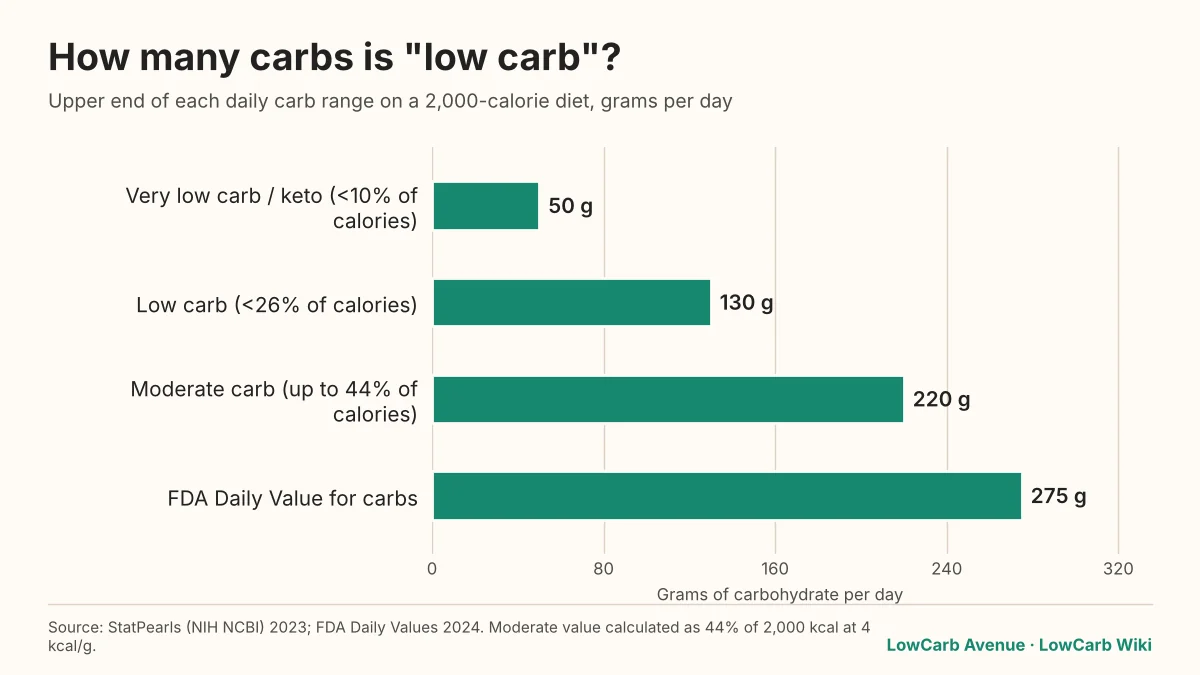
Most beginners do well starting somewhere in the low-carb band rather than jumping straight to keto. If you’re curious about the stricter version, our guide to keto vs. low carb walks through the trade-offs.
Before day one: three quick steps
1. Talk to your doctor if you take medication
This one matters. Cutting carbs can lower blood sugar and blood pressure fairly quickly, and doses that were right last month may be too strong now. The NIH review notes that people with type 2 diabetes cutting carbs need close monitoring for low blood sugar, and medication changes may be needed [1]. The American Diabetes Association recommends regular monitoring and medication adjustment for people on glucose-lowering drugs [4]. If you take diabetes or blood-pressure medication, please check with your doctor or a registered dietitian before you start.
2. Choose your number
Write down one daily target and keep it for the full two weeks. A forgiving approach is to pick a number comfortably under the 130-gram low-carb line rather than the strict 20 to 50 grams used for keto [1]. You can always lower it later. If you want to track net carbs instead of total carbs, decide that now so your numbers stay consistent.
3. Clean up the kitchen
Move sweetened drinks, crackers, chips and most boxed cereals out of easy reach. Then get comfortable with the Nutrition Facts panel. On a US label, “Total Carbohydrate” includes sugars, dietary fiber and sugar alcohols [5], so that’s the line to watch. Our step-by-step guide on how to read a nutrition label for low-carb eating covers the details, and the list of hidden sugar names helps with ingredient lists.
Week one: getting through the switch
Days 1-3: keep meals boring on purpose
Early on, simple wins. Repeat a handful of meals you like so you’re not calculating every bite. A reliable plate looks like this:
- A palm-sized portion of protein: eggs, chicken, fish, tofu, Greek yogurt or lean beef
- Half the plate in non-starchy vegetables: leafy greens, broccoli, zucchini, peppers, cauliflower
- A thumb or two of fat: olive oil, avocado, nuts, cheese
- Water, unsweetened tea or coffee to drink
Days 4-7: the “keto flu” window
Some people feel off during the first week, especially if they cut carbs sharply. A Harvard Health writer describes headache, fatigue, brain fog, irritability, nausea, poor sleep and constipation, often showing up two to seven days after starting a ketogenic diet [6]. A 2025 scoping review found these symptoms usually appear within the first two to three days and mostly fade within two to four weeks [7]. Drinking enough water, eating regular meals with plenty of vegetables and easing in rather than going cold turkey are the practical tips Harvard offers [6]. If you feel truly unwell or run a fever, call your doctor, because that’s not a typical diet reaction [6].
Week two: settling in
By the second week, most people know which meals work and which ones leave them hungry. This is the time to fine-tune.
Watch your fiber
Cutting bread, pasta and cereal can quietly drop your fiber intake. The FDA’s Daily Value for fiber is 28 grams [3], and the National Academies set adequate intakes of 25 grams a day for women and 38 grams for men aged 19 to 50, a bit lower after 50 [2]. Vegetables, berries, nuts, seeds, avocado and high-fiber low-carb bread help close the gap. See our guide to fiber on a low-carb diet for more ideas.
Keep protein steady
Protein helps meals feel filling. The FDA uses 50 grams a day as the label Daily Value for protein [3], though many people need more depending on size and activity. Our article on how much protein you need explains the range.
Swap, don’t just subtract
The diets that last tend to replace foods rather than leave empty spaces. Cauliflower rice for white rice, lettuce wraps or low-carb bread for regular sandwich bread, berries for juice. For lunch ideas, try our guide to building a satisfying low-carb sandwich.
Common beginner mistakes
- Going too low, too fast. Jumping straight to keto-level intake of 20 grams a day [1] can make the adjustment rougher, and easing in is one of Harvard’s tips for avoiding keto flu [6].
- Living on processed “keto” snacks. In the large DIETFITS trial, the low-carb group was coached toward whole, minimally processed foods, not low-carb junk food [8].
- Forgetting drinks. Juice, sweet tea and specialty coffees can carry a full day’s carb budget.
- Skipping vegetables. They’re your main source of fiber and many vitamins on a low-carb plan.
- Judging results by the scale on day three. Early numbers bounce around. Give it the full two weeks before deciding anything.
What results can you expect?
Honest answer: it varies a lot. In DIETFITS, 609 adults followed either a healthy low-carb or healthy low-fat diet for a year. Median weight loss was 6.0 kg on low carb and 5.3 kg on low fat, a difference that wasn’t statistically significant, and individual results ranged from a 30 kg loss to a 10 kg gain [8]. A Mayo Clinic analysis found low-carb dieters lost roughly 2.5 to 5 pounds more than people on comparison diets, though long-term effects weren’t studied [9].
For people with diabetes or prediabetes, the American Diabetes Association says reducing overall carbohydrate intake has the most evidence for improving blood sugar, while also noting there’s no single ideal split of carbs, protein and fat for everyone [4]. The takeaway for beginners: the best plan is the one you can keep doing.
Where LowCarb Avenue fits
Bread is often the hardest thing to give up, and it doesn’t have to go. At LowCarb Avenue, we bake clean-label low-carb and keto bread with real fiber and protein, so a sandwich or morning toast can stay on the menu while you learn your new routine. Try Wilbur, our multigrain loaf, Frankie sourdough, Elodie sourdough sandwich bread, or Brooklyn Baby bagels. Check each label against your daily target, just like any other food. Browse our low-carb bread and bagels.
Frequently asked questions
How many carbs should a beginner eat on a low-carb diet?
Low carb is commonly defined as under 130 grams a day, and keto as 20 to 50 grams. Many beginners pick a target comfortably under 130 grams, stick with it for two weeks, then adjust. Your doctor or dietitian can help you pick a number that fits your health needs.
What is keto flu and how long does it last?
Keto flu is a group of symptoms like headache, fatigue, brain fog and constipation that some people feel when they cut carbs sharply. It often starts within the first few days, and research suggests most symptoms fade within two to four weeks.
Can I eat bread on a low-carb diet?
Yes, as long as it fits your daily carb target. Regular bread can use up a big share of a low-carb budget, so many people switch to low-carb bread with more fiber and protein. Always check the label.
Should I count total carbs or net carbs?
Either can work. Total carbs is the number printed on US labels. Net carbs subtracts fiber and sometimes sugar alcohols. Pick one method and stay consistent so your tracking makes sense.
Is a low-carb diet safe if I have diabetes?
Many people with diabetes eat lower-carb, and the American Diabetes Association says reducing carbs has strong evidence for improving blood sugar. Because medication may need adjusting, talk with your doctor before you change how you eat.
Sources
- Low-Carbohydrate Diet (StatPearls).
- Dietary Reference Intakes for Energy, Carbohydrate, Fiber, Fat, Fatty Acids, Cholesterol, Protein, and Amino Acids (DRI summary tables).
- Daily Value on the Nutrition and Supplement Facts Labels.
- Nutrition Therapy for Adults With Diabetes or Prediabetes: A Consensus Report (Evert AB et al.), Diabetes Care 42(5):731-754.
- Interactive Nutrition Facts Label: Total Carbohydrate.
- What is keto flu? (Campos M).
- Symptoms during initiation of a ketogenic diet: a scoping review of occurrence rates, mechanisms and relief strategies (Skartun O et al.), Frontiers in Nutrition 12.
- Effect of Low-Fat vs Low-Carbohydrate Diet on 12-Month Weight Loss in Overweight Adults: The DIETFITS Randomized Clinical Trial (Gardner CD et al.), JAMA 319(7):667-679.
- Mayo Clinic Minute: Low-carb diet findings and cautions.
This article is for general education and is not medical advice. Talk with your doctor or a registered dietitian before changing your diet, especially if you take medication for diabetes or blood pressure. How we research and write.