
How to Calculate Net Carbs on Any Label: Sugar Alcohols, Allulose and EU Labels
Knowing how to calculate net carbs on a real package takes more than one subtraction. You need to know the label type, the sweeteners inside, and how much you will eat. This step-by-step guide walks through six steps and four worked examples, including sugar alcohols, allulose and European labels. If you want the basics first, start with What Are Net Carbs? To see the math on our own breads, read How We Calculate Net Carbs.
The six steps at a glance
Check the label type, subtract fiber on US labels, sort the sugar alcohols, then multiply by your servings.
- Find out if it is a US/Canada label or an EU/UK label.
- Write down the carbohydrate number and the serving size.
- Subtract dietary fiber, but only on US/Canada labels.
- Subtract all of the erythritol and half of other sugar alcohols.
- Subtract allulose only when the label gives grams.
- Multiply by the number of servings you will really eat.
Here is each step in plain words.
Step 1: Check which kind of label you have
US labels include fiber in “Total Carbohydrate.” EU and UK labels leave fiber out of “Carbohydrate.”
On a US Nutrition Facts panel, “Total Carbohydrate” counts starch, sugars, fiber and sugar alcohols together [1]. Canada works the same way. On a European or UK label, “Carbohydrate” already excludes fibre. Fibre gets its own line, and sugar alcohols (“polyols”) stay inside the carbohydrate number [2].
This one difference changes the math. Red flag: never subtract fiber on a European label. It is already gone, so the answer would come out too low.
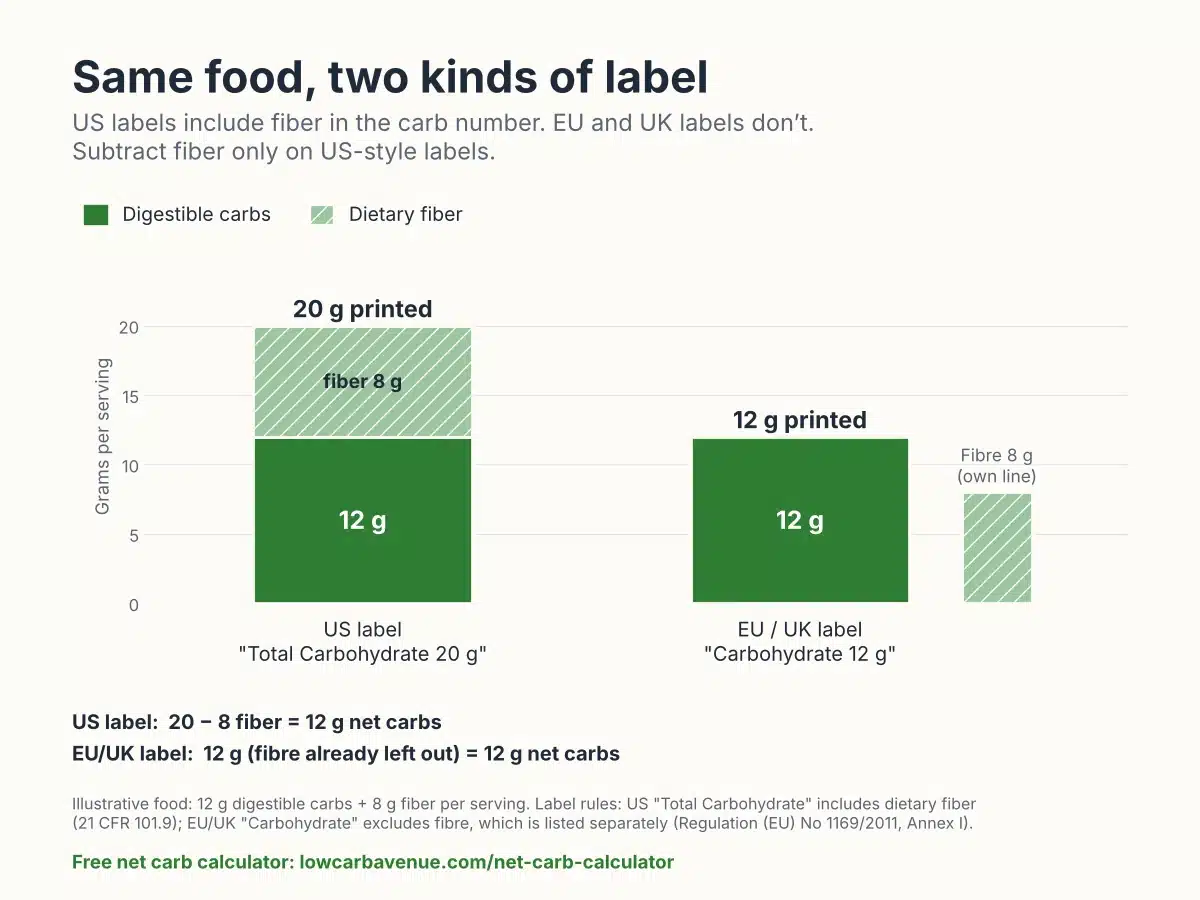
Not sure? US labels say “Nutrition Facts” and “Total Carbohydrate.” European labels usually say “Nutrition information.” They list “per 100 g” and show energy in kJ.
Step 2: Start with the right carb number and serving
Use the carbohydrate line for the serving you will eat, not the per-container or per-100 g column.
Many labels have two columns. US labels may show “per serving” and “per container.” European labels often show “per 100 g” and “per portion.” Pick one column and use it for every number. Mixing columns is one of the easiest mistakes to make.
Also note the serving size in grams. A bar might be one serving, but a bag of chips could be four.
Step 3: Subtract fiber (US and Canada labels only)
Fiber is not digested into sugar, so subtract all of it on US-style labels.
The FDA counts plant fiber as dietary fiber. It also counts some added fibers it has reviewed, like psyllium and inulin [3]. Your small intestine cannot break these down into glucose, so they are subtracted in full.
Red flag: not every “fiber” behaves like fiber. Isomalto-oligosaccharides (IMO) are often sold as a fiber syrup. In two studies, IMO raised blood sugar and insulin in healthy adults [6][7]. If IMO is high on the ingredient list, be cautious about subtracting the fiber line in full. Learn more in Added Fibers in Keto Bread.
Step 4: Sort the sugar alcohols
Subtract all of the erythritol. Subtract half of maltitol, sorbitol, xylitol and other sugar alcohols.
Sugar alcohols are only partly absorbed, and each one is different. In a major review, erythritol had a glycemic index (GI) of 0, while maltitol scored 35 [4]. Counting the others at 50% is a common, cautious rule of thumb. It is a simplified convention, not a measurement, and people respond differently.
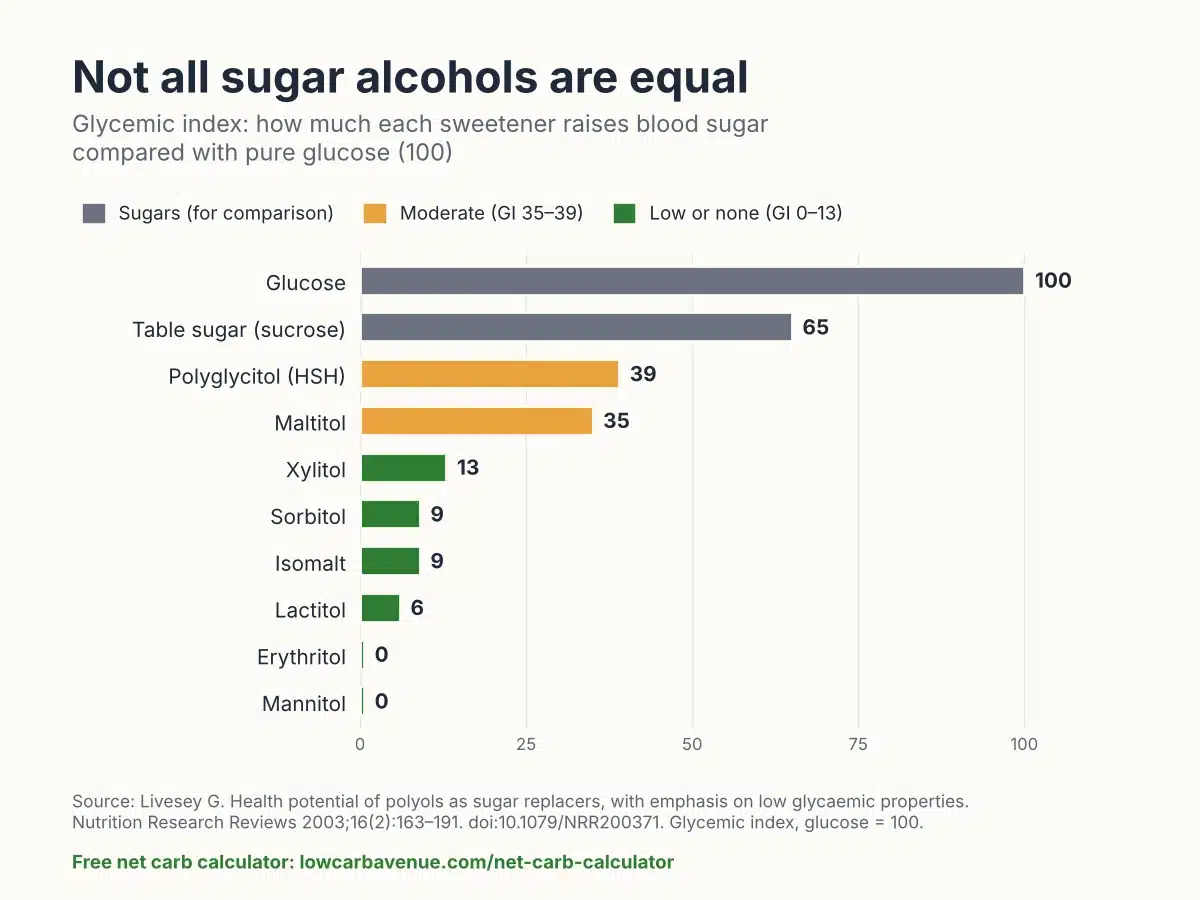
US labels often list one “Sugar Alcohol” line for all of them. Check the ingredient list to see which ones are inside:
- Only erythritol: subtract the whole line.
- Maltitol, sorbitol, xylitol or a mix: subtract half the line.
- Not sure: subtract half. It is the safer guess.
Red flag: some labels list the sugar alcohol total and erythritol underneath it. The erythritol is part of the total. Subtract each gram once, never twice.
For more on how these sweeteners differ, including the 2023 erythritol heart study [8], see Sugar Alcohols and Low-Carb Sweeteners.
Step 5: Subtract allulose only when grams are listed
Allulose is not used by the body like sugar, so subtract it, but only the grams the label shows.
The FDA lets brands leave allulose out of “Total Sugars” and “Added Sugars,” but it still counts in Total Carbohydrate [5]. Some labels give an allulose line. If yours does, subtract it in full. If allulose only appears in the ingredients with no grams, you cannot subtract a guessed amount.
Step 6: Multiply by the servings you will eat
Net carbs per serving times servings eaten gives the number that matters for your day.
A cookie with 3 g net carbs per serving sounds fine. Two and a half cookies are 7.5 g. Always finish with this step.
Worked examples
Four labels show how the type of sweetener and the type of label change the answer.
Example 1: Maltitol bar vs. erythritol bar
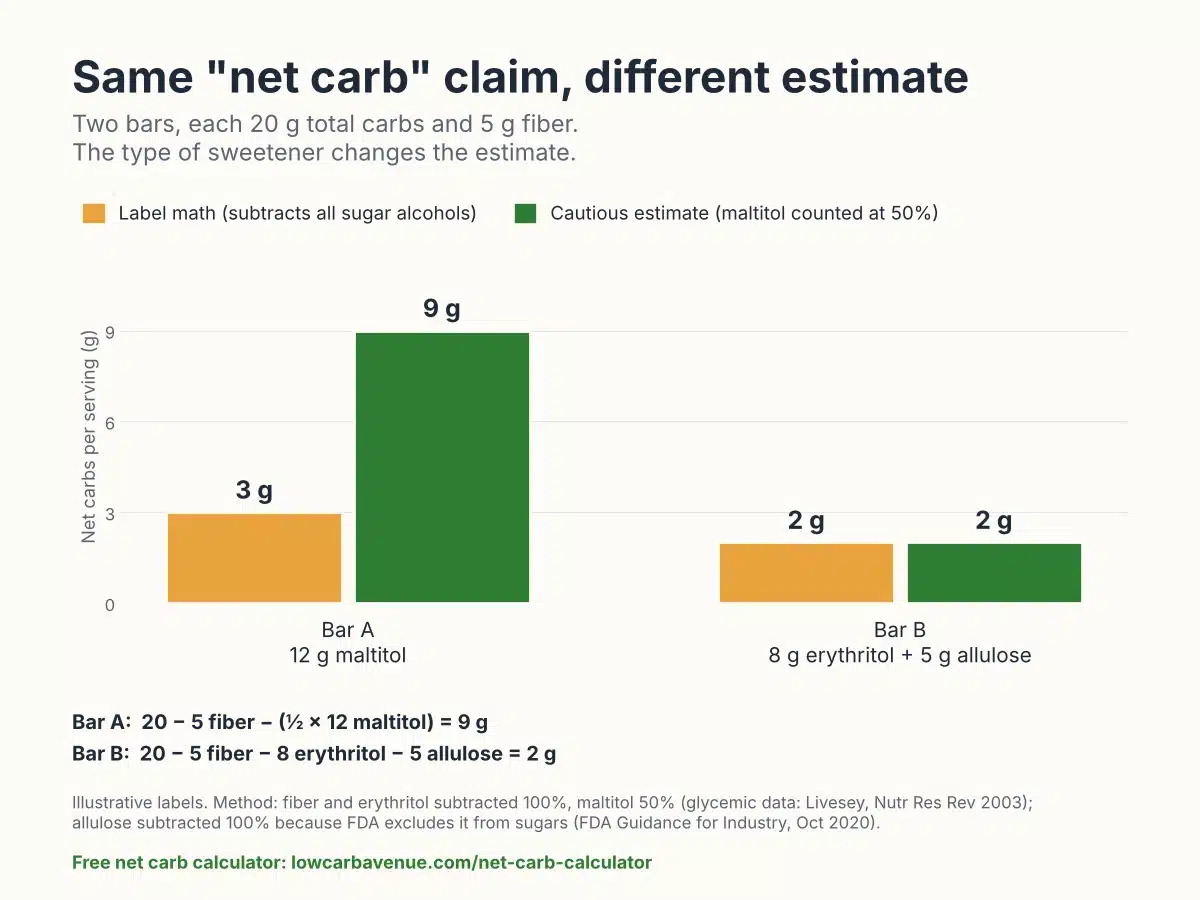
Both bars have 20 g total carbohydrate and 5 g fiber on a US label.
- Bar A has 12 g sugar alcohol, and the ingredients say maltitol: 20 − 5 − (½ × 12) = 9 g.
- Bar B has 8 g erythritol and lists 5 g allulose: 20 − 5 − 8 − 5 = 2 g.
Many brands subtract every sugar alcohol, so Bar A could still print “3 g net carbs” on the front.
Example 2: A total plus erythritol listed underneath
A US label shows 25 g total carbohydrate, 5 g fiber and 8 g sugar alcohol, with “erythritol 5 g” indented below. The ingredients also list maltitol. So the 8 g is 5 g erythritol plus 3 g maltitol.
25 − 5 − 5 − (½ × 3) = 13.5 g. Subtracting the 8 g line and the 5 g erythritol would wrongly give 7 g.
Example 3: A European chocolate
Per 30 g portion: carbohydrate 12 g, of which polyols 9 g (maltitol), fibre 6 g.
Fibre is already left out, so do not subtract it. 12 − (½ × 9) = 7.5 g. Read as a US label, the same numbers would give a confusing answer below zero.
Example 4: Low carb bread with no sweeteners
A slice with 10 g total carbohydrate and 7 g fiber, and no sugar alcohols: 10 − 7 = 3 g. When there are no sweeteners, the math is that simple.
Mistakes that throw off the math
Double-counting fiber or sugar alcohols and ignoring rounding are the most common errors.
- Subtracting fiber on a European label. It is already gone.
- Subtracting a sugar alcohol total and its parts. Each gram counts once.
- Trusting “net carbs” on the front. The FDA has not defined the term, so brands use their own formulas [9].
- Forgetting rounding. US labels round to the nearest gram, so “0 g” can mean up to 0.49 g per serving [1].
- Counting IMO, maltodextrin or dextrose as free. These are digestible carbs.
Pro tip: our free net carb calculator follows these same steps. Snap a label, scan a barcode or type the numbers. You pick the label type, check the numbers, and see the math line by line.
These estimates are for education, not medical advice. They do not predict your own blood sugar. If you take insulin or diabetes medicine, talk with your care team before changing how you eat.
Where LowCarb Avenue fits
The easiest label to calculate is one with no sugar alcohols at all. At LowCarb Avenue, we bake clean-label low carb sourdough, breads and keto bagels with real fiber and protein, so the math stays simple: carbs minus fiber. See our breads and bagels.
Frequently asked questions
How do you calculate net carbs on a UK or European label?
Start with 'Carbohydrate,' which already excludes fibre. Subtract erythritol in full and half of other polyols such as maltitol. Don't subtract the fibre line, or you'll count it twice.
Do you subtract all sugar alcohols for net carbs?
No. Subtract all of the erythritol, but only half of maltitol, sorbitol, xylitol and similar sugar alcohols. The 50% rule is a cautious convention, not a measurement, and people respond differently.
What if a label lists a sugar alcohol total and erythritol under it?
The erythritol is part of the total. Subtract the erythritol in full, then half of whatever is left of the total. Never subtract both the total and its parts.
Can I subtract allulose if it's only in the ingredient list?
Only subtract allulose when the label gives a gram amount. If it appears in the ingredients without grams, there's no way to know how much to subtract.
Is 'net carbs' defined by the FDA?
No. The term doesn't appear in FDA labeling rules, so brands use their own formulas. Doing the math yourself is the only way to compare products fairly.
Sources
- 21 CFR 101.9: Nutrition labeling of food.
- Regulation (EU) No 1169/2011 on the provision of food information to consumers, Annex I (definitions).
- Scientific Evaluation of the Evidence on the Beneficial Physiological Effects of Isolated or Synthetic Non-digestible Carbohydrates Submitted as a Citizen Petition: Guidance for Industry.
- Health potential of polyols as sugar replacers, with emphasis on low glycaemic properties (Livesey G.).
- The Declaration of Allulose and Calories from Allulose on Nutrition and Supplement Facts Labels: Guidance for Industry.
- Ingestion of isomalto-oligosaccharides stimulates insulin and incretin hormone secretion in healthy adults (Subhan FB, et al.).
- The effects of soluble corn fibre and isomaltooligosaccharides on blood glucose, insulin, digestion and fermentation in healthy young males and females (Lowery RP, et al.).
- The artificial sweetener erythritol and cardiovascular event risk (Witkowski M, Nemet I, et al.).
- Low-Carb Food Labeling: What FDA Rules Mean for Food Manufacturers.
This article is for general education and is not medical advice. Talk with your doctor or a registered dietitian before changing your diet, especially if you take medication for diabetes or blood pressure. How we research and write.