
Low Carb Sourdough vs. Regular Sourdough: What Is the Difference?
The difference between low carb sourdough and regular sourdough is the flour, not the fermentation. Regular sourdough is made mostly from refined wheat flour, so a 28g slice has about 14g of net carbs. Low carb sourdough replaces much of that starchy flour with high-fiber wheat flour and wheat protein. Our Frankie and Elodie loaves have 3g of net carbs per 28g slice, along with 6 to 7g of protein [1][2][3]. Sourdough fermentation by itself does not make bread low carb.
What makes bread “sourdough”?
Sourdough bread rises with a starter, a living mix of flour and water that holds wild yeasts and lactic acid bacteria. During a long fermentation, these microbes feed on some of the sugars in the dough. They produce gas that raises the loaf and acids that give sourdough its tangy flavor and longer-lasting crumb [4][5].
Traditional sourdough has very few ingredients: flour, water, salt and starter. Many supermarket loaves sold as sourdough also use commercial yeast to speed things up, and some add acids or “sourdough flavor” for tang. If the fermentation matters to you, read the ingredient list.
What makes sourdough “low carb”?
Low carb sourdough starts from different flour. Instead of a dough built on refined white flour, it uses ingredients that bring fiber and protein but little digestible starch. Our Frankie loaf is made from water, high-fiber wheat flour, wheat protein, sourdough starter, olive oil and sea salt, with no added commercial yeast in its ingredient list [2]. Elodie uses the same base plus yeast for a softer sandwich crumb [3]. The result is a bread that looks and tastes like sourdough but has about one-fifth of the net carbs per slice.
Low carb vs. regular sourdough: nutrition compared
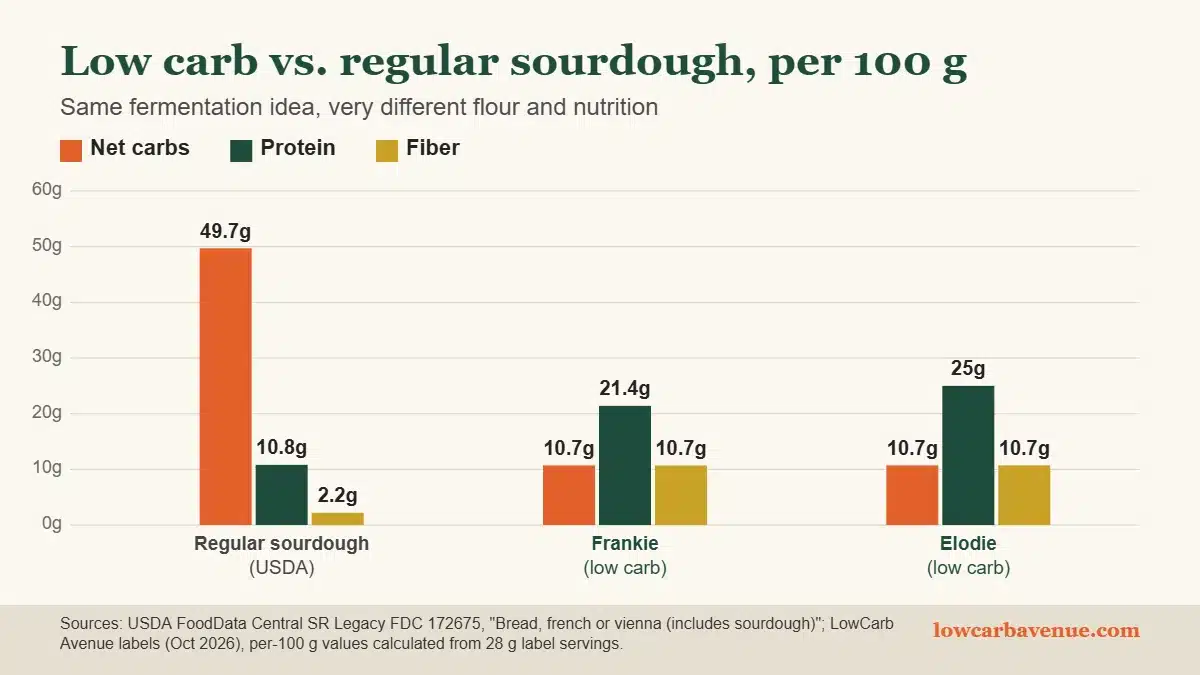
Here are the numbers side by side, both per 28g slice (a typical sandwich slice) and per 100g, which makes any two breads easy to compare.
| Regular sourdough (USDA) | Frankie | Elodie | |
|---|---|---|---|
| Per 28g slice | |||
| Calories | 76 | 60 | 60 |
| Total carbohydrate | 14.5g | 6g | 6g |
| Dietary fiber | 0.6g | 3g | 3g |
| Net carbs | 13.9g | 3g | 3g |
| Protein | 3.0g | 6g | 7g |
| Per 100g | |||
| Net carbs | 49.7g | about 10.7g | about 10.7g |
| Protein | 10.8g | about 21.4g | about 25g |
| Fiber | 2.2g | about 10.7g | about 10.7g |
Sources: USDA FoodData Central, “Bread, french or vienna (includes sourdough),” FDC 172675, scaled from 100g [1]; LowCarb Avenue Nutrition Facts labels, October 2026 [2][3]. Our per-100g values are calculated from rounded label numbers, so they are approximate.
Does fermentation lower the carbs in sourdough?
Only a little. Starter microbes use some of the sugars in the dough, but most of the starch in the flour is still there when the bread is baked. That is why USDA data for sourdough and French bread show about 52g of total carbohydrate per 100g, close to ordinary white bread [1].
Research on sourdough and blood sugar is mixed:
- A review of clinical studies in the British Journal of Nutrition found that bread-making methods, including sourdough fermentation, can lower the blood sugar response to bread in some studies [6].
- In a Finnish trial, sourdough fermentation of wholemeal wheat bread led to lower blood glucose and insulin responses than the same bread made without sourdough [7].
- A randomized crossover study in Cell Metabolism compared industrial white bread with artisanal whole-grain sourdough. On average, there was no significant difference in blood sugar responses, and people’s responses varied widely from person to person [8].
- A 2023 systematic review in Advances in Nutrition concluded that some sourdough benefits are promising but the clinical evidence is inconsistent [5].
In short, fermentation may soften the blood sugar effect of a bread for some people, but it does not turn a high-carb bread into a low carb one. Read more in our article on sourdough and blood sugar.
Taste and texture: what changes?
Low carb sourdough keeps the tang and the chewy, open crumb that sourdough fans love, because it still relies on fermentation for flavor. Wheat protein gives the dough strength and chew. Breads with more fiber and protein tend to be a little denser and toast faster than white sourdough, so start on a lighter toaster setting. Frankie is our classic New York-style loaf with a crusty exterior. Elodie is a softer sandwich loaf for everyday lunches.
Which sourdough is right for you?
- Choose regular sourdough if you are not limiting carbohydrates and you enjoy a traditional loaf made with refined or whole-grain flour.
- Choose low carb sourdough if you are following a low carb or keto plan, counting carbs for diabetes with your care team, or want more protein and fiber in each slice.
- Choose neither if you need to avoid gluten. Both regular and low carb sourdough are made with wheat. A food labeled gluten-free must contain less than 20 parts per million of gluten under FDA rules [9], and sourdough fermentation does not remove enough gluten to meet that limit.
How to spot a truly low carb sourdough
- Check the serving size. Compare breads at the same weight, such as 28g or 100g.
- Do the net carb math. Subtract dietary fiber from total carbohydrate. Our guide on how we calculate net carbs shows worked examples.
- Read the ingredient list. Look for fiber-rich flours and wheat protein near the top, and be cautious of breads that rely mainly on refined flour plus an added fiber powder.
- Look for real fermentation. A starter-based loaf usually lists only flour, water, salt and perhaps a small amount of yeast.
- Check protein. A good low carb sourdough should offer meaningfully more protein than the roughly 3g in a regular slice.
Clean-label low carb sourdough with fiber and protein
We bake Frankie and Elodie in small batches in Frederick, Maryland, with short ingredient lists, real fiber and 6 to 7g of protein in every slice. If you have missed sourdough on a low carb plan, explore our low carb sourdough breads and the rest of our range at lowcarbavenue.com.
Frequently asked questions
What is the difference between regular sourdough and low carb sourdough?
The flour. Regular sourdough is made mostly from refined wheat flour and has about 14g of net carbs per 28g slice. Low carb sourdough uses high-fiber wheat flour and wheat protein; Frankie and Elodie have 3g of net carbs per 28g slice.
Is sourdough bread low carb?
Regular sourdough is not low carb. USDA data show about 52g of total carbohydrate per 100g of sourdough or French bread. Fermentation uses only a small share of the carbohydrate in the dough.
Is low carb sourdough gluten-free?
No. Low carb sourdough made with wheat flour and wheat protein contains gluten. Under FDA rules, a gluten-free food must contain less than 20 parts per million of gluten.
Does sourdough raise blood sugar less than white bread?
Some studies show a smaller blood sugar rise after sourdough, while others, including a 2017 trial in Cell Metabolism, found no average difference. Responses vary from person to person.
Does low carb sourdough taste like regular sourdough?
It keeps the tangy flavor and chewy texture that come from fermentation. Because it has more fiber and protein, it can be a little denser and toasts faster than white sourdough.
Sources
- Bread, french or vienna (includes sourdough), FDC ID 172675, SR Legacy.
- Frankie Low Carb Sourdough Bread: Nutrition Facts and ingredients.
- Elodie Low Carb Sourdough Sandwich Bread: Nutrition Facts and ingredients.
- Does sourdough bread provide clinically relevant health benefits?.
- Nutritional benefits of sourdoughs: a systematic review.
- Bread making technology influences postprandial glucose response: a review of the clinical evidence.
- Sourdough fermentation of wholemeal wheat bread increases solubility of arabinoxylan and protein and decreases postprandial glucose and insulin responses.
- Bread affects clinical parameters and induces gut microbiome-associated personal glycemic responses.
- Gluten and Food Labeling.
This article is for general education and is not medical advice. Talk with your doctor or a registered dietitian before changing your diet, especially if you take medication for diabetes or blood pressure. How we research and write.