
What Are Net Carbs? How to Calculate Them (and When They Mislead)
Net carbs are the carbohydrates left after you subtract dietary fiber, and sometimes sugar alcohols, from a food’s total carbohydrate. The idea is to estimate the carbs that actually raise your blood sugar. It’s a handy shortcut on a low-carb or keto diet, but it isn’t an official number, and it can be off depending on which fibers and sweeteners a product uses.
Where the idea of net carbs comes from
The Nutrition Facts label shows one carb number that matters most: Total Carbohydrate. That line already includes total sugars, dietary fiber, and sugar alcohols [1]. You won’t find “net carbs” on the official panel, because no U.S. regulation defines the term. The American Diabetes Association goes further and says it doesn’t recognize net carbs at all [2].
So why do so many keto packages print it on the front? The logic is simple. Your body can’t break most fiber down into sugar, so it passes into the large intestine instead of entering your bloodstream as glucose. Federal labeling rules reflect this. Ordinary carbohydrates are counted at 4 calories per gram [1], while soluble non-digestible carbohydrates get a general factor of 2 calories per gram, and erythritol is counted at 0 calories per gram [4]. If those carbs don’t behave like sugar, the thinking goes, you shouldn’t have to count them like sugar.
How to calculate net carbs
The basic math takes about ten seconds:
- Find Total Carbohydrate for one serving.
- Subtract the grams of Dietary Fiber.
- If the label lists Sugar Alcohols, subtract all of them, part of them, or none, depending on which ones they are (more on that below).
Here’s a made-up example to show the steps. A slice of bread lists 12 g total carbohydrate, 9 g dietary fiber, and no sugar alcohols. Twelve minus nine leaves 3 g net carbs per slice. If you eat two slices, double it.
This table sums up how each part of the carb line is usually treated:
| Part of the label | Included in Total Carbohydrate? | Usually subtracted for net carbs? |
|---|---|---|
| Starch (not listed on its own line) | Yes | No |
| Total sugars, including added sugars | Yes | No |
| Dietary fiber | Yes | Yes, with caveats |
| Erythritol | Yes, as a sugar alcohol | Usually yes |
| Maltitol, sorbitol, xylitol and similar | Yes, as sugar alcohols | Only partly, if at all |
When net carbs can mislead you
The formula assumes every gram of fiber and sugar alcohol skips your bloodstream. That’s not always true, and here’s where the math can drift.
Not every added fiber acts like the fiber in vegetables
Since the 2016 label update, the FDA counts fiber that’s naturally intact in plants as dietary fiber. Isolated or synthetic fibers that manufacturers add only count if the agency has decided they have a physiological effect that benefits health [3]. The regulation started with seven approved added fibers, including psyllium husk, cellulose, guar gum, pectin, and beta-glucan soluble fiber, and the FDA reviews petitions for others [3].
Some ingredients sold as “fiber” turned out to be partly digestible. In a 2018 study funded by an ingredient maker, isomaltooligosaccharides (IMO) produced a two-hour blood sugar response that wasn’t significantly different from dextrose, and the authors concluded IMO is digestible [6]. If a product subtracts a fiber like that, its net carb number will look better than your blood sugar does. Our guide to added fibers in keto bread goes ingredient by ingredient.
Sugar alcohols aren’t all equal
Sugar alcohols range from nearly inert to surprisingly active. A 2021 review in the Journal of Food and Drug Analysis lists erythritol with a glycemic index of 0, while maltitol sits at 35. Table sugar is 69 on the same scale [5].
That’s why many low-carb eaters subtract erythritol fully but only part of maltitol or sorbitol, or none at all. It’s a rule of thumb, not a standard. Calories differ too: the same review puts maltitol around 2.1 calories per gram and xylitol around 2.6 [5]. Large amounts of sugar alcohols can also cause bloating, gas, and diarrhea [10]. For the full rundown, see sugar alcohols and low-carb sweeteners.
Rounding and serving sizes add up
Label values are rounded to the nearest gram, and a carb amount under 0.5 g per serving can be listed as zero [4]. That’s fine for one serving, but it adds up when you eat three. Always check the serving size before you trust a small number. Our guide on how to read a Nutrition Facts label for low-carb eating walks through each line.
Total carbs or net carbs: which should you count?
Either can work, as long as you’re consistent. Research definitions are a useful frame of reference. A widely cited 2015 review defines a very low-carbohydrate ketogenic diet as 20 to 50 grams of carbs a day, and a low-carb diet as under 130 grams a day, or less than 26% of calories [9]. Many keto plans apply their daily limit to net carbs, while others count total carbs to keep things simple.
A few practical guidelines:
- Count net carbs if most of your fiber comes from whole foods like vegetables, nuts, and seeds, and you want room for more of them.
- Count total carbs if you eat a lot of packaged “keto” products, or you’re not seeing the results you expected.
- Test new products. The ADA suggests counting total carbohydrate and checking your blood glucose when you eat foods high in fiber or sugar alcohols [2].
If you take insulin or other diabetes medication, or medicine for blood pressure, talk with your doctor or a registered dietitian before you change how you count carbs.
Not sure which style of eating suits you? Read keto vs. low-carb.
Don’t let net-carb math crowd out real fiber
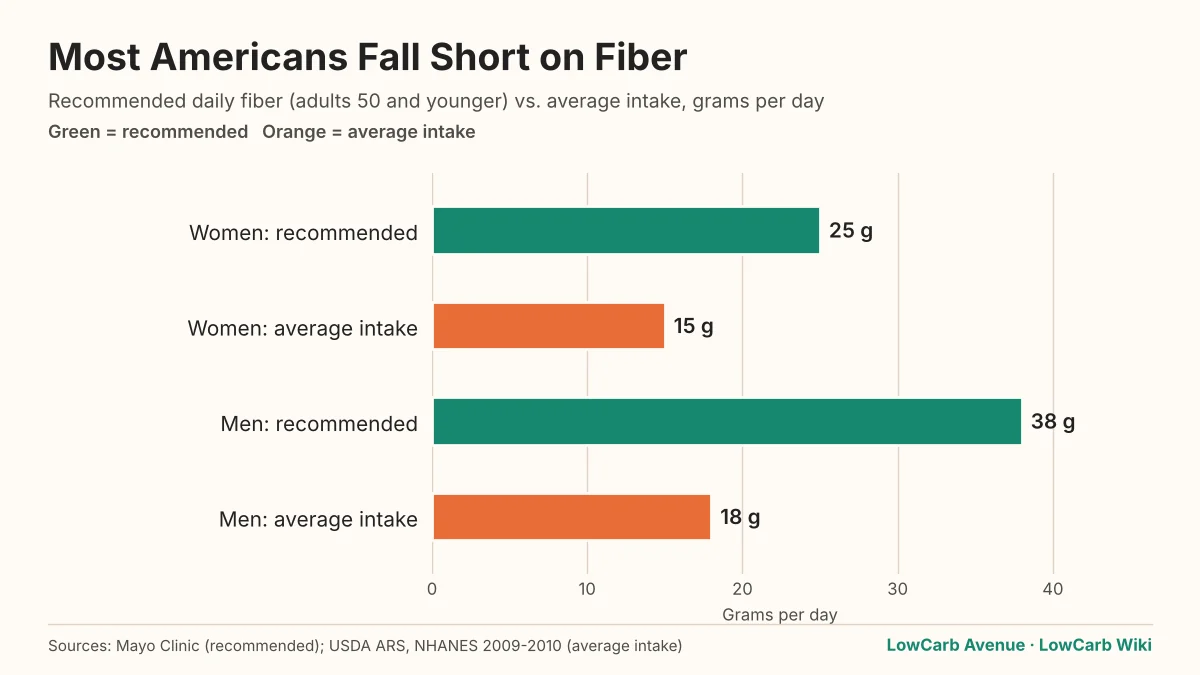
The point of subtracting fiber isn’t to hunt for the lowest number. It’s to make room for foods that are good for you. Most Americans already fall short. Recommended amounts are 25 g a day for women 50 and younger and 21 g after 50, and 38 g for men 50 and younger and 30 g after 50 [7]. Average intakes in national survey data were just 18 g for men and 15 g for women [8].
Soluble fiber can help slow sugar absorption, and insoluble fiber keeps digestion moving [7]. Low-carb sources include avocados, nuts, cauliflower, green beans, and psyllium [7]. If you’re adding a lot of fiber at once, go slowly over a few weeks and drink plenty of water to avoid gas and bloating [7]. Our article on fiber on a low-carb diet has more ideas.
Where LowCarb Avenue fits
Bread is usually the first thing people miss on keto, and it’s also where net carb claims get the most creative. At LowCarb Avenue, we bake clean-label low-carb bread built on fiber and protein, with ingredient lists you can read without a chemistry degree. Try Wilbur, our multigrain loaf, Frankie, our sourdough, Elodie, our sourdough sandwich bread, or Brooklyn Baby bagels. Check each label, do the math yourself, and see how they fit your day. Shop LowCarb Avenue.
Frequently asked questions
Is net carbs an official FDA term?
No. The Nutrition Facts label only lists Total Carbohydrate and the lines under it. No U.S. regulation defines net carbs, and the American Diabetes Association does not recognize the term.
Should I subtract all sugar alcohols?
Not always. Erythritol has a glycemic index of 0, so many people subtract it fully. Maltitol's glycemic index is 35, so many low-carb eaters subtract only part of it or none. Check the ingredient list to see which one a product uses.
How many net carbs a day is keto?
A widely cited review defines a very low-carbohydrate ketogenic diet as 20 to 50 grams of carbohydrate a day. Many keto plans apply that range to net carbs. Your own target depends on your goals and health, so check with your doctor or dietitian.
Why does my blood sugar rise after a low net carb product?
The product may use a partly digestible fiber, a sugar alcohol like maltitol, or a larger serving than you think. The ADA suggests counting total carbs and checking your glucose when you try foods high in fiber or sugar alcohols.
Sources
- Interactive Nutrition Facts Label: Total Carbohydrate.
- Get to Know Carbs.
- Scientific Evaluation of the Evidence on the Beneficial Physiological Effects of Isolated or Synthetic Non-digestible Carbohydrates Submitted as a Citizen Petition: Guidance for Industry.
- 21 CFR 101.9: Nutrition labeling of food.
- Suitability of sugar alcohols as antidiabetic supplements: A review (Msomi NZ, Erukainure OL, Islam MS).
- Gastrointestinal Tolerance and Glycemic Response of Isomaltooligosaccharides in Healthy Adults (Gourineni V, et al.).
- Dietary fiber: Essential for a healthy diet.
- Fiber Intake of the U.S. Population: What We Eat in America, NHANES 2009-2010 (Hoy MK, Goldman JD).
- Dietary carbohydrate restriction as the first approach in diabetes management: Critical review and evidence base (Feinman RD, et al.).
- Understanding Sugar Substitutes.
This article is for general education and is not medical advice. Talk with your doctor or a registered dietitian before changing your diet, especially if you take medication for diabetes or blood pressure. How we research and write.