
How to Read a Nutrition Facts Label for Low-Carb Eating
To read a Nutrition Facts label for low-carb eating, start with the serving size, then go straight to Total Carbohydrate and the lines beneath it: dietary fiber, total sugars, added sugars, and sugar alcohols if they’re listed. Finish with the ingredient list, because the panel tells you how much is in the food and the ingredients tell you what it actually is.
Step 1: Check the serving size first
Every number on the panel depends on the serving size, so it’s the first thing to read. The FDA is clear that a serving size isn’t a recommendation of how much to eat. By law, it reflects how much people typically eat or drink [2]. When the label was updated, some reference amounts changed to match real habits. Ice cream went from 1/2 cup to 2/3 cup, and soda went from 8 to 12 ounces [3].
Look at “servings per container,” too. If you eat two servings, you get twice the carbs. Some packages now show a dual-column label, with one column per serving and one for the whole package, so you can see the total at a glance [2].
Step 2: Go to Total Carbohydrate
This is the main number for anyone counting carbs. Total Carbohydrate includes total sugars, dietary fiber, and sugar alcohols [4]. Starch is counted here too, even though it doesn’t get its own line. Each gram of carbohydrate provides about 4 calories [4].
The %DV next to it can be confusing on a low-carb diet. The Daily Value for total carbohydrate is 275 g, based on a 2,000-calorie diet [1]. For comparison, a widely cited review defines a low-carb diet as under 130 g of carbohydrate a day, and a very low-carb ketogenic diet as 20 to 50 g a day [9]. A food that’s only 10% of the carb Daily Value could still use up much of a keto budget. For carbs, read the grams and skip the percentage.
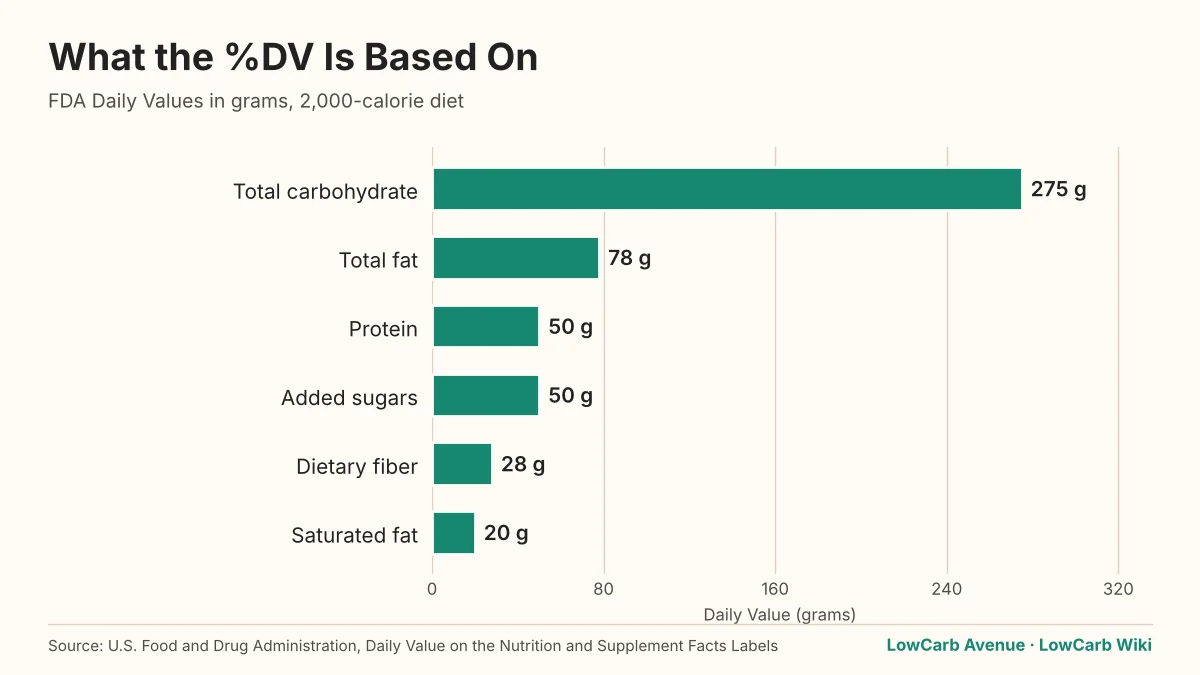
The FDA’s quick rule of thumb is that 5% DV or less is low and 20% DV or more is high [1]. That rule is still useful for fiber, where you want more, and for added sugars, where you want less.
Dietary fiber
Fiber is listed under Total Carbohydrate, and its Daily Value is 28 g [1]. Fiber is the number low-carb eaters subtract to get net carbs. Since the 2016 update, added isolated or synthetic fibers only count as dietary fiber if the FDA has found they offer a health benefit [10]. That’s helpful, but it’s not a guarantee that every added fiber has zero effect on blood sugar. Our guide to net carbs explains when the math can mislead.
Total sugars and added sugars
“Total Sugars” includes both natural sugars, like those in milk or fruit, and sugars added during processing. Right below it, “Includes Added Sugars” shows the added portion. The Daily Value for added sugars is 50 g [1], which matches the advice to keep added sugars under 10% of calories on a 2,000-calorie diet [4]. Large manufacturers had to use the updated label by January 1, 2020, and smaller ones by January 1, 2021 [3]. Some foods aren’t required to list total sugars at all if a serving has less than 1 g and the package makes no claims about sugar [5].
Sugar alcohols
Here’s a line many people miss. Listing sugar alcohols is voluntary, unless the package makes a claim about sugar alcohols or sugars, such as “sugar free” [5]. So a product can contain them without a separate line, and you’ll only spot them in the ingredient list. Sugar alcohols have fewer calories per gram than sugar [4], but they aren’t all the same. Erythritol has a glycemic index of 0, while maltitol’s is 35, compared with 69 for table sugar [11]. In large amounts they can also cause bloating, gas, and diarrhea [12]. See sugar alcohols and low-carb sweeteners for details.
Step 3: Watch for rounding
Carb, fiber, and sugar values are rounded to the nearest gram. If a serving has less than 1 g of carbohydrate, the label can say “less than 1 gram,” and if it has less than 0.5 g, it can be listed as zero [5]. One serving of a “0 g” sweetener or sauce really is tiny. Five servings may not be.
Step 4: Decode the front-of-package claims
Claims on the front are marketing, but some of them have legal definitions. Here’s what the common ones mean:
| Claim | What it legally means | Low-carb watch-out |
|---|---|---|
| Sugar free | Less than 0.5 g of sugars per serving [6] | Starch and sugar alcohols can still add carbs |
| No added sugar | No sugars or sugar-containing ingredients added during processing [6] | Natural sugars and starch still count |
| Reduced sugar | At least 25% less sugar than a comparable food [6] | Could still be high in carbs |
| Net carbs | No legal definition [7] | Do the math yourself from the panel |
A “sugar free” claim must also say the food isn’t low calorie or reduced calorie, unless it meets those standards [6]. Words like “keto” or “low carb” on the front tell you how a product is marketed. They don’t replace the panel.
Step 5: Read the ingredient list
Ingredients are listed in descending order by weight, so the first one is the heaviest [8]. For a low-carb food, look for three things:
- What’s first. If wheat flour, rice, or sugar leads the list, the food is built on carbs, whatever the front says.
- Sugars under other names. Syrups, dextrose, maltodextrin, and fruit juice concentrates all count. Our list of hidden sugars on ingredient labels covers more than 40 names.
- Added fibers and sweeteners. Names like soluble corn fiber, resistant wheat starch, or maltitol explain how a product hits its carb count. Learn more in added fibers in keto bread.
A 30-second label checklist
- Serving size: is it what you’ll really eat?
- Total Carbohydrate in grams, multiplied by your servings.
- Dietary fiber: subtract it if you count net carbs.
- Added sugars: lower is better.
- Sugar alcohols: which ones, and how much?
- Ingredient list: what’s first, and what’s doing the sweetening?
The ADA recommends counting total carbohydrate and checking blood glucose when you eat foods high in fiber or sugar alcohols [7]. If you take diabetes or blood-pressure medication, talk with your doctor or a registered dietitian before you change how you eat or count carbs. New to all this? Start with low-carb for beginners.
Where LowCarb Avenue fits
Once you know how to read a label, bread aisles get a lot more revealing. At LowCarb Avenue, we bake clean-label low-carb and keto bread with fiber and protein, and we want our labels to hold up to exactly this kind of reading. Look at Wilbur, our multigrain loaf, Frankie, our sourdough, Elodie, our sourdough sandwich bread, and our Brooklyn Baby bagels. Flip the package, run through the checklist, and decide for yourself. Shop LowCarb Avenue.
Frequently asked questions
What is the most important number on a label for low-carb eating?
Total Carbohydrate in grams, read together with the serving size. If you count net carbs, subtract dietary fiber and, depending on the type, some or all sugar alcohols.
Does 'sugar free' mean low carb?
No. Sugar free means less than 0.5 g of sugars per serving. The food can still contain starch, flour, or sugar alcohols that add carbohydrates, so check Total Carbohydrate.
Why don't I see sugar alcohols on some labels?
Listing sugar alcohols is voluntary unless the package makes a claim about sugar or sugar alcohols. Check the ingredient list for names like erythritol, maltitol, sorbitol, or xylitol.
Is the %DV useful on a keto diet?
It's useful for fiber and added sugars, where 5% DV or less is low and 20% or more is high. For total carbs it's less helpful, because the 275 g Daily Value is much higher than most low-carb targets.
Sources
- Daily Value on the Nutrition and Supplement Facts Labels.
- Serving Size on the Nutrition Facts Label.
- Changes to the Nutrition Facts Label.
- Interactive Nutrition Facts Label: Total Carbohydrate.
- 21 CFR 101.9: Nutrition labeling of food.
- 21 CFR 101.60: Nutrient content claims for the calorie content of foods.
- Get to Know Carbs.
- A Food Labeling Guide: Guidance for Industry.
- Dietary carbohydrate restriction as the first approach in diabetes management: Critical review and evidence base (Feinman RD, et al.).
- Scientific Evaluation of the Evidence on the Beneficial Physiological Effects of Isolated or Synthetic Non-digestible Carbohydrates Submitted as a Citizen Petition: Guidance for Industry.
- Suitability of sugar alcohols as antidiabetic supplements: A review (Msomi NZ, Erukainure OL, Islam MS).
- Understanding Sugar Substitutes.
This article is for general education and is not medical advice. Talk with your doctor or a registered dietitian before changing your diet, especially if you take medication for diabetes or blood pressure. How we research and write.