
What Is the Healthiest Bread? Sprouted vs Sourdough vs Multigrain
Sprouted, sourdough or multigrain? We compare carbs, fiber, protein and sodium per slice with USDA data and clinical research, plus how to pick a healthy loaf.


TL;DR: The healthiest bread for most people is sprouted whole grain bread, such as Ezekiel 4:9. It has 3 g of fiber and 75 mg of sodium per slice, and in a clinical trial it caused the lowest blood sugar rise of five breads tested. 100% whole wheat and rye are close behind. If you watch carbs, a low carb bread with 1–3 g of net carbs per slice cuts carbs the most.
The short answer
The healthiest bread is the one made from whole or sprouted grains, with more fiber and less added sugar and salt. The word on the front of the bag matters less than the ingredient list and the Nutrition Facts panel on the back.
That sounds simple. But “multigrain,” “sourdough” and “wheat” can all describe a loaf made mostly of refined white flour. Below, we compare the six breads people ask about most, using U.S. Department of Agriculture (USDA) data and published research. Then we show you how to pick a good loaf in under a minute.
One more reason this matters now: the 2025–2030 Dietary Guidelines for Americans, released in January 2026, tell people to cut back on refined carbohydrates like white bread and to choose fiber-rich whole grains instead (World Grain, Supermarket Perimeter).
Healthiest bread compared, slice by slice
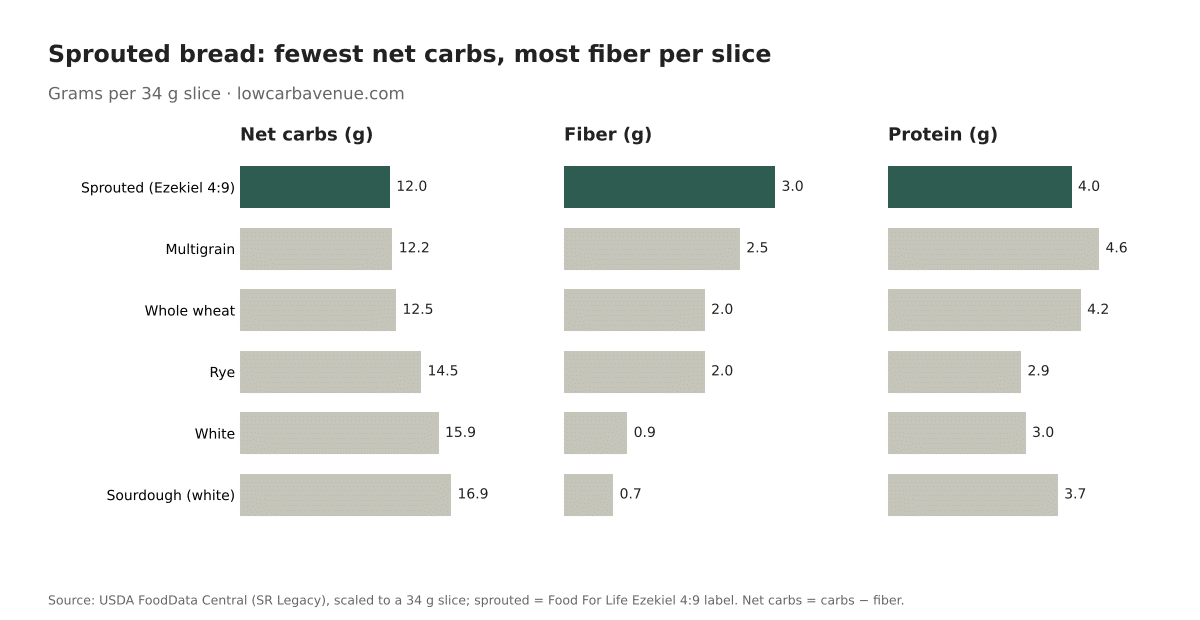
Sprouted, multigrain and whole wheat sit close together on carbs. The real gap is fiber: sprouted bread has more than four times the fiber of white sourdough. Calories barely differ, but sodium does:
| Bread (34 g slice) | Calories | Sodium (mg) |
|---|---|---|
| Sprouted (Ezekiel 4:9) | 80 | 75 |
| Multigrain | 90 | 130 |
| Whole wheat | 86 | 155 |
| White | 90 | 167 |
| Rye | 88 | 205 |
| Sourdough (white) | 92 | 205 |
Sprouted grain bread: the best all-rounder
Sprouted bread is made from whole grains that start to germinate before they are milled. Sprouting breaks down some starch and can make minerals easier to absorb. A typical sprouted loaf has 12 g of net carbs, 3 g of fiber and 75 mg of sodium per slice, with no added sugar.
It also did best in a clinical trial. Researchers at the University of Guelph fed overweight men five breads, each with the same 50 g of carbohydrate. Sprouted-grain bread caused a smaller blood sugar rise than white, 11-grain and sourdough bread (Mofidi et al., 2012).
Which bread raises blood sugar least?
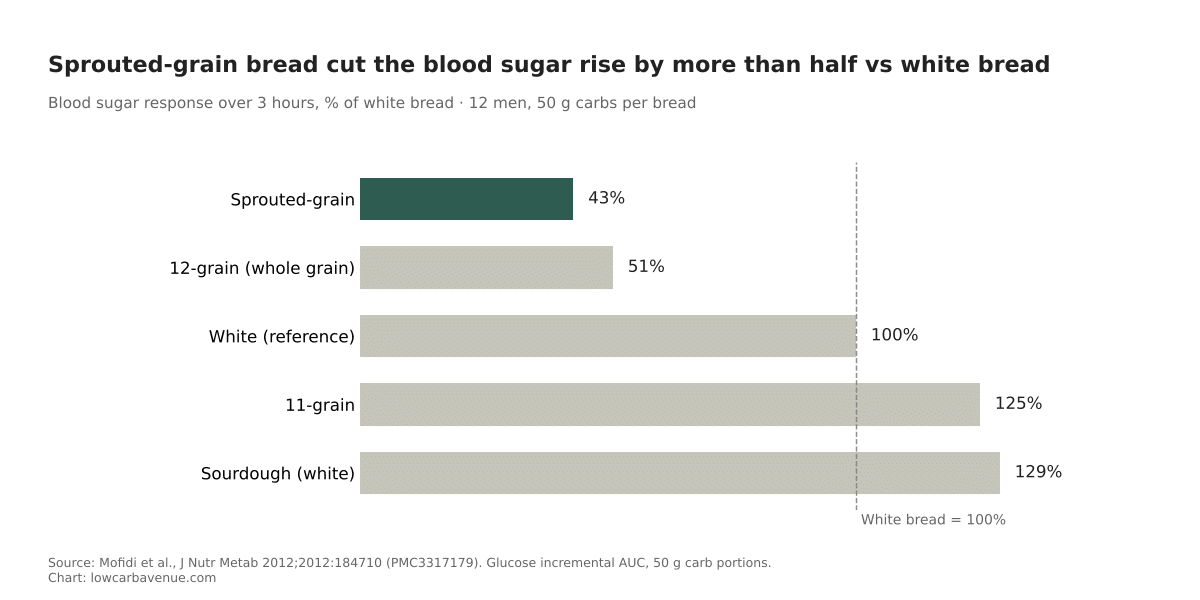
In this trial, sprouted-grain bread raised blood sugar 57% less than white bread for the same amount of carbs. White sourdough did not help: its response was about the same as, or slightly above, white bread. The study was small (12 men) and short (one meal), so treat it as a strong hint, not the final word.
Multigrain bread: only as good as its first ingredient
“Multigrain” just means more than one grain. Those grains can be refined. Harvard Health notes that a “multigrain” or “7 grain” loaf can still be mostly enriched white flour, and that shoppers often pick it over a true whole grain bread because of the label (Harvard Health Publishing).
USDA’s multigrain entry (which includes whole-grain versions) has 12.2 g of net carbs, 2.5 g of fiber and 4.6 g of protein per slice. It also has about 2 g of sugar. A multigrain bread is a good choice when “100% whole grain” is on the label and a whole grain is the first ingredient.
Sourdough bread: great flavor, mixed science
Sourdough is leavened with wild yeast and lactic acid bacteria instead of commercial yeast alone. Its long fermentation lowers phytic acid, which helps the body absorb iron, zinc and magnesium, especially in whole-grain sourdough.
The blood sugar story is less clear than many blogs claim. A 2022 systematic review of 25 clinical trials found that more than half of the studies comparing sourdough with white bread saw no real difference in blood sugar (Ribet et al., 2022). In the Guelph trial, white sourdough produced the highest blood sugar response of the five breads. Most store sourdough is white flour, with 16.9 g of net carbs and under 1 g of fiber per slice.
The best sourdough is whole grain or rye sourdough. The flour type matters more than the fermentation. Want fewer carbs? See our guide to low carb sourdough bread.
Whole wheat and rye: solid, everyday picks
100% whole wheat bread keeps the bran and germ, so it has about twice the fiber of white bread (2 g per slice). Rye bread has a similar amount of fiber but more carbs and more sodium. Many “rye” loaves in U.S. stores are mostly wheat flour, so check that rye flour comes first.
White bread: the one to swap out
White bread is made from refined flour with the bran and germ removed. It has the least fiber (0.9 g per slice) and digests fast. The new Dietary Guidelines name refined grains like white bread as foods to cut back on.
Why whole grains and fiber matter
The benefits of “healthy bread” come mostly from fiber and whole grains:
- Whole grains: in a review of 45 studies, eating 90 g of whole grains a day (about three servings) was linked to a 19% lower risk of heart disease and a 17% lower risk of early death (Aune et al., 2016, BMJ).
- Fiber: a review of 185 studies and 58 trials for the World Health Organization found that people who ate the most fiber had 15–30% lower death rates from all causes and heart disease. Most benefit came at 25–29 g of fiber a day (Reynolds et al., 2019, The Lancet).
These are observational studies, so they show a link, not proof. Still, most Americans eat far less than 25 g of fiber a day, and bread is an easy place to add some.
How to pick a healthy bread in 60 seconds
Turn the bag over and check five things:
- First ingredient: it should say “whole” or “sprouted” (for example, “whole wheat flour” or “sprouted whole wheat”). “Enriched wheat flour” means refined white flour.
- Fiber: at least 3 g per slice, the benchmark Harvard Health suggests for bread.
- Added sugar: 2 g or less per slice. Watch for honey, molasses and cane sugar near the top of the list.
- Sodium: under 150 mg per slice. Breads and rolls are the top source of sodium in the American diet, about 7.4% of the total, per a CDC report (Harvard Health).
- Front-label words: ignore “multigrain,” “wheat,” “stone ground” and dark color. Molasses or caramel color can make white bread look brown.
For a step-by-step guide, see how to read bread nutrition labels.
Is bread “empty calories”? Not if you pick well. A good whole grain or sprouted slice adds fiber, protein and minerals. Refined white bread is the one that comes close to empty calories.
The best bread for your goal
| Your goal | Best pick | Why |
|---|---|---|
| Overall health | Sprouted or 100% whole grain | Most fiber and nutrients from whole grains |
| Lower blood sugar response | Sprouted grain, or a low carb bread with added fiber | Lowest glucose response in one 2012 trial; fewer net carbs |
| Easier digestion | Whole-grain sourdough | Fermentation lowers phytic acid; some people find it easier on the stomach |
| Lower sodium | Sprouted (often 75 mg a slice) | About half the salt of most store breads |
| Low carb or keto | Low carb bread with added fiber and protein | 1–5 g net carbs instead of 12–17 g |
If you have diabetes or another medical condition, talk with your doctor or a registered dietitian about how much bread fits your plan. Blood sugar responses to the same bread can differ a lot from person to person (Korem et al., 2017, Cell Metabolism, reviewed in Ribet et al., 2022). Curious about keto bread specifically? Read is keto bread good for diabetics.
Frequently Asked Questions
Sprouted grain or 100% whole grain bread is the healthiest choice for most people. Look for at least 3 g of fiber and no more than 2 g of added sugar per slice.
Yes, especially whole-grain sourdough. Fermentation helps you absorb minerals. But white sourdough has about the same carbs and fiber as white bread, and studies on its blood sugar benefit are mixed.
No. Multigrain means several grains, which may be refined. Whole grain means the entire grain kernel is used. Look for “100% whole grain” on the label.
Slightly. Sprouted bread has a bit more fiber and less sodium per slice, and it caused a lower blood sugar rise in a clinical trial. Both are good choices.
A low carb bread with added fiber and protein. It keeps the fiber and protein while net carbs drop to a few grams per slice.
Want bread with fewer carbs and more protein?
If you love bread but want fewer carbs, LowCarb Avenue is a physician-founded keto sourdough bakery in Frederick, Maryland. We bake clean-label low carb and keto bread with high-fiber flour, added protein and no sugar. Our Frankie sourdough has 3 g of net carbs and 6 g of protein per serving, per our product label. See our low carb sourdough bread or shop all breads at lowcarbavenue.com.
This article is for general information only and is not medical advice. Talk with your doctor or a registered dietitian about your own diet.
Sources
- Mofidi A, Ferraro ZM, Stewart KA, et al. The acute impact of ingestion of sourdough and whole-grain breads on blood glucose, insulin, and incretins in overweight and obese men. J Nutr Metab. 2012;2012:184710. PMC3317179
- Ribet L, Dessalles R, Lesens C, Brusselaers N, Durand-Dubief M. Nutritional benefits of sourdoughs: a systematic review. Adv Nutr. 2022;14(1):22–29. PMC10103004
- Korem T, Zeevi D, Zmora N, et al. Bread affects clinical parameters and induces gut microbiome-associated personal glycemic responses. Cell Metab. 2017;25(6):1243–1253.
- Aune D, Keum N, Giovannucci E, et al. Whole grain consumption and risk of cardiovascular disease, cancer, and all cause and cause specific mortality. BMJ. 2016;353:i2716. Summary
- Reynolds A, Mann J, Cummings J, et al. Carbohydrate quality and human health: a series of systematic reviews and meta-analyses. The Lancet. 2019. Summary
- McManus KD. Whole grains or no grains? Food labels can be misleading. Harvard Health Publishing, 2020. Harvard Health on misleading whole grain labels
- Harvard Health Publishing. Everyday foods are top 10 sources of sodium (CDC data). 2012. Harvard Health on the top sources of sodium
- USDA FoodData Central, SR Legacy: Bread, multi-grain (FDC 168013); Bread, whole-wheat, commercially prepared (172688); Bread, rye (172684); Bread, white, commercially prepared (174924); Bread, french or vienna, includes sourdough (172675). Values scaled to a 34 g slice. fdc.nal.usda.gov
- Food For Life Ezekiel 4:9 Sprouted Whole Grain Bread, nutrition label, 1 slice (34 g).
- Dietary Guidelines for Americans 2025–2030 coverage: World Grain, Jan 9, 2026; Supermarket Perimeter, Jan 13, 2026


