
How We Calculate Net Carbs: Worked Examples From Our Labels
LowCarb Avenue calculates net carbs one way for every product: total carbohydrate minus dietary fiber, using the numbers printed on our Nutrition Facts labels. We do not subtract anything else. Our breads and bagels contain no sugar alcohols or allulose, so there is nothing else to take away, and any sugar in a product, such as the cane sugar in our biscotti, stays in the net carb count [1][2].
This page shows the exact math for each product, explains where the fiber comes from, and covers the limits of net carb numbers. If you are new to the idea, start with our general explainer, What are net carbs?
What is our net carb formula?
Net carbs = Total Carbohydrate − Dietary Fiber. Both numbers come straight from the label, for the serving size printed at the top of the label. That’s it. We use this simple formula because it is easy for you to check yourself, with nothing hidden.
“Net carbs” is not a term the FDA defines or regulates. The official Nutrition Facts label lists total carbohydrate, dietary fiber, total sugars and added sugars, and some labels also list sugar alcohols [1]. Different brands calculate net carbs in different ways, which is why it helps to see the arithmetic.
Want to check another brand? Use our free net carb calculator to snap a label, scan a barcode, or type the numbers. It shows every step of the math, just like the examples on this page.
Worked examples from our labels
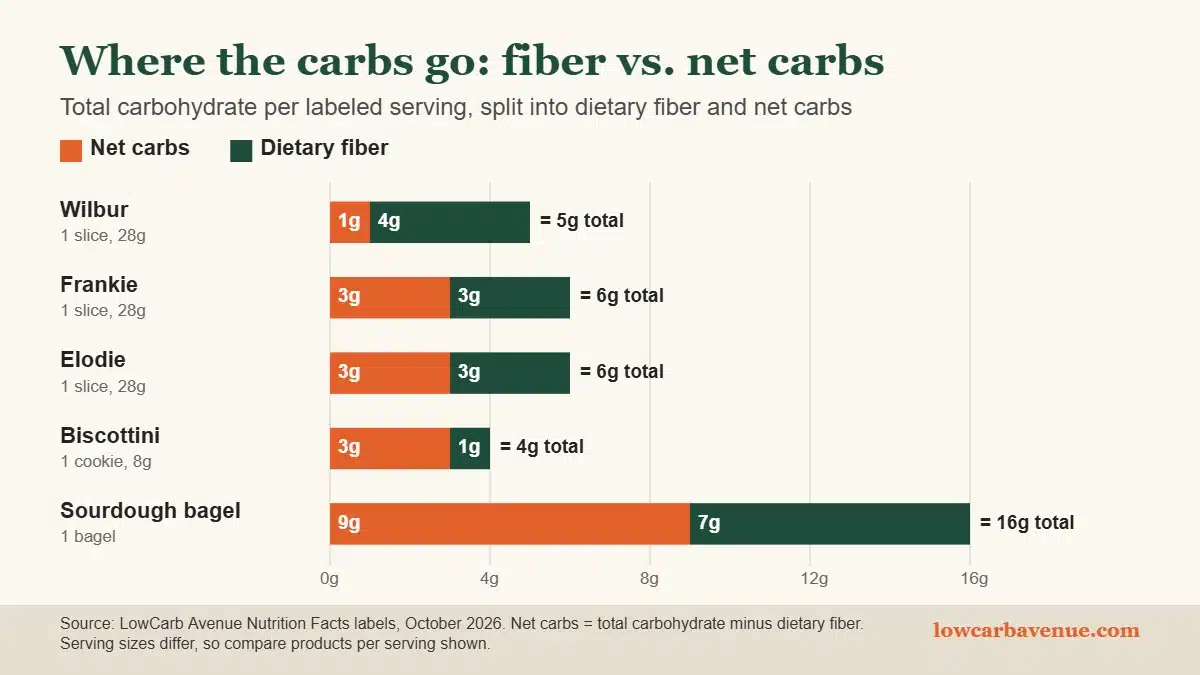
Here is the calculation for each LowCarb Avenue product, using the serving size on its label:
| Product | Serving | Total carbohydrate | Dietary fiber | Net carbs | Protein |
|---|---|---|---|---|---|
| Wilbur (Plain) | 1 slice (28g) | 5g | 4g | 5 − 4 = 1g | 7g |
| Frankie | 1 slice (28g) | 6g | 3g | 6 − 3 = 3g | 6g |
| Elodie | 1 slice (28g) | 6g | 3g | 6 − 3 = 3g | 7g |
| Sourdough bagel | 1 bagel (86g) | 16g | 7g | 16 − 7 = 9g | 25g |
| Lemon Pistachio Biscottini | 1 cookie (8g) | 4g | 1g | 4 − 1 = 3g | 2g |
Source: LowCarb Avenue Nutrition Facts labels, October 2026. Always use the label on the package in your hand, because recipes and labels can be updated.
Where does the fiber come from?
The fiber in our products comes from high-fiber flours and plant fibers that are listed by name on each ingredient label. Here is what is in each dough:
- Frankie, Elodie and our bagels: water, high-fiber wheat flour, wheat protein, sourdough starter, olive oil and sea salt, plus yeast in Elodie [3][4][5].
- Wilbur: wheat protein, almond flour, ground flaxseed, oat fiber, wheat starch, dark rye and wheat fiber, with olive oil, fermented oregano and flaxseed, vinegar, yeast and sea salt [6].
- Biscottini: wheat flour and wheat protein with eggs, butter, cane sugar, pistachios and lemon. This is a small treat rather than a high-fiber food, which is why most of its 4g of carbohydrate counts as net carbs [7].
For the Nutrition Facts label, the FDA counts two kinds of dietary fiber: fibers that are naturally “intrinsic and intact” in plants, and isolated or synthetic fibers that the FDA has reviewed and found to have a beneficial effect on health, such as psyllium husk, cellulose, guar gum and pectin [2]. Some added fibers sold to bakers are only partly digestible. Our article on added fibers in keto bread explains which ones to watch for on other brands’ labels.
Why do labels round the numbers?
Labels show whole grams, so net carb math is an estimate, not an exact measurement. Under FDA rules, total carbohydrate and dietary fiber are rounded to the nearest gram. Amounts under 1 gram may be listed as “less than 1 gram,” and amounts under 0.5 gram may be listed as zero [8].
Here is what that means in practice. A slice listed as 5g total carbohydrate could contain anywhere from 4.5g to just under 5.5g. Fiber listed as 4g could be 3.5g to just under 4.5g. So a “1g net carb” slice could truly be a little less or a little more than 1g. Rounding is why two breads with the same label can differ slightly in real life, and why it is wise not to treat any single number as exact.
What net carbs do not tell you
Net carbs are a useful shortcut for comparing foods, but they have limits:
- They are per serving. Two slices double everything. A thick, hand-cut slice of unsliced Frankie may weigh more than the 28g on the label, so weigh it if you are tracking closely.
- They do not predict your blood sugar. How your body responds depends on the whole meal, portion size, activity, sleep and medications. The American Diabetes Association does not use the term “net carbs” and encourages people with diabetes to work with their care team on carb counting [9].
- Brands count differently. Some subtract sugar alcohols or certain added fibers in full. When you compare products, recalculate everything the same way: total carbohydrate minus dietary fiber.
- Fiber has value of its own. Do not choose a food only because its net carbs are low. Look at the fiber, protein and ingredient list too. Our guide to reading a nutrition label on a low carb diet walks through the whole panel.
If you have diabetes or take medication that lowers blood sugar, talk with your doctor or a registered dietitian before changing how you count carbs.
How to check any bread label in 30 seconds
- Find the serving size and the number of servings you will eat.
- Find Total Carbohydrate and Dietary Fiber.
- Subtract fiber from total carbohydrate.
- Multiply by the number of servings you will eat.
- Check Total Sugars and Added Sugars. They are part of total carbohydrate and are not subtracted.
Using the same five steps on every label is the simplest way to compare brands fairly. To see how our three breads compare beyond carbs, read Wilbur vs. Frankie vs. Elodie.
Clean-label low carb bread with fiber and protein
We keep our net carb math simple because we keep our recipes simple: short ingredient lists, real fiber from the flours we use and plenty of protein in every serving. You can check every number yourself on the label. See our full range of low carb breads, bagels and biscotti at lowcarbavenue.com.
Frequently asked questions
How does LowCarb Avenue calculate net carbs?
We subtract dietary fiber from total carbohydrate, using the numbers on each Nutrition Facts label for the serving size shown. We do not subtract sugar, sugar alcohols or anything else.
Why does Wilbur have only 1g of net carbs?
A 28g slice of Wilbur has 5g of total carbohydrate and 4g of dietary fiber, so 5 minus 4 leaves 1g of net carbs.
How many net carbs are in a LowCarb Avenue bagel?
Each sourdough bagel has 16g of total carbohydrate and 7g of dietary fiber, which equals 9g of net carbs. It also has 25g of protein.
Are net carbs on a label exact?
No. FDA rules round total carbohydrate and fiber to the nearest gram, so a net carb number calculated from a label can be off by a fraction of a gram either way.
Is net carbs an FDA term?
No. The FDA does not define net carbs. The Nutrition Facts label lists total carbohydrate, dietary fiber, sugars and sometimes sugar alcohols, and brands calculate net carbs in different ways.
Sources
- How to Understand and Use the Nutrition Facts Label.
- Questions and Answers on Dietary Fiber.
- Frankie Low Carb Sourdough Bread: Nutrition Facts and ingredients.
- Elodie Low Carb Sourdough Sandwich Bread: Nutrition Facts and ingredients.
- Low Carb Sourdough Bagels: Nutrition Facts and ingredients.
- Wilbur Low Carb Plain Bread: Nutrition Facts and ingredients.
- Lemon Pistachio Biscotti: Nutrition Facts and ingredients.
- 21 CFR 101.9, Nutrition labeling of food, paragraph (c)(6): carbohydrate content.
- Get to Know Carbs.
This article is for general education and is not medical advice. Talk with your doctor or a registered dietitian before changing your diet, especially if you take medication for diabetes or blood pressure. How we research and write.