
Fiber on a Low-Carb Diet: How Much You Need and the Best Sources
Most adults need about 21 to 38 grams of fiber a day, depending on age and sex, and the average American gets only about 15 [1][5]. You can absolutely hit a healthy fiber target on a low-carb or keto diet. It just takes some planning, because many classic high-fiber foods, like beans and whole grains, are also high in carbs.
How much fiber do you need?
The general rule behind U.S. fiber recommendations is 14 grams of fiber for every 1,000 calories you eat [2]. Translated into daily targets for adults, that looks like this [1]:
| Group | Daily fiber target |
|---|---|
| Women 50 and younger | 25 g |
| Women 51 and older | 21 g |
| Men 50 and younger | 38 g |
| Men 51 and older | 30 g |
The Daily Value printed on Nutrition Facts labels is 28 grams [8], which sits right in the middle of those targets. So a food listing 10% DV for fiber has roughly 3 grams.
Very few people get there. An analysis of national survey data from 2013 to 2018, presented at a 2021 American Society for Nutrition meeting, found that only about 7% of U.S. adults met their fiber recommendation: about 5% of men and 9% of women [3]. Those results were preliminary at the time, but they line up with the long-standing estimate of roughly 15 grams a day for the average American [1][5].
Why fiber is worth the effort
Fiber is a type of carbohydrate your body can’t break down and absorb the way it does sugar and starch. That’s exactly why it’s useful.
Two main types
- Soluble fiber dissolves in water and forms a gel that slows digestion. Chia seeds, nuts, and some fruits are good sources [5].
- Insoluble fiber doesn’t dissolve. It adds bulk and helps food move through your digestive tract. Leafy greens, almonds, walnuts, and seeds all supply it [5].
Some fibers are also “fermentable,” which means the bacteria in your gut feed on them and produce short-chain fatty acids that support gut health [5].
What the research shows
The biggest look at this question so far was a 2019 series of reviews in The Lancet. It pooled 185 observational studies and 58 clinical trials [4]. People who ate the most fiber had a 15% to 30% lower risk of dying from any cause, and from heart disease, than those who ate the least [4]. They also had a 16% to 24% lower rate of coronary heart disease, stroke, type 2 diabetes, and colorectal cancer [4]. The benefits appeared strongest at about 25 to 29 grams a day, with hints that more may help further [4]. Much of this evidence is observational, so it shows strong links rather than proof that fiber alone caused the difference.
Harvard’s Nutrition Source adds a few practical benefits. Soluble fiber can blunt the rise in blood sugar after a meal and may help you feel full. It also binds bile acids in the gut, which nudges the liver to pull cholesterol out of the blood [5]. And fiber in general helps prevent constipation [5], a complaint many people notice in the first weeks of a new low-carb diet.
Why fiber gets tricky on low-carb and keto
When you cut out bread, pasta, rice, cereal, and beans, you lose a lot of the foods most Americans rely on for fiber. If you replace them mostly with meat, eggs, and cheese, which contain no fiber, your daily total can drop fast.
The good news is that fiber doesn’t count against you the way sugar and starch do. Because it isn’t digested like other carbs, most low-carb eaters subtract it from total carbohydrates to get net carbs. That means high-fiber, low-starch foods give you a lot of bulk and nutrition for a small net-carb cost.
The best low-carb sources of fiber
Non-starchy vegetables, berries, avocado, nuts, and seeds are the backbone of a high-fiber low-carb plan. Here’s how some of them stack up per standard portion, using USDA data published with the Dietary Guidelines [6].
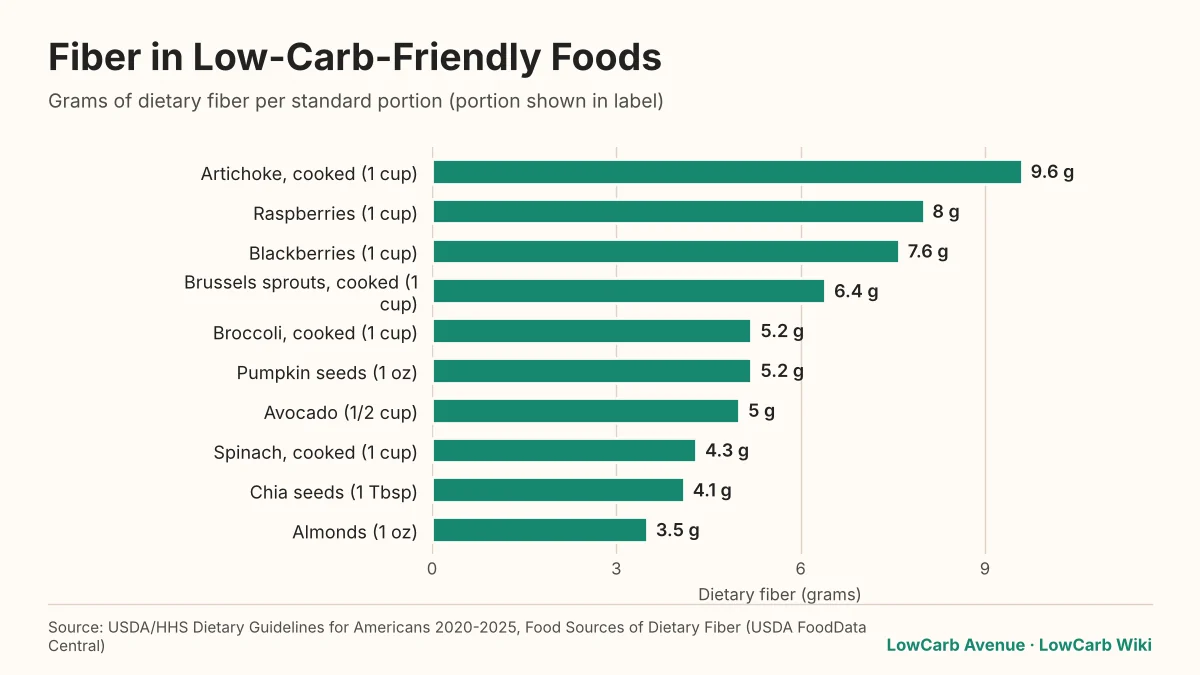
A few things stand out. A single cup of raspberries or blackberries delivers about 8 grams [6], which is a lot for a fruit that fits easily into most low-carb plans in modest amounts. Cooked artichoke tops the list at nearly 10 grams per cup [6]. And tiny additions add up: a tablespoon of chia seeds provides about 4 grams [6][9], and 2 tablespoons of ground flaxseed gives about 4 grams as well [9].
Easy ways to add fiber without adding many carbs
- Stir chia seeds or ground flaxseed into Greek yogurt, smoothies, or low-carb “oatmeal” [5].
- Fill half your plate with broccoli, Brussels sprouts, leafy greens, or cauliflower.
- Add half an avocado to eggs or salads.
- Snack on a small handful of almonds or pumpkin seeds instead of chips.
- Top a bowl of berries with nuts for dessert.
- Choose a low-carb bread that gets its fiber from recognizable ingredients.
Natural fiber vs. added fiber
Read enough “keto” labels and you’ll notice that some packaged foods list surprisingly high fiber numbers. Often that fiber is added as an isolated ingredient rather than coming from whole plants.
The FDA counts two kinds of fiber on Nutrition Facts labels. The first is fiber that occurs naturally and intact in plants. The second is isolated or synthetic fiber that the agency has decided has a real health benefit, like helping lower blood sugar or cholesterol or improving regularity [7]. Approved examples include psyllium husk, cellulose, guar gum, and pectin, and the agency has signaled it will also allow ingredients like inulin, polydextrose, and resistant maltodextrin to count [7].
Added fibers aren’t automatically bad, and some have good research behind them. But they don’t bring along the vitamins, minerals, and plant compounds you get from vegetables, nuts, and seeds. Harvard notes that fiber supplements can help but don’t replace high-fiber foods [5]. If you want to know what’s in your bread or tortillas, our guide to added fibers in keto bread breaks down the common ones, and our article on reading a nutrition label shows where to find them.
Go slow and drink water
If your fiber intake has been low, jumping straight to 30 grams can leave you bloated and gassy. Harvard suggests raising fiber gradually, and drinking more fluids helps ease the transition [5]. Mayo Clinic gives similar advice for fiber supplements: start with a low dose and increase slowly [1].
If you have a digestive condition, or you take medication for diabetes or blood pressure, check with your doctor or a registered dietitian before making big changes to your diet. Fiber can affect blood sugar after meals, and some supplements can interfere with how medicines are absorbed.
Where LowCarb Avenue fits
Bread is one of the hardest foods to give up on a low-carb diet, and it’s also where many people lost most of their fiber. At LowCarb Avenue, we bake clean-label low-carb and keto bread with fiber and protein, made in small batches with ingredients you can recognize. Wilbur, our multigrain loaf, Frankie and Elodie sourdough, and Brooklyn Baby bagels make it easier to build a fiber-friendly sandwich or breakfast without the carb load of regular bread. See what’s fresh at lowcarbavenue.com/shop.
Frequently asked questions
How much fiber should I eat on keto?
The same targets apply as for anyone else: about 25 grams a day for women 50 and under, 21 for women over 50, 38 for men 50 and under, and 30 for men over 50. Non-starchy vegetables, berries, avocado, nuts, and seeds make those numbers reachable on keto.
Does fiber count toward net carbs?
No. Most low-carb eaters subtract fiber from total carbohydrates to calculate net carbs, because fiber isn't digested and absorbed the way sugar and starch are.
Why am I constipated on a low-carb diet?
Cutting grains, beans, and many fruits can lower your fiber intake quickly. Adding more non-starchy vegetables, berries, chia or flax, and drinking more fluids often helps. If it continues, talk with your doctor.
Is added fiber in keto bread as good as fiber from vegetables?
The FDA only lets isolated fibers count on labels if they have a recognized health benefit, so they aren't empty. But they don't come with the vitamins, minerals, and plant compounds in whole foods, so it's smart to get most of your fiber from vegetables, nuts, and seeds.
What is the highest-fiber low-carb food?
Among common low-carb foods in USDA data, cooked artichoke is near the top at about 9.6 grams per cup, followed by raspberries at 8 grams per cup. By weight, chia seeds are especially dense, with about 4 grams per tablespoon.
Sources
- Mayo Clinic Q and A: What's the best way to boost your fiber intake?.
- Chart of high-fiber foods.
- Most Americans are not getting enough fiber in our diets (NUTRITION 2021 abstract, NHANES 2013-2018).
- Carbohydrate quality and human health: a series of systematic reviews and meta-analyses (Reynolds A, et al.). The Lancet.
- Fiber.
- Food Sources of Dietary Fiber (Dietary Guidelines for Americans 2020-2025 online materials).
- Questions and Answers on Dietary Fiber.
- Daily Value on the Nutrition and Supplement Facts Labels.
- A Guide to High Fiber Foods.
This article is for general education and is not medical advice. Talk with your doctor or a registered dietitian before changing your diet, especially if you take medication for diabetes or blood pressure. How we research and write.