
Added Fibers in Keto Bread: Corn Fiber, Wheat Starch & More
Added fibers are fibers that food makers extract from plants or produce in a plant, then mix into products like low-carb bread. On a US label, an isolated fiber only counts as “dietary fiber” if FDA has accepted evidence that it benefits health, and the blood-sugar research looks quite different from one fiber to the next.
If you buy keto bread, wraps, or snack bars, you’ve probably seen ingredients like soluble corn fiber, resistant wheat starch, or inulin near the top of the list. They’re a big reason a slice can show very few net carbs. Here’s what they are, how the rules work, and what the studies actually show.
What counts as an “added” fiber?
FDA’s definition of dietary fiber has two parts. The first covers non-digestible carbohydrates (with three or more sugar units) and lignin that are naturally present and still intact in plants. The second covers isolated or synthetic non-digestible carbohydrates that FDA has decided have a beneficial physiological effect on people [1].
Intact fiber is what you get when you eat flaxseed, almonds, beans, or a bowl of oats. The fiber is still locked inside the food’s original structure. Isolated fiber has been separated from its source, such as cellulose or inulin from chicory root. Synthetic fiber is built from smaller pieces, like polydextrose. Either way, it arrives at the bakery as a powder.
Why bakers use them
- Structure and bulk. They replace part of the wheat flour so a loaf still looks and slices like bread.
- Moisture and softness. Many soluble fibers hold water, which keeps low-carb bread from drying out.
- Fewer digestible carbs. Swapping starch for fiber lowers the carbs your body can turn into glucose.
- A bigger fiber number. Most Americans eat only about 15 grams of fiber a day, well below the 25 to 35 grams often recommended [4]. The Daily Value used on labels is 28 grams [3], so a high fiber count is an easy selling point.
How FDA decides which isolated fibers count
When FDA finalized the updated Nutrition Facts label in 2016, it named seven isolated or synthetic fibers that qualify: beta-glucan soluble fiber, psyllium husk, cellulose, guar gum, pectin, locust bean gum, and hydroxypropylmethylcellulose [1].
Any other isolated fiber needs a citizen petition with scientific evidence of a health benefit. FDA’s 2018 guidance gives lowering the rise in blood glucose after a meal as one example of a qualifying effect [2]. Glucomannan, from konjac root, was accepted in 2020 because the evidence suggested it can help lower blood cholesterol [10].
One detail in that guidance matters a lot for shoppers. To test a blood-sugar benefit, FDA wants the fiber added to a food that contains sugar or starch and compared with a control that has the same amount of sugar or refined carbohydrate. It shouldn’t simply replace the sugar [2]. Why? If you take 10 grams of starch out of a muffin, blood sugar will drop no matter what you put in its place. Keep that in mind when you read the studies below.
Since 2016, FDA has said it intends to add eleven more fibers to the definition: eight in 2018, cross-linked phosphorylated RS4 in 2019, glucomannan in 2020, and acacia (gum arabic) in 2021. Until the formal rulemaking is done, companies may include them in the fiber line [1]. A carbohydrate whose petition is still pending can’t be counted as fiber, but it must still be counted in Total Carbohydrate [1].
| Fiber | Names you may see on the ingredient list | FDA status |
|---|---|---|
| Cellulose, psyllium, guar gum, pectin, locust bean gum, HPMC | Cellulose, psyllium husk, guar gum, pectin, locust bean gum, hydroxypropylmethylcellulose | Named in the 2016 rule |
| Inulin and inulin-type fructans | Inulin, chicory root fiber | Added 2018 |
| Resistant maltodextrin/dextrin | Resistant dextrin, resistant maltodextrin, soluble corn fiber | Added 2018 |
| Polydextrose | Polydextrose | Added 2018 |
| High-amylose starch (RS2) | High-amylose corn starch, resistant corn starch | Added 2018 |
| Cross-linked phosphorylated RS4 | Resistant wheat starch, modified wheat starch | Added 2019 |
| Glucomannan | Konjac, glucomannan | Added 2020 |
| Acacia | Acacia gum, gum arabic | Added 2021 |
| Isomaltooligosaccharide | IMO, isomalto-oligosaccharide | Not on FDA’s list |
One thing the label doesn’t show you: whether a fiber is one FDA recognizes. Fiber grams are fiber grams on the panel. That’s why the ingredient list is worth a closer look.
What the research says about blood glucose
Soluble fiber can form a gel that slows digestion, which may help soften blood-sugar spikes after eating [4]. But isolated fibers aren’t all alike, and the evidence for each one comes from different study designs.
Soluble corn fiber
In a 2020 crossover trial of 22 healthy men, a drink made with soluble corn fiber produced about a 20% lower blood glucose response and about a 40% lower insulin response than a matching maltodextrin drink [5]. The study was partly funded by the ingredient’s maker, which also supplied the test materials [5].
Resistant wheat starch (RS4)
RS4 is starch that has been chemically modified so your gut enzymes can’t easily break it down. In a 2018 study, 32 adults whose glucose was analyzed had a 43% to 45% smaller glucose response after a high-fiber RS4 scone than after a low-fiber scone [6]. The fiber scone, though, also had about 10 fewer grams of available carbohydrate (28.9 g vs. 38.8 g) [6]. So it’s hard to say how much of the drop came from the fiber itself and how much came from simply having less starch.
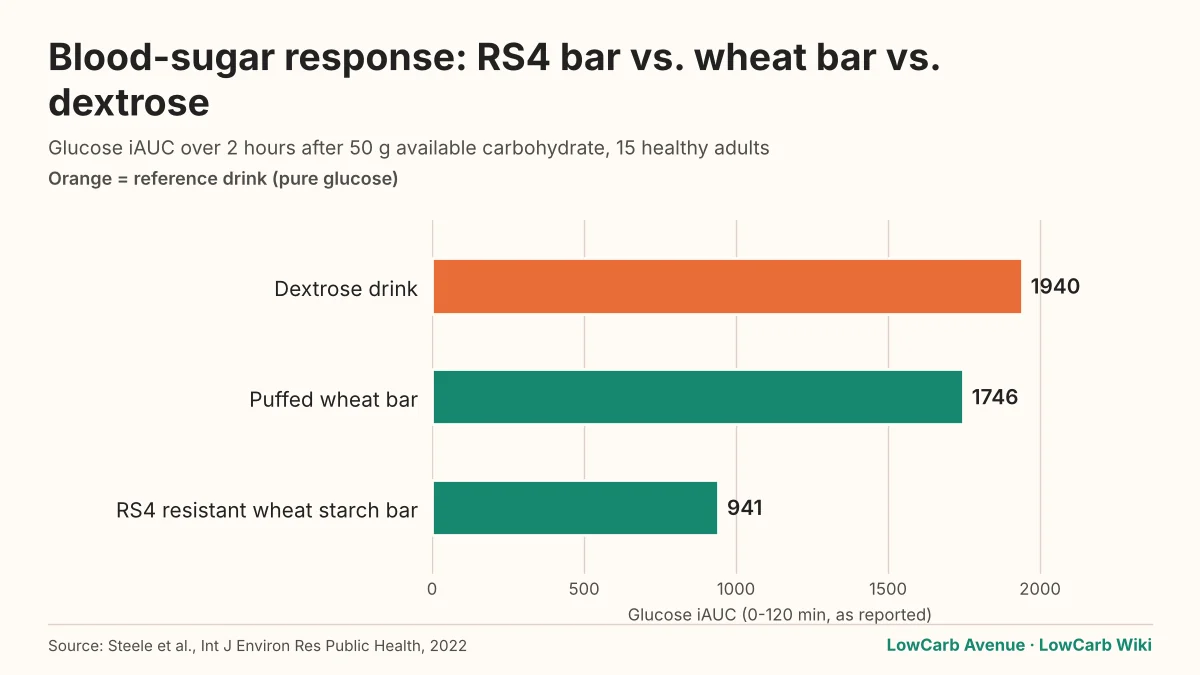
A 2022 trial in 15 young adults found the same pattern. When RS4 stood in for part of the carbohydrate in a nutrition bar, the glucose response was roughly half that of an otherwise similar puffed-wheat bar [7]. An earlier small study of 11 people found that a cross-linked RS4 raised blood glucose less than both dextrose and a type 2 resistant starch [9].
Isomaltooligosaccharide (IMO)
IMO is a syrup or powder sometimes marketed as a fiber. In a 2018 trial of 26 adults, IMO raised blood glucose over the first two hours about as much as dextrose did, and the difference wasn’t statistically significant [8]. The authors, who worked for the ingredient’s producer, described IMO as digestible and a source of calories [8]. It isn’t on FDA’s list of recognized fibers [1].
What these studies can’t tell you
- Most were small, short, and done in healthy adults, not people with diabetes.
- Several were funded by the companies that make the fiber [5][6][7][8].
- They tested one serving on one day, not months of regular eating.
- Some swapped fiber for starch, which is the design FDA’s guidance warns against for proving a fiber’s own effect [2].
How to spot added fibers on an ingredient list
- Skip the front of the package. “High fiber” and “low net carb” claims don’t tell you which fiber is doing the work.
- Scan the first five ingredients. Ingredients are listed from most to least by weight, so a fiber near the top makes up a big share of the loaf.
- Match the names to the table above. Soluble corn fiber, resistant wheat starch, oat fiber, inulin, and polydextrose are common in keto bread.
- Compare fiber with total carbs. If dietary fiber is almost as large as Total Carbohydrate, nearly all the carbs come from added fiber. That isn’t bad on its own, but it tells you what you’re eating.
- Look twice at IMO. If you see isomaltooligosaccharide, remember the research above suggests it acts more like a digestible carb.
- Check your own response. A glucose meter or continuous glucose monitor will show you how a specific bread affects you.
If you take diabetes or blood-pressure medication, talk with your doctor or a registered dietitian before making big changes to your carb intake.
For more on reading labels, see our guides to net carbs, the Nutrition Facts label, fiber on a low-carb diet, and glycemic index vs. glycemic load.
Where LowCarb Avenue fits
At LowCarb Avenue, we bake low-carb and keto bread in small batches with clean-label ingredients, aiming for real fiber and protein in every slice. We list every ingredient plainly so you can read the label the same way this guide suggests. Try Wilbur, our multigrain loaf, Frankie and Elodie, our sourdough breads, or our Brooklyn Baby bagels, and judge them by the ingredient list as much as the taste. You can see the full lineup at lowcarbavenue.com/shop.
Frequently asked questions
Is added fiber in keto bread bad for you?
Not necessarily. Many added fibers are recognized by FDA as having a health benefit. The issue is that they behave differently, so it helps to know which one is in your bread and how your own blood sugar responds.
Does soluble corn fiber raise blood sugar?
In a 2020 trial of 22 healthy men, a soluble corn fiber drink produced about a 20% lower glucose response than a maltodextrin drink. That was a small, single-day study, so individual results can differ.
Why does my keto bread label show almost as much fiber as carbs?
That usually means most of the carbohydrate comes from added fiber, such as resistant wheat starch or soluble corn fiber. Net carbs on the front of the pack are calculated by subtracting that fiber.
Is isomaltooligosaccharide (IMO) a fiber?
It isn't on FDA's list of recognized dietary fibers. In a 2018 study, IMO raised blood glucose over two hours about as much as dextrose, and the researchers described it as digestible.
How can I tell which fiber is in my bread?
Check the ingredient list, not the front of the package. Look for names like soluble corn fiber, resistant dextrin, resistant or modified wheat starch, inulin, chicory root fiber, polydextrose, or IMO.
Sources
- Questions and Answers on Dietary Fiber.
- FDA Releases Guidance on Fiber and Several Other Key Issues.
- Daily Value on the Nutrition and Supplement Facts Labels.
- Fiber.
- The Role of Soluble Corn Fiber on Glycemic and Insulin Response (Tan et al.).
- Type-4 Resistant Starch in Substitution for Available Carbohydrate Reduces Postprandial Glycemic Response and Hunger in Acute, Randomized, Double-Blind, Controlled Study (Stewart et al.).
- Glycemic and Insulinemic Responses of Healthy Humans to a Nutrition Bar with or without Added Fibersym RW, a Cross-Linked Phosphorylated RS4-Type Resistant Wheat Starch (Steele et al.).
- Gastrointestinal Tolerance and Glycemic Response of Isomaltooligosaccharides in Healthy Adults (Gourineni et al.).
- Different Types of Resistant Starch Elicit Different Glucose Responses in Humans.
- FDA Grants Citizen Petition on Glucomannan as a Dietary Fiber.
This article is for general education and is not medical advice. Talk with your doctor or a registered dietitian before changing your diet, especially if you take medication for diabetes or blood pressure. How we research and write.