
Frozen Bread Shipping and Storage: What to Expect When Your Order Arrives
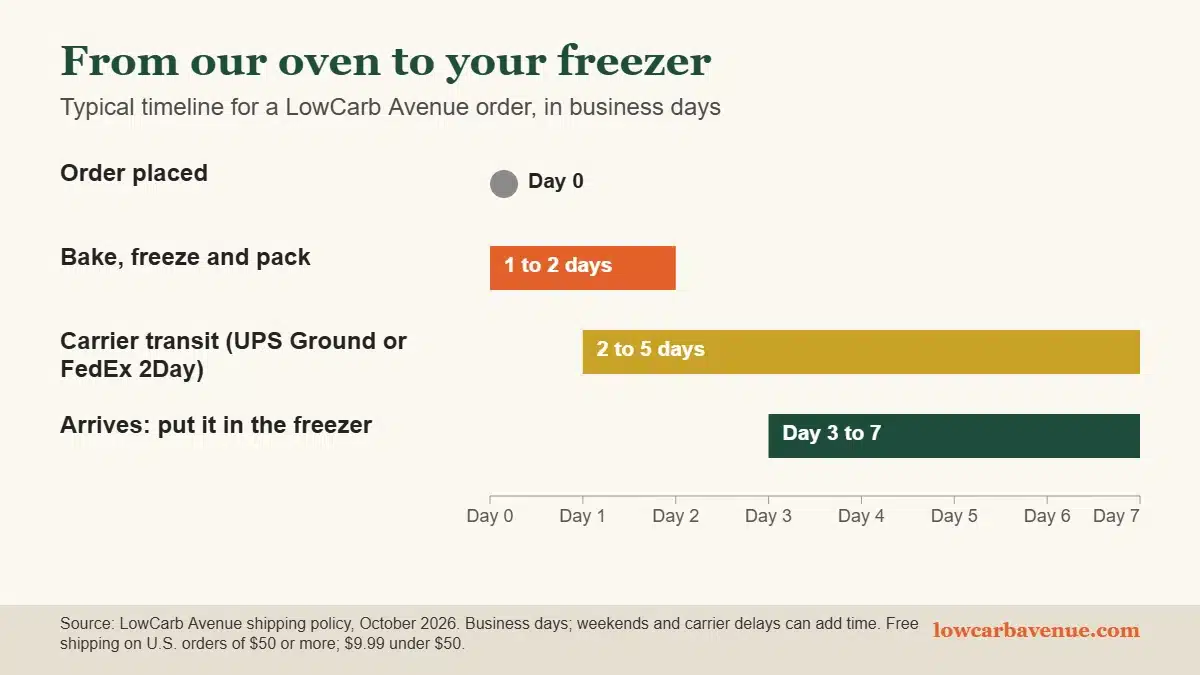
LowCarb Avenue bakes its breads and bagels in small batches, freezes them at peak freshness and ships them to you. Most orders are packed within 1 to 2 business days and spend 2 to 5 business days with the carrier. When your box arrives, put everything in the freezer right away. Because our products contain no preservatives, the freezer is what keeps them tasting fresh. Frozen at 0°F, they keep their best quality for about 2 to 3 months [1][2].
How does frozen shipping work?
We freeze our products before they leave the bakery so they start their trip as fresh as possible. Here is what happens after you order:
- Bake, freeze and pack (1 to 2 business days). We bake in Frederick, Maryland, freeze the bread and bagels, and pack your order.
- Ship (2 to 5 business days). Most orders go by UPS Ground. Orders to the West Coast and other far-away states, such as California, Washington, Texas, Colorado and Alaska, go by FedEx 2Day so they spend less time in transit.
- Track. As soon as your order ships, we email a tracking link to the address you used at checkout.
Carrier transit time starts when the package is picked up, not when you place the order. Weekends, holidays and weather can add time.
How much does shipping cost?
Shipping is free on orders of $50 or more anywhere in the United States. Orders under $50 ship for a flat $9.99. Your exact shipping charge is always shown at checkout before you pay.
What should I expect when my box arrives?
Your bread and bagels may arrive frozen, cool or fully thawed, depending on the weather and how long the trip took. Thawed on arrival is normal and is not a safety problem. Bread and bagels are not perishable the way meat or dairy are; we freeze them to protect flavor and texture, not because they must stay frozen to be safe. The USDA notes that freezer storage times are about quality only [1].
When the box arrives:
- Open it the same day.
- Check each item for damage, mold or a torn bag.
- Put everything you will not eat in the next day or two straight into the freezer, still in its bag.
- Note the “freeze by” date on each package.
How should I store low carb bread and bagels?
The freezer is the best place for bread you will not finish within a few days. Here is how each storage option compares:
| Where | How long | What happens |
|---|---|---|
| Counter (room temperature) | Until the “freeze by” date on the package | Best texture for bread you will eat soon. Without preservatives, mold can develop if bread is left out too long. |
| Refrigerator | Not recommended | Slows mold but makes bread go stale faster [3]. |
| Freezer (0°F) | About 2 to 3 months for best quality [2] | Locks in freshness. Food kept frozen at 0°F stays safe indefinitely, but quality slowly declines [1]. |
Why the fridge makes bread stale
Staling is not the same as drying out. As bread cools and sits, its starch slowly rearranges into firm, crystal-like structures, a process called retrogradation. A study in the journal Starch compared bread stored at room temperature (25°C), in the refrigerator (4°C) and in the freezer (-18°C). Retrogradation was fastest at refrigerator temperature. In frozen bread, almost no new crystals formed, and the crumb’s water activity stayed nearly constant for the 23 days studied [3]. In plain terms, the fridge speeds up staling and the freezer nearly pauses it.
Tips for freezing
- Slice before you freeze. If you bought an unsliced loaf, slice it first so you can take out one slice at a time.
- Keep the air out. Press extra air out of the bag, or move slices to a freezer bag, to help prevent freezer burn.
- Label the bag. Write the date you froze it so you can use the oldest bread first.
- Do not stack heavy items on bagels until they are frozen solid, so they keep their shape.
How do I thaw and toast frozen bread and bagels?
You do not need to thaw before toasting. Here are three easy ways to enjoy them:
- Toast from frozen. Put a frozen slice straight into the toaster. You may need a slightly longer cycle. Slice bagels before freezing, or let them sit for a few minutes so a knife can get through, then toast.
- Thaw on the counter. Leave slices in the bag at room temperature for about 15 to 30 minutes, then use them for sandwiches.
- Warm in the oven. For a whole bagel or a crusty slice of Frankie, warm it in a 350°F oven for a few minutes until heated through.
Low carb breads made with nut flours, added fiber and extra protein often brown faster than regular bread, so start with a lighter toaster setting and adjust. For more ideas, see our guide on how to build a low carb sandwich.
What if my order arrives damaged or never arrives?
We want every box to arrive in great shape. If something goes wrong:
- Damaged or defective items: if a product arrives moldy, stale or improperly packaged, contact us within 7 days of delivery. Include your order number, the email address you used, and clear photos of the package and the affected items.
- Missing package: if tracking shows your order was never delivered, email us with your order number within 7 days of the expected delivery date so we can investigate.
You can read the full details on our refunds and returns page or reach the team through our contact page.
Food safety basics for frozen bread
A few simple rules from food safety experts apply to bread too:
- Keep your freezer at 0°F (-18°C) or colder. Food kept frozen at that temperature stays safe indefinitely [1].
- Throw away any bread with visible mold. Do not try to cut the mold off soft bread, because mold can spread below the surface [4].
- Freezer burn, the dry, grayish patches on frozen food, affects quality but not safety. Trim off small dry spots, or toast the slice well [5].
Freshly baked, clean-label low carb bread delivered
We freeze our bread instead of adding preservatives because we want our ingredient lists to stay short and simple. Every loaf and bagel is baked in small batches with real fiber and protein in every serving. Browse our breads and bagels at lowcarbavenue.com, and compare our three breads in Wilbur vs. Frankie vs. Elodie.
Frequently asked questions
Is it okay if my bread arrives thawed?
Yes. Bread and bagels may arrive frozen, cool or thawed depending on weather and transit time. We freeze them to protect freshness, not because they must stay frozen to be safe. Put them in the freezer when they arrive.
How long does low carb bread last in the freezer?
Bread without preservatives keeps its best quality for about 2 to 3 months at 0u00b0F, according to Kansas State University Extension. Frozen food stays safe indefinitely, but texture and flavor slowly decline.
Should I keep low carb bread in the refrigerator?
We do not recommend it. Research shows bread stales fastest at refrigerator temperature. Keep bread you will eat soon on the counter and freeze the rest.
Can I toast bread and bagels straight from the freezer?
Yes. Slice before freezing, then toast slices straight from frozen. You may need a slightly longer toaster cycle. Low carb breads can brown faster, so start on a lighter setting.
What should I do if my order arrives damaged?
Contact LowCarb Avenue within 7 days of delivery with your order number, the email you ordered with, and photos of the package and the affected items so the team can help.
Sources
- Freezing and Food Safety.
- Safe Food Storage: The Refrigerator and Freezer (MF3130).
- Aguirre JF, Osella CA, Carrara CR, Su00e1nchez HD, Buera MP. Effect of storage temperature on starch retrogradation of bread staling. Starch/Stu00e4rke 63(9):587-593.
- Molds on Food: Are They Dangerous?.
- Freezer Burn and Food Safety.
This article is for general education and is not medical advice. Talk with your doctor or a registered dietitian before changing your diet, especially if you take medication for diabetes or blood pressure. How we research and write.