What Is a Fiber Bomb Bread? The Trick Behind “Zero Net Carb” Loaves
You walk into the bread aisle. Two loaves catch your eye. One says “1g net carbs.” The other says “0g net carbs.” Both look similar. Both cost about the same. You grab the zero — obviously. After all, fewer carbs is better, right?
Not quite. If that “zero” loaf is what we call a fiber bomb, you may have just bought something that behaves in your body almost nothing like the simple, low-carb staple the front of the bag promises.
A fiber bomb bread is any loaf that uses unusually large amounts of isolated fiber additives — typically 12 to 18 grams per slice — to mathematically erase its net carb count on the label. The math is technically legal. The result on your blood sugar, your gut, and your hunger? Often a different story entirely.
This article breaks down exactly what’s happening, why it matters, and how to identify a fiber bomb in under 30 seconds the next time you’re holding a loaf at the store.
The math problem at the center of every “zero net carb” claim
Net carbs are calculated by subtracting fiber from total carbohydrates. For a slice that has 18g total carbs and 14g fiber, the math works out to 4g net carbs. Not bad for a slice of bread, on paper.
But “fiber” isn’t a single thing. The word covers a wide range of substances, and the gap between them is enormous. Naturally occurring fiber from things like flax, almond flour, oat bran, or chia seeds behaves very differently inside your body than the highly processed fiber concentrates that food manufacturers can extract, refine, and dump into a recipe by the cupful.
The most common isolated fibers you’ll find in fiber bomb breads include:
- Modified wheat starch (also written “resistant wheat starch”)
- Soluble corn fiber (Promitor, Fibersol, Nutriose)
- Polydextrose
- Inulin / chicory root fiber in concentrated form
- Vital wheat gluten (technically a protein, but often used to compensate for what isolated fiber takes away in structure)
These ingredients let bakers hit a low net carb number on the label while still producing something that looks, slices, and toasts like ordinary bread. The catch is that the FDA permits all of these to be counted as fiber for labeling purposes — but your body doesn’t necessarily treat them that way.
What “isolated fiber” actually does to your body
Real, intrinsic fiber — the kind embedded in nuts, seeds, vegetables, and whole grains — passes through your digestive system mostly intact. It slows the absorption of sugars from the food it’s bound to. It feeds your gut bacteria. It helps you feel full. It does not spike blood glucose.
Isolated fibers are a more complicated story. Some, like polydextrose and modified wheat starch, are partially digestible. They can cause real glycemic responses, especially in larger amounts. Many cause significant gastrointestinal distress — bloating, gas, urgency, and discomfort — at the doses you’d hit by eating two slices of fiber bomb bread for a sandwich. Independent continuous glucose monitor (CGM) studies on these products have documented blood sugar spikes that the labels would suggest are impossible.
The bigger issue is that 14g of isolated fiber in a single 28g slice of bread is, frankly, an industrial dose. You’re consuming a fiber concentrate, not a food. Your gut wasn’t built for it.
How to spot a fiber bomb in 30 seconds
You don’t need a chemistry degree. You need three numbers and an ingredient list.
- Look at the dietary fiber line. Anything over 5g per slice is already unusual.
- Compare it to total carbs. If fiber is more than 70% of total carbs (e.g. 14g fiber out of 18g total), you’re looking at a likely fiber bomb.
- Scan the ingredient list for the words above. “Modified wheat starch,” “soluble corn fiber,” “polydextrose” — if any of these appear in the first five ingredients, the bread depends on isolated fiber to hit its carb numbers.
The TrueCarbs app automates this check. Snap a photo of any nutrition label and it flags fiber bombs in real time, so you can decide for yourself whether the trade-off is worth it before you buy.
What honest low-carb bread looks like
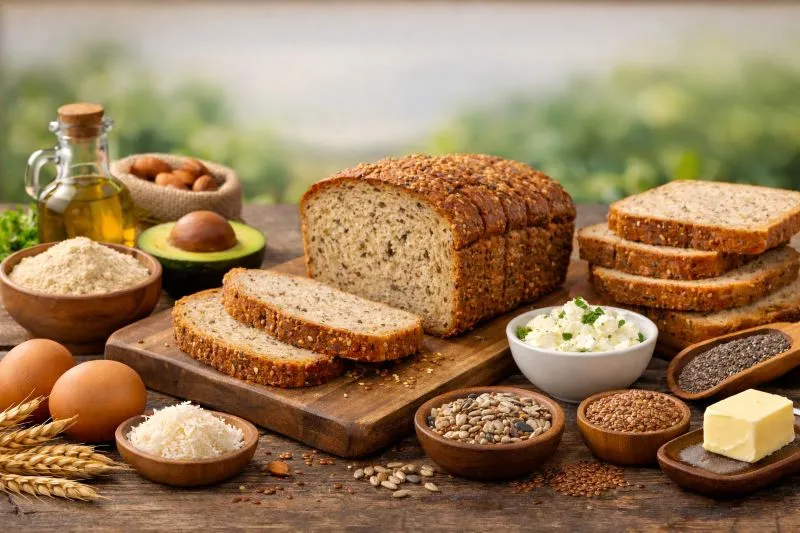
Real low-carb bread doesn’t need 14 grams of fiber per slice to claim a low net carb number. It gets there by replacing the wheat flour itself — using almond flour, coconut flour, ground flax, or a blend that is naturally low in starch. The fiber on the label is the fiber in those ingredients, not a chemistry experiment added on top.
Our own breads at LowCarb Avenue are an example of how this looks: Wilbur (a multigrain loaf, 1g net carbs per slice), Frankie (a New York-style sourdough, 3g net carbs), and Elodie (a Parisian sourdough, 3g net carbs). The fiber comes from real flax, oat hulls, and seeds — not from a 50-pound bag of soluble corn fiber. You’ll see it in the ingredient list. You’ll feel it in the way the bread sits with you.
Why this matters more than it seems
A “zero net carb” loaf you can’t actually digest comfortably isn’t really zero net carbs in any meaningful sense. It’s a marketing number that lets a brand earn a spot in the keto section of your grocery store without doing the harder, more expensive work of actually formulating a low-carb bread from scratch.
Once you know what to look for, you can’t unsee it. And that’s a good thing — because you can finally choose between options based on what’s actually happening, not just what the front of the bag is selling you.
Frequently asked questions
Are fiber bombs unsafe?
Not for most people in moderate amounts. The bigger issues are GI distress and the gap between what the label claims and what your blood sugar does. People with IBS, diabetes, or sensitive guts are most likely to notice.
Is all isolated fiber bad?
No. Small amounts of isolated fiber in a varied diet are fine. The problem is concentration — when you’re eating 14g per slice and 28g per sandwich, you’ve left “ingredient” and entered “supplement” territory.
Will a fiber bomb kick me out of ketosis?
It depends on the specific fibers used and how your body responds. Many keto dieters wearing CGMs have measured real glucose spikes from these breads. The only way to know is to test your own response.
What’s the safest amount of “added fiber” per slice?
A practical rule: under 5g total fiber per slice, with no isolated fiber additives in the first five ingredients. That’s where bread starts looking like food again.
Why do brands do this?
Because the keto bread market is competitive and “0g net carbs” sells. Until shoppers know what to look for, the label gets to be the whole story. Now you do.